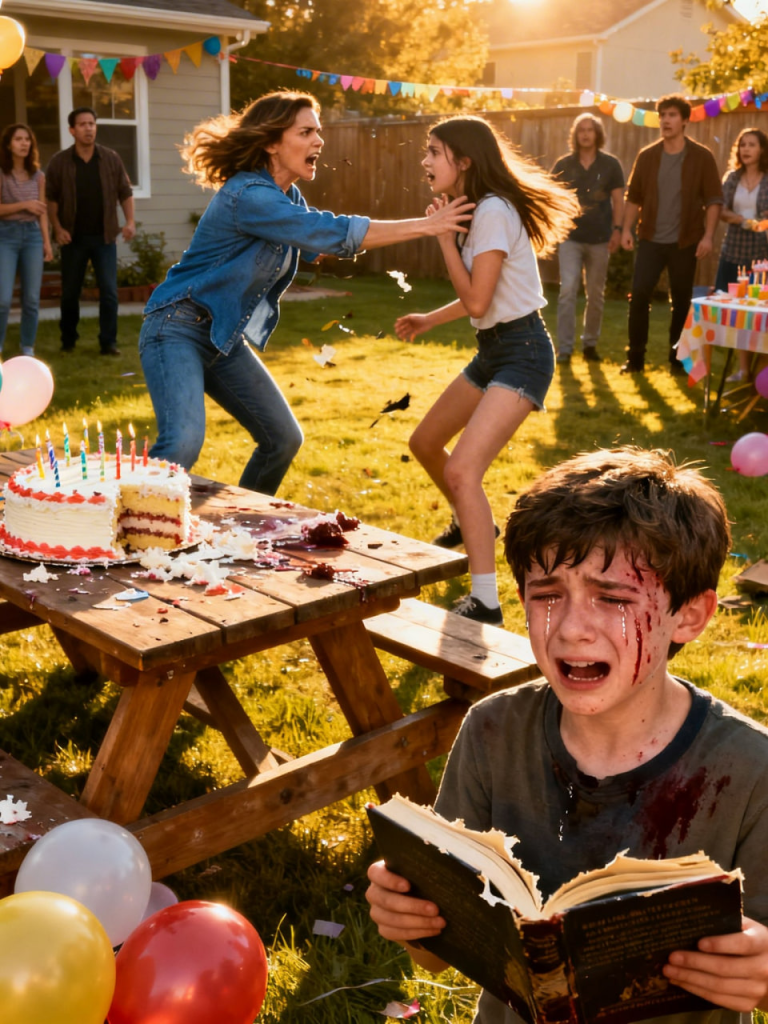
The day of the party felt wrong from the moment I woke up. The light through my window was too dim, the air too heavy. Even as I made breakfast for Finn, the silence between the two of us felt fragile, like a surface that could shatter at the slightest touch.
He was excited, though—bubbling with the kind of innocent enthusiasm only a nine-year-old could have. He sat at the kitchen table, swinging his legs, eyes bright as he double-checked the wrapping paper on his cousin Hazel’s gift.
“Do you think she’ll like it?” he asked for the third time, holding up the little box like it was a treasure.
“It’s perfect,” I told him, forcing warmth into my voice. “Hazel loves art stuff. You picked the best one.”
Finn grinned, satisfied, and went back to smoothing the corners of the paper with the seriousness of a man signing a treaty.
I watched him and felt that familiar pinch behind my ribs—the one that always came on days my family was involved. It was the pinch of remembering every Christmas where my mother laughed at my haircut, every birthday where my sister “accidentally” spilled something on me, every gathering where I learned the same lesson: in our family, kindness was optional, but cruelty was tradition.
Still, I told myself what I always told myself: It’s just one afternoon. Finn wants to see his cousins. Don’t ruin it by expecting the worst.
I packed extra snacks. I packed a change of clothes. I packed band-aids. I packed optimism like it was something you could zip into a bag and pull out when needed.
By noon, we were in the car driving to my mother’s house.
Finn hummed along to the radio. I kept my hands tight on the steering wheel, fighting the urge to turn around.
When we pulled into the driveway, my mother’s yard looked exactly the way it always did—trim hedges, bright flowers, everything in place. She loved order because it made her look good from the outside.
Inside, the house smelled like roast meat and perfume. Voices overlapped. Laughter bounced off walls.
My sister, Brianna, swept into the entryway the moment we stepped inside. She wore a white sundress and a smile that never reached her eyes.
“There he is!” she squealed, bending down to Finn. She pinched his cheek lightly—not gentle, more like testing fruit. “My favorite little guy.”
Finn smiled politely because I’d raised him to be polite even when people weren’t.
I stiffened. “Hi, Bri.”
She looked up at me, grin sharpening. “Well, look at you,” she said. “Still doing the single-mom martyr thing.”
I ignored it. I always tried to ignore it. Because reacting was what she wanted.
My mother appeared behind her, wiping her hands on a kitchen towel like a queen preparing to greet her subjects. Her eyes flicked over Finn first, then me.
“You’re late,” she said.
“It’s noon,” I replied.
She made a sound like I’d offended her. “Come in. Don’t make everything difficult.”
Finn tugged my sleeve. “Can I go find Hazel?”
I crouched and kissed his forehead. “Yes. Stay where there are grown-ups.”
He ran off, gift clutched in his hands, disappearing into the crowd of relatives.
For a moment, I let myself believe it might be fine.
Then I saw my brother-in-law—Brianna’s husband—holding a beer and watching Finn with an amused expression. Like he was waiting for a show.
And something in my stomach tightened again.
An hour passed.
I tried to stay in sight of Finn, but the house was crowded. People pulled me into conversations I didn’t want. My aunt asked me if I was “still alone.” My uncle joked about how “kids need a father.” My mother’s friends looked at me with that mix of pity and judgment that makes your skin itch.
Every time I looked for Finn, I saw him in glimpses—near the dining table, near the backyard door, laughing with Hazel and the other kids.
Then, at around two, he disappeared.
Not in a dramatic way. Just… gone.
I checked the living room. The hallway. The backyard.
The air in my chest turned cold.
I asked Hazel where Finn went.
Hazel shrugged. “Aunt Bri said she wanted to show him something.”
My stomach dropped.
I turned, scanning the room, and saw Brianna near the kitchen, laughing loudly with two of our cousins. She met my gaze and smiled like she’d just won something.
I walked toward her fast.
“Where’s Finn?” I asked.
Brianna sipped her drink slowly. “Relax,” she said. “He’s fine.”
“Where is he,” I repeated, voice sharper now.
She rolled her eyes. “God. You’re always so dramatic.”
My mother’s voice cut in from behind me. “Don’t start.”
I ignored her. “Brianna. Where. Is. My. Son.”
Brianna finally pointed her chin toward the mudroom. “He’s back there. We were just playing.”
Playing.
My heart hammered as I pushed past people and headed toward the mudroom.
The door was half closed.
I opened it.
And my world narrowed to one image:
Finn stood near the coat hooks, shoulders hunched. His face—my sweet boy’s face—was bruised along the cheekbone, a bluish-purple swelling that looked too big for a child. His shirt was smeared with food—brown sauce, crumbs, something sticky. His hair was damp like someone had poured something over him.
His eyes lifted to mine, and he flinched.
Flinched.
Like he expected me to be mad at him.
My breath left me in a harsh, broken sound. “Finn,” I whispered. “Oh my God—Finn—what happened?”
His lip trembled. “I’m sorry,” he said, so quietly it tore me in half. “I didn’t mean to—”
I crossed the room in two steps and crouched in front of him, hands trembling as I touched his cheek gently. The skin was warm and tender. My stomach turned.
“Who did this?” I asked, voice shaking.
Finn’s eyes darted toward the hallway. “Aunt Bri said it was a joke,” he whispered.
A sound rose in my ears—blood rushing, rage boiling.
I stood up so fast my knees almost buckled and stormed back into the kitchen.
Brianna was still laughing.
I didn’t wait.
I didn’t argue.
I didn’t ask politely.
I slapped her.
The sound was sharp and clean—a crack that silenced the room like someone had turned off the music.
Brianna stumbled back, hand flying to her face, eyes wide with shock.
For one stunned second, nobody moved.
Then Brianna shrieked, “Are you INSANE?!”
My voice came out low and deadly. “You bruised my son.”
Brianna blinked rapidly, stunned, then her mouth twisted into a sneer. “It was a joke! He’s a boy. He needs to toughen up.”
The room erupted into murmurs.
My mother surged forward, her face twisted with fury—not at Brianna, but at me.
“How dare you!” she screamed. “You hit your sister!”
“You hurt my child,” I said, trembling with rage. “You humiliated him. You put hands on him.”
Brianna scoffed. “Oh please. He tripped. He’s clumsy. And the food was funny. Everyone laughed.”
“Everyone?” I snapped, turning to the room. “Did you laugh when you saw his face?”
People avoided my eyes. Silence answered.
My mother’s voice rose even higher, shrill and poisonous. “You come into my house and attack my daughter? You’re disgusting.”
I took one step closer to her. “Your grandson is bruised.”
My mother’s eyes were wild. “He’s not my grandson,” she spat. “That bastard isn’t blood!”
The word hit me like a punch.
Bastard.
Finn flinched in the doorway behind me.
I saw it.
I felt something inside me go numb and crystal clear at the same time.
I turned and walked back to Finn. I took off my jacket and wrapped it around his shoulders like armor.
“We’re leaving,” I said softly to him.
Finn nodded quickly, eyes wet.
I didn’t look at anyone as I walked out. Not my mother. Not my sister. Not the relatives who suddenly found the floor fascinating.
Behind me, my mother shouted, “Don’t you walk away from me!”
I kept walking.
Brianna screamed, “You’ll regret this!”
I didn’t answer.
The only thing that mattered was Finn’s small hand gripping mine like a lifeline.
In the car, Finn finally started crying—silent at first, then shaking sobs that made my chest ache. He tried to hide it by turning his face toward the window, like he was ashamed of tears.
I pulled over two blocks away and climbed into the back seat with him.
“Look at me,” I whispered.
Finn’s eyes were red-rimmed. “I’m sorry,” he repeated, like it was the only sentence he’d been taught.
I took his face gently in my hands, careful of the bruise. “No,” I said firmly. “You did nothing wrong. Nothing. Do you understand me?”
Finn sniffed. “But Grandma said—”
I swallowed hard. “Grandma is wrong.”
He stared at me like that sentence was illegal.
I kissed his forehead. “I’m going to keep you safe,” I whispered. “I promise.”
At urgent care, the doctor confirmed it was a deep bruise, no fracture, but warned me to watch for concussion symptoms. He asked how it happened.
Finn looked at me, terrified.
I squeezed his hand. “Tell the truth,” I said gently.
Finn whispered, “Aunt Bri threw a chair cushion at me. And then she pushed me and I hit the wall. And then she poured gravy on me and said it was funny.”
The doctor’s face hardened. “That’s assault,” he said quietly.
My stomach twisted. “I know.”
He asked if I wanted to report it.
My mouth went dry.
Then I remembered Finn flinching.
I remembered my mother screaming bastard.
And I realized something: if I didn’t report it, I was teaching Finn that his pain didn’t matter if it came from “family.”
So I nodded. “Yes,” I whispered. “I do.”
The next morning, at 7:02 a.m., my doorbell rang.
I opened the door and found my mother standing on my porch.
Her hair was messy. Her eyes were red like she’d been crying. She clutched her purse like a shield.
For one tiny second, I thought—stupidly—that maybe she’d come to apologize.
Then she spoke.
“Please,” she said, voice trembling. “You have to stop this.”
I stared at her. “Stop what.”
“The report,” she hissed. “The calls. People are asking questions.”
Ah.
Not Finn. Not his bruise. Not his fear.
People.
Her image.
She stepped closer, lowering her voice. “Brianna’s husband is furious. They’re talking about pressing charges against you for assault. For that slap.”
I laughed once, bitter. “She bruised my son.”
My mother’s eyes darted past me, scanning my apartment as if looking for proof of my failure. “He’s fine,” she snapped. “Boys get bruises.”
My chest burned. “He flinched when I walked into the room.”
My mother’s face flickered, just for a second, like she remembered the moment she’d called him bastard in front of him.
Then she hardened again. “You made everything worse,” she said. “You always do.”
I stared at her for a long time. Then I stepped aside and gestured her in.
She blinked, surprised. “So you’ll listen?”
“I will,” I said calmly.
She walked in, shoulders stiff, like she was entering enemy territory.
I closed the door behind her.
Then I pointed to the kitchen table.
On it sat my laptop, open.
My mother frowned. “What’s that.”
I clicked play.
Video filled the screen.
My mother’s face, frozen mid-scream, eyes wild.
Her voice filled my kitchen, loud and clear:
“He’s not my grandson. That bastard isn’t blood!”
My mother’s face drained of color.
She took a step back, clutching her purse. “Where did you get that.”
“I recorded it,” I said calmly. “Because I knew you’d deny it.”
My mother’s lips trembled. “You… you can’t—”
“I can,” I said, voice steady. “And I already sent it to my lawyer. And to the investigator.”
My mother’s eyes widened. “Investigator?”
I nodded. “Child Protective Services will likely want to know why a grandmother used that word while a child was bruised. The police will want to know what happened in the mudroom. The school counselor will want to know why Finn now panics when adults laugh.”
My mother’s knees almost buckled. She grabbed the back of a chair.
“No,” she whispered. “You wouldn’t.”
I leaned forward slightly. “I already did.”
My mother’s eyes filled with tears—real this time, but not the kind that meant regret. The kind that meant consequences were finally touching her.
“Please,” she whispered, voice cracking. “You’re ruining us.”
I tilted my head. “You ruined yourselves. I’m just refusing to protect you anymore.”
My mother’s mouth opened, then closed. She looked small suddenly, not powerful.
And for the first time, I saw it clearly:
My mother didn’t love me the way a mother should. She loved control. She loved appearances. She loved the story where she was the matriarch and I was the cautionary tale.
But I wasn’t her story anymore.
I stood up straight. “You’re not welcome here,” I said calmly. “And you’re not welcome around Finn. Ever again.”
My mother’s face crumpled. “He’s family—”
“No,” I said, cutting her off. “Family doesn’t bruise children and call them bastards.”
Silence.
Then my mother whispered, desperate, “What do you want.”
I looked toward the hallway where Finn was still asleep, safe for now in his room.
“I want you gone,” I said softly. “And I want you to understand something.”
My mother stared at me, breathing fast.
“If you ever come near my son again,” I said, voice low and final, “the next door you knock on won’t be mine. It’ll be a courtroom door.”
My mother stood there trembling, then finally turned toward the exit.
At the door, she paused. “You’ll regret this,” she whispered, the old threat trying to return.
I didn’t flinch. “No,” I said quietly. “I’ll heal from this.”
Then I opened the door and watched her step out into the morning light, smaller than she’d ever looked.
When she was gone, I locked the door and leaned against it, breathing hard.
Finn padded down the hallway a few minutes later, rubbing his eyes.
“Mom?” he whispered.
I crouched and opened my arms. “Come here.”
He walked into my hug and melted against me like he’d been holding himself together with strings.
“Are we going back?” he asked, voice small.
I kissed his hair. “Never,” I whispered. “We’re not going back to people who hurt you.”
Finn’s body relaxed, just a fraction.
And in that fraction, I felt something shift in me too.
Because the truth is, the slap wasn’t the turning point.
The turning point was the moment I chose my son over the family that taught me to accept cruelty as love.
And once you make that choice—once you build the kind of family you choose on purpose—
you don’t go back.


Leave a Reply