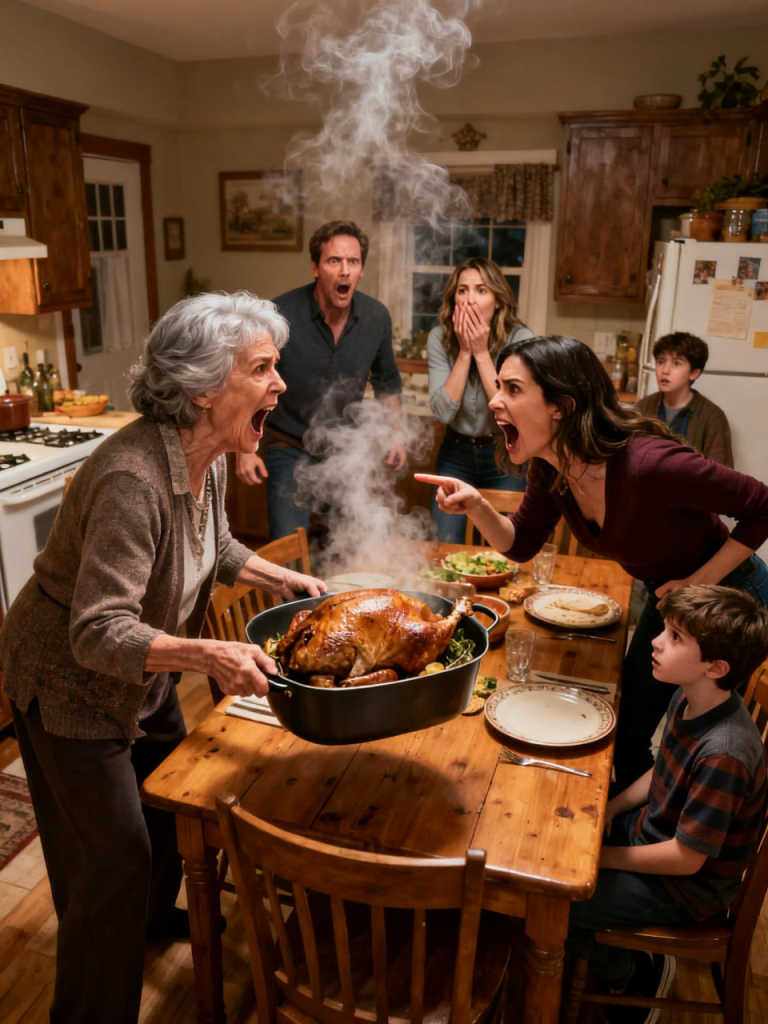
The first thing I noticed was the carving knife.
Not the fancy kind you see in commercials, gliding through turkey like butter. This one was old, heavy, and a little dull—my knife, the one I’d sharpened myself last week because nobody else would notice if it tore the meat instead of slicing it.
It lay beside the roast like a quiet warning.
The kitchen was warm, too warm, filled with the thick smell of rosemary, browned fat, and the sweet sting of onions that had been cooked down until they surrendered. The windows were fogged from steam. Somewhere in the living room, the TV murmured through a football game nobody was watching.
My daughter’s voice cut through all of it like a clean snap.
“You eat last.”
And that was it. No debate needed. One “you eat last” was enough to show me exactly where I ranked at that table.
It wasn’t shouted. It wasn’t even cruel in the dramatic way people expect when they picture a breaking point. It was said the way you tell a dog to sit—automatic, effortless, like obedience was built into the furniture and I was part of the set.
“You eat last,” my daughter said, and she didn’t look up from the serving platter.
Her hair was pulled into a sleek bun, the kind she started doing once she moved back in with her husband, once she started watching those videos about “high-value presentation” and “traditional family hierarchy.” She had a clip-on microphone still attached to her sweater—she’d been filming earlier, her little lifestyle channel where she taught women how to “keep a peaceful home.”
Peaceful. The word tasted bitter.
I stood by the counter with the roast juices drying on my hands, feeling the heat from the oven on my shins, and waited for the punchline.
There wasn’t one.
Behind her, my son-in-law, Grant, was arranging plates like a man conducting an orchestra. He had that calm, managerial way about him—never raising his voice, never making a scene—just assigning everyone their place like it was the most natural thing in the world.
My husband, Walt, sat at the table already, napkin tucked into his collar like a king preparing for tribute.
Our daughter, Brielle, placed the first slice of roast on Walt’s plate. Then she did Grant’s. Then she did her own.
Then she turned her head toward me, finally meeting my eyes.
“You can eat after we’re done,” she said, the same tone you’d use to tell someone the dishwasher needed unloading. “You know… so you’re not in the way.”
I felt something inside my chest go very quiet.
Not sadness. Not anger, not yet.
Recognition.
Like a door clicking shut.
Walt cleared his throat without looking at me. “Honey, don’t make a thing out of it,” he said, already reaching for the gravy boat.
Grant didn’t even pretend to be uncomfortable. “It’s just efficient,” he said, smiling like he was explaining a spreadsheet. “Brielle’s right. We’ve got to keep the flow. You can sit when we’re finished.”
Flow.
Like I was traffic.
Like I was clutter.
Like I was the help.
I glanced at the table—my table, that I’d refinished years ago, sanding down the scratches from homework and spilled milk and the time Brielle carved a heart into the corner with a fork when she was nine. I’d kept the heart. I liked that heart.
I looked at their plates—my plates, the wedding set I’d saved for, that Walt had called “unnecessary” until his boss came over and he wanted to show off.
My hands tightened around the edge of the counter.
“You don’t… hear yourself,” I said, my voice soft.
Brielle blinked, impatient. “Mom, don’t start. We’re trying to have a nice dinner.”
A nice dinner.
Where I stood like a waitress in my own kitchen.
I watched Brielle lift her fork and take the first bite.
She chewed, eyes half-lidded, satisfied.
Grant took a bite next, nodding like he’d approved the seasoning.
Walt took a bite and hummed, pleased, as if he’d cooked it himself.
Nobody spoke to me.
Nobody offered me a chair.
Nobody noticed that my stomach had already been growling for an hour because I’d been “tasting” while cooking, the way mothers do when they pretend they’re not hungry because everyone else matters more.
Something in me shifted.
I reached for the roasting pan.
It was heavy, still hot, the meat resting in the center like a prize.
Brielle looked up sharply. “What are you doing?”
I lifted it with both hands, the smell of the roast rising up in a wave that made my mouth water and my eyes sting.
“I’m eating,” I said.
Then I walked toward the back door.
Grant stood halfway. “Hey—hold on.”
Brielle’s face flushed. “Mom!”
Walt finally looked up, annoyed. “For God’s sake, what is wrong with you?”
I didn’t answer.
I opened the back door. Cold air slapped my face, sharp and clean.
I stepped onto the porch with the roast cradled against my ribs like I was stealing my own food.
Behind me, Brielle’s voice rose—higher now, sharp with embarrassment more than concern.
“Put that back! You’re acting crazy!”
Crazy.
That word was the family’s favorite tool. Any time I stepped out of my assigned role, they called it crazy.
I kept walking.
Down the porch steps.
Across the yard.
To my car.
I set the roast in the passenger seat like it was a passenger too—like it deserved a seat at the table more than I did.
Then I drove.
I didn’t even know where I was going at first.
I just knew I couldn’t stay.
The streetlights blurred past like yellow smears. My hands shook on the steering wheel, not from fear but from the adrenaline of doing something I’d never done: refusing.
For years, refusal had felt impossible. Like trying to push water uphill.
Because my whole life had been built on making things smooth.
Making the house run.
Making Walt comfortable.
Making Brielle feel supported.
Making Grant “respected,” because Brielle had decided her marriage was the center of the universe and everyone else had to orbit it.
I’d been the gravity. The invisible force.
And now I’d stepped out of orbit.
At a stoplight, I glanced at myself in the rearview mirror.
My face looked older than it used to. Not in the normal way. In the drained way. Like a candle that had burned too long.
My hair had streaks of gray I hadn’t had time to dye because Brielle always needed help with her channel, her baby plans, her “content calendar,” her life.
I looked at my eyes.
They looked… awake.
I didn’t go to a friend’s house. I didn’t have a friend I trusted enough anymore. Over the years, my social circle had shrunk the way mine always did when Walt wanted me home more, when Brielle wanted me available.
Instead, I drove to a little motel off the highway that rented rooms by the night and didn’t ask questions.
I carried the roast inside like a ridiculous trophy.
The room smelled like old carpet and lemon cleaner.
I sat on the bed, staring at the roast.
Then I laughed.
Not because it was funny.
Because it was absurd.
Because my breaking point had been meat.
A roast.
A symbol.
I took the lid off the pan and ate a slice with my fingers, hot and salty and real.
I ate like a person who was allowed.
Then I cried.
Hard.
Ugly.
The kind of crying you do when you realize you’ve been disappearing for years and nobody noticed.
My phone buzzed on the nightstand.
Brielle.
I didn’t answer.
It buzzed again.
Walt.
I didn’t answer.
A third time.
Grant.
I stared at the screen and let it ring out.
Then, finally, silence.
For the first time in years, silence.
I slept in fits, waking up with my heart hammering like I’d done something illegal.
In the morning, sunlight leaked through cheap curtains.
I sat up slowly, sore, and reached for my phone.
There were twelve missed calls.
Seven texts.
Most were from Walt. Short, angry:
WHERE ARE YOU?
THIS IS EMBARRASSING.
COME HOME NOW.
Brielle’s were longer, melodramatic:
Mom, you can’t just leave like that.
Grant is furious.
You made me look bad.
Please don’t do this.
Grant’s text was the one that made my stomach tighten.
If you don’t come back, we’ll have to handle your accounts. You’re not thinking clearly.
My accounts.
The words hung in my mind.
Because Grant always talked that way—like life was something to “handle,” like people were problems to manage.
I stared at the phone, and my mouth went dry.
Accounts.
I’d always let Walt “help” with finances. He’d been in charge since forever because he “understood numbers better,” which really meant he wanted control. Brielle had recently started “helping” too, since she moved back in and insisted they needed to “simplify household systems.”
Simplify. Another word that meant take.
I swallowed and opened my banking app.
Or tried to.
My password didn’t work.
I tried again.
No.
A cold wave rolled through me.
I opened my email.
My password didn’t work.
My throat closed.
I tried my cloud storage account where I kept family documents.
Password failed.
I stared at the screen as if it might change its mind.
It didn’t.
My heart began to pound, slow and heavy.
They’d changed them.
While I was gone less than twelve hours.
They weren’t worried about me.
They were worried about access.
My hands shook as I sat back on the bed.
I remembered Grant’s text:
You’re not thinking clearly.
That wasn’t concern.
That was groundwork.
The kind you lay before you call someone unstable.
The kind you lay before you take their name off a bank account.
Before you file something.
Before you lock them out of their own life and call it “help.”
My phone rang again.
Brielle.
I answered before I could stop myself.
Her voice came through instantly, high and sharp with panic.
“Mom—oh my God, where are you? You can’t just disappear like this!”
I gripped the phone. “Why can’t I?”
“Because—because Dad is freaking out, and Grant—” She took a breath, and I heard something strange beneath her anger.
Fear.
Real fear.
Not embarrassment.
Panic.
“Mom,” Brielle said, voice lower now, “I need you to come back. Please.”
The word please from Brielle felt like stepping into a room that had been sealed for years.
My stomach tightened. “Why?”
Silence.
Then she whispered, “Because… something happened.”
My skin went cold.
“What happened?”
Brielle’s voice cracked. “Grant… Grant opened your folder.”
My mouth went dry. “What folder?”
Another silence—thick, heavy.
Then: “The one you didn’t tell him about. The one with the documents.”
My blood turned to ice.
Because I had a folder.
A physical folder.
One I’d kept hidden in the back of the linen closet behind old towels.
It wasn’t dramatic. It wasn’t a spy file.
It was something I started years ago when Walt had “accidentally” missed a mortgage payment and blamed me for not reminding him, when I realized he could ruin us and call it a mistake.
The folder held copies of:
- the deed to the house (in my name too, though Walt pretended it wasn’t)
- my mother’s small inheritance paperwork
- old tax returns I’d quietly printed
- a list of account numbers and passwords—written in my own code
- insurance policies
- and one thing I’d never told anyone about: a letter from my late aunt, dated ten years ago, warning me not to trust Walt with money.
I’d forgotten the folder existed the way you forget a fire extinguisher exists—until there’s smoke.
“How did he find it?” I whispered.
Brielle’s breathing sounded shaky. “I—I was looking for towels last night, and I moved the box, and it fell, and Grant saw it, and he… he opened it, Mom.”
My hand clenched around the phone. “Why would he open it?”
Brielle sounded defensive even through panic. “Because he thought—he thought maybe you had something. Because you left with the roast like you were… like you were done. And he said we needed to ‘understand the situation.’”
Understand.
Another word that meant control.
“And now what?” I asked, voice dangerously calm.
Brielle’s voice broke. “He’s furious. He says you’ve been hiding assets. He says if you don’t come back, he’s going to—he’s going to file something. He’s calling his friend. A lawyer.”
My heart hammered.
A lawyer.
I swallowed. “Brielle. Listen to me. I need you to tell me exactly what he took.”
“I don’t know,” she cried. “He grabbed papers, he took pictures—he said he needed proof—Mom, please, just come back and talk to him. He’s—he’s scary right now.”
Scary.
Brielle finally said the word I’d been swallowing for years.
My throat tightened so hard it hurt.
“Is Dad there?” I asked.
“Yes,” she whispered. “He’s… he’s on Grant’s side. They’re saying you’re unstable. That you can’t manage your own finances. That you—” She sobbed. “Mom, I didn’t mean it. I didn’t mean ‘you eat last’ like that. I was just—Grant says it’s respectful, and I—”
I closed my eyes.
There it was.
Brielle wasn’t the mastermind.
She was the echo.
Grant trained her. Walt benefited. And I paid.
I inhaled slowly.
“Brielle,” I said, voice steady, “I’m not coming back.”
Her sob turned sharp. “Mom, please—”
“No,” I said. “But I’m going to help you.”
She went quiet.
“What?”
I stared at the motel wall, the ugly painting of a sailboat that looked like it was trying to escape too.
“You said Grant is scary,” I said. “Is he hurting you?”
Brielle’s breathing caught.
A pause.
Then a whisper: “Not… not like that. But he yells. He throws things. And when he gets like this, he says I’m nothing without him.”
My stomach clenched.
The same script.
Different actor.
I stood up, adrenaline flooding my veins.
“Listen,” I said. “I need you to do exactly what I say. Go to Mia—” I stopped, realizing she didn’t have a child yet. “Go to your room. Lock the door. And find your phone charger, your ID, and your keys.”
Brielle sounded confused. “Why?”
“Because you’re going to leave the house,” I said.
Her voice rose in panic. “I can’t! Dad will stop me!”
“Then you wait until they’re distracted,” I said. “But you need to be ready.”
Brielle sobbed again. “Mom, I can’t do this.”
I closed my eyes, swallowing my own fear.
“Yes, you can,” I said. “You’re my daughter. And you’re going to learn something today.”
“What?”
I opened my eyes and looked at my reflection in the mirror again.
I looked like a woman waking up.
“You’re going to learn,” I said, “that nobody gets to decide you eat last.”
I hung up and didn’t wait for her to argue.
I moved fast.
Because panic is one thing.
But clarity is faster.
First, I drove to a public library.
Not because I needed books.
Because libraries have computers, printers, and quiet corners where nobody asks questions.
I sat at a terminal and began the work.
Password recovery.
Email verification.
Two-factor authentication.
It took time, and my hands shook, but the system asked questions only I would know.
The first account I regained access to was an old email I’d made before Walt convinced me to “simplify” into a shared family email.
It was dusty, full of spam.
But it was mine.
From there, I traced the recovery links.
One by one, I got back into my accounts.
And the more I clicked, the uglier it got.
Alerts.
Security emails.
Unrecognized device sign-ins.
Grant had logged in from his phone.
Walt had logged in from the home computer.
They’d been trying to lock me out like I was a tenant.
I changed every password.
Every one.
Long, ugly passwords with random words and symbols.
I turned on two-factor authentication using a number they didn’t have.
I removed devices from my account lists.
I printed the login history.
Evidence.
Then I opened the bank account details.
And my heart stopped.
A transfer request had been started.
Not completed—but started.
A large amount. My mother’s inheritance money.
My mouth went dry.
They were going to move it.
Maybe into an account “for safekeeping.”
Maybe into a joint “household management” account.
Maybe into Grant’s.
Maybe into a place I’d never see again.
My hands clenched into fists so hard my nails cut my skin.
Not today.
I called the bank.
I spoke calmly, because I’d learned that calm gets you listened to.
I froze the account.
I flagged the attempted transfer.
I set a verbal password with the bank.
I changed the contact email and phone number.
Then I did something I’d never done before.
I opened my own new account—at a different bank.
In my name only.
When the bank teller asked if I wanted a joint owner, I almost laughed.
“No,” I said.
My voice didn’t shake.
Next, I called an attorney.
Not one from Walt’s golf club.
Not one Grant’s friend knew.
One recommended by a woman sitting near me at the library who’d overheard my trembling voice on the phone and slid me a card without saying a word.
Sometimes help comes quietly.
The attorney’s name was Pamela Ross. Her voice was steady and sharp.
“You have a legal right to your accounts,” she said. “And if they’re locking you out and attempting transfers, that’s serious.”
I swallowed. “They’re saying I’m unstable.”
Pamela sighed. “Of course they are. That’s a classic play. Do you have documentation?”
I looked at the printed login history, the attempted transfer, the texts.
“Yes,” I said.
“Good,” Pamela replied. “Now we make a plan.”
A plan.
Not panic.
Not survival.
A plan.
Pamela advised me to do three things immediately:
- Retrieve the folder—if it was still in the house or get copies of what was taken.
- Document every attempt to access or control my finances.
- Do not return alone.
I stared at the phone. “I can’t get the folder. They have it.”
Pamela was quiet for a beat.
“Then we treat that like evidence of their intent,” she said. “But we still need you safe. Do you have somewhere to go besides that motel?”
I thought of friends I’d lost touch with.
Then my mind landed on one person.
My sister.
Dawn.
We hadn’t spoken in years because Walt hated her—because she saw through him. Because she’d told me once, “If you stay, you’ll disappear.”
I’d been angry at her for saying it.
Now I realized she’d been trying to save me.
I found Dawn’s number through an old contact list.
My hands shook as I called.
She answered on the second ring.
“Hello?”
Her voice was older. Warmer.
I swallowed. “Dawn… it’s me.”
Silence.
Then, softly: “Lacey?”
My throat tightened. “Yes.”
Another pause.
Then: “Where are you?”
I laughed once, broken. “Not home.”
Dawn exhaled. “Thank God.”
And just like that, the wall between us cracked.
I told her everything in a rush—“you eat last,” the roast, the passwords, the folder, the threats.
Dawn didn’t interrupt.
When I finished, she said one sentence that made my knees go weak.
“Come to my house. Right now.”
Dawn lived two towns over in a small house with a porch swing and wind chimes that sounded like soft bells, not alarms.
When I arrived, she opened the door and hugged me hard enough that I almost collapsed.
“You look tired,” she whispered.
I wanted to say, “I’m fine.”
Instead, I said, “I’m awake.”
Dawn pulled back and looked me in the eyes.
“Good,” she said. “Stay awake.”
Inside, her home smelled like cinnamon and laundry and safety.
I sat at her kitchen table and drank tea while my hands finally stopped shaking.
Then my phone rang again.
Brielle.
I answered.
Her voice was strangled. “Mom—he’s coming down the hall.”
“Who?” I whispered.
“Grant,” she said, breathless. “He found out I called you. He—he’s banging on the door. Dad is yelling.”
My heart slammed against my ribs.
“Are you locked in?” I asked.
“Yes,” she cried. “But he says he’ll break it.”
Dawn grabbed my hand and mouthed, Call the police.
I nodded, then spoke to Brielle.
“Listen,” I said. “Go to the window. Is it locked?”
“Yes,” she whispered.
“Open it,” I said. “If you can get out, do it. Take your phone, your keys, your ID.”
“I can’t,” she sobbed. “It’s too high. And—Mom, he’s saying he’s going to call someone and have you committed.”
Committed.
There it was.
The word that had haunted me for years, even though they’d never said it out loud before.
Because once someone says you’re unstable, they can do anything.
I forced myself to stay calm.
“Brielle,” I said, “put the phone on speaker. Do you hear me?”
“Yes,” she whispered.
“Okay. I’m calling 911 on another phone,” I said. “Stay on speaker so they hear everything.”
Dawn was already dialing.
In the background, Grant’s voice thundered through Brielle’s door.
“Open it! You’re acting insane! Your mother is poisoning you!”
Walt’s voice chimed in, angry and useless.
“This is what happens when you don’t respect your husband!”
My stomach turned.
Dawn spoke clearly into her phone: “My niece is at 1248 Willow Ridge Drive. Her husband is threatening to break down her door—she’s scared for her safety.”
We waited, breath held.
Brielle sobbed quietly.
Grant shouted again, louder.
Then—something crashed.
Brielle screamed.
My blood went cold.
“Brielle!” I yelled.
“I’m here,” she gasped. “He threw something—he broke the mirror—Mom, he’s—”
Then the line went muffled, like the phone fell.
I heard voices.
Shouting.
A heavy thud.
Then Brielle’s voice, faint: “Stop. Stop.”
My whole body shook with rage so sharp it tasted like metal.
Dawn’s eyes were fierce.
“Stay with me,” she whispered to me. “Stay with me.”
Minutes later, sirens wailed through the phone.
Grant’s voice shifted suddenly—higher, fake.
“What? No, officer, she’s hysterical—”
Then a new voice, firm: “Sir, step away from the door.”
Brielle sobbed again, this time with relief.
“I’m okay,” she whispered into the phone, voice shaking. “They’re here.”
I closed my eyes and let out a breath that felt like it had been trapped in my chest for twenty years.
That night, Brielle didn’t go back to her room.
She went with the police to a friend’s house.
Not Grant’s friend. Hers.
She called me later, voice small, stripped of performance.
“Mom,” she whispered, “I’m sorry.”
I swallowed hard. “I know.”
“I didn’t… I didn’t realize,” she cried. “I thought if I did everything right, he’d be calm. I thought if I followed his rules—”
“I know,” I said again, because I did.
I’d lived that thought.
Brielle sniffed. “Dad kept saying you were weak. That you needed discipline.”
A bitter laugh rose in my throat. “And you believed him.”
Silence.
Then she whispered, “Yes.”
It wasn’t a confession as much as grief.
I closed my eyes. “Brielle… you’re not bad. But you have to choose who you want to be.”
Her voice trembled. “What if Grant hates me now?”
I thought of my cheek, my hands, my years of silence.
“Let him,” I said.
It shocked even me.
Brielle went quiet, then whispered, “Okay.”
And in that one word, I heard the start of her waking up too.
Over the next weeks, everything moved fast.
Pamela filed emergency paperwork.
Restraining orders were discussed. Asset protection steps were taken.
Walt showed up at Dawn’s house once, pounding on the door, red-faced.
Dawn didn’t open it.
She called the police.
Walt left in a rage, screaming that I was “destroying the family.”
But the family had been destroyed long before.
I’d just stopped pretending it wasn’t.
Grant tried to spin the story online. Brielle’s channel suddenly posted a tearful video about “family conflict” and “praying for peace.”
But Brielle took it down the next day.
She called me and whispered, “I don’t want to lie anymore.”
I didn’t say “good job.” I didn’t praise her like she was a child.
I simply said, “Then don’t.”
Pamela helped me retrieve my legal documents through a formal request. The folder was not “lost.” It had been photographed, copied, and—Pamela suspected—used as ammo in whatever plan Grant was cooking up.
But now, because I’d acted quickly, their plan failed.
The bank froze transfers.
The attempt was documented.
Grant’s lawyer friend suddenly stopped returning calls when Pamela sent formal letters.
Walt’s name—so proud, so entitled—looked smaller on paper when it was attached to documented misconduct.
And the biggest change wasn’t legal.
It was internal.
I stopped apologizing for existing.
One afternoon, Brielle came to Dawn’s house.
She looked different—no sleek bun, no microphone, no performative smile.
Just a tired young woman with red eyes and shaking hands.
She stood in the doorway and stared at me like she didn’t know if she was allowed to come in.
I walked to her and opened my arms.
Brielle hesitated for half a second, then collapsed into me like a child.
“I said it,” she sobbed into my shoulder. “I said ‘you eat last.’ I sounded like him. Like Dad. Like I—like I didn’t even hear it.”
I held her tightly.
“You heard it now,” I whispered.
She pulled back, wiping her face. “I don’t know who I am without their rules.”
I nodded. “Then you get to find out.”
Brielle looked down at her hands. “Grant says you’re trying to steal money.”
I laughed once, sharp. “He’s trying to steal money.”
Brielle flinched. “He said you have a folder of secrets. That you’re manipulating everyone.”
I touched her cheek gently. “Brielle, the folder wasn’t secrets. It was survival.”
She stared at me.
And slowly, her eyes filled again—not with panic this time, but with understanding.
“I’m sorry,” she whispered.
“I know,” I said for the third time. Because I did.
Then I added, “But sorry isn’t the end. It’s the start.”
The court dates came.
Walt tried to charm the judge like he charmed everyone—smiling, sighing, talking about “my wife’s stress.”
Pamela laid out the evidence like bricks.
The lockouts.
The transfer attempt.
The texts.
The timeline.
The judge didn’t smile.
When Walt tried to talk over Pamela, the judge raised a hand.
“Mr. Harper,” the judge said coolly, “this is not your kitchen. You will wait your turn.”
I nearly laughed out loud.
Because for the first time, someone else had told him to sit.
And he couldn’t punish them for it.
The judge granted temporary financial protections, ordered no further access changes without mutual consent, and warned Walt sharply about manipulation.
It wasn’t everything.
But it was something.
And “something” was more than I’d ever had before.
Meanwhile, Brielle filed for separation.
Grant’s reaction was predictable.
He posted a vague rant about “disloyal women.” He sent Brielle long messages about how she’d fail without him.
Brielle didn’t respond.
She blocked him.
Then she called me, voice shaking but proud.
“I blocked him,” she said.
I leaned back in Dawn’s kitchen chair, sunlight warming my hands.
“Good,” I said.
Brielle sniffed. “What do I do now?”
I looked out at Dawn’s porch swing, gently moving in the wind.
“You eat,” I said.
Brielle went quiet, then laughed through tears.
“I mean it,” I said softly. “You eat. You rest. You rebuild.”
Months later, on a Sunday afternoon, I cooked again.
Not because I had to.
Because I wanted to.
Dawn and Brielle sat at the table together, talking quietly, like two people learning how to be honest in the same room.
The kitchen smelled like garlic and thyme.
A roast sat in the oven again—because life is funny that way.
But this time, when it came out, I carved it and placed pieces on plates.
I served Dawn first because she’d saved me.
I served Brielle next because she was healing.
Then I sat down and served myself.
No one said “you eat last.”
No one watched me like a worker.
No one treated my presence like clutter.
We ate slowly, the kind of meal you taste, the kind you remember.
Brielle looked at me over her fork.
“Mom,” she said quietly, “I didn’t know how much I’d been copying them.”
I nodded. “That’s how it works. Power teaches its language.”
Brielle swallowed. “Do you hate me for it?”
The question trembled.
I reached across the table and took her hand.
“No,” I said. “But I will never let you talk to me like that again.”
Brielle’s eyes filled.
“Okay,” she whispered.
And this time, the okay wasn’t surrender.
It was respect.
Later, after dishes, I went upstairs to the guest room Dawn had given me.
I opened a new folder—this one a real folder on my laptop, encrypted, backed up, protected.
Inside were scanned documents, legal notes, and the most precious thing of all:
A list of passwords.
All mine.
I stared at them for a long time.
Then I closed the laptop and stood by the window, watching the late afternoon light stretch across the yard.
I didn’t feel victorious.
I felt free.
Because taking my life back didn’t look like revenge.
It looked like a woman sitting at her own table.
It looked like a daughter learning a new language.
It looked like a roast cooling on a counter without being used as a weapon.
And it began with one sentence that finally made the truth impossible to ignore.
“You eat last.”
No.
Not anymore.

Leave a Reply