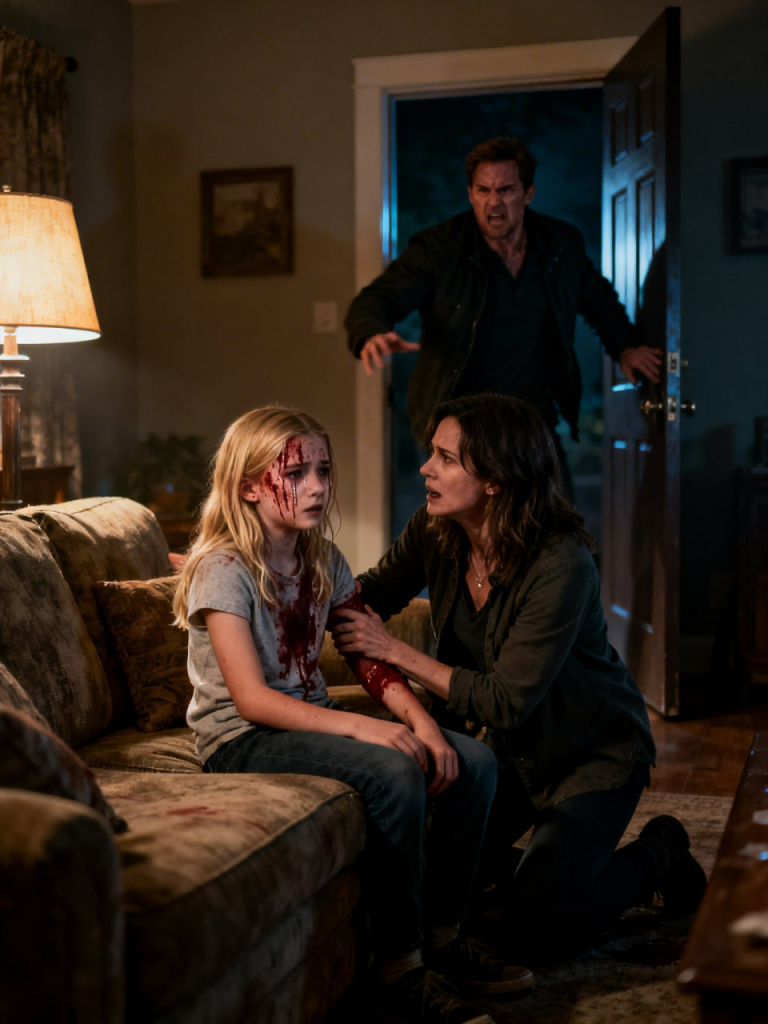
The first thing I noticed was the color draining from my daughter’s face.
Not the usual “I’m tired” pale, or the dramatic teen “I hate everything” sigh. This was different—waxen, almost gray, like someone had turned down the brightness in her skin. Mia sat on the edge of our living room couch with both hands braced on her knees, breathing through her mouth like the air was too thick to pull in.
“Mom,” she whispered. “I feel… really sick.”
It was late—past ten. The house was quiet in that way it gets when the world outside has gone dark and every small sound feels louder. The dishwasher hummed. A ceiling fan clicked on its rhythm. Somewhere down the hall, the dog shifted in his bed with a soft huff.
Mia swallowed hard, then pressed a hand to her stomach.
“Okay,” I said, dropping the laundry basket I’d been folding from my lap. My voice came out calm because that’s what mothers do, even when their insides start sprinting. “Tell me what you’re feeling.”
“Nauseous,” she said. “Like… like I’m going to throw up. And my hands—” She lifted them, and I saw the tremor. Not a little jitter. A real shake.
Sweat dotted her upper lip. Her hair clung at the temples.
My heart did something sharp and stupid. Fifteen-year-old girls get sick all the time. Stomach bug. Anxiety. Something she ate. But the shaking—her eyes glassy, unfocused—that didn’t match a normal bellyache.
“Mia, have you taken anything?” I asked. “Any new vitamins? Energy drinks? Anything your friends gave you?”
She shook her head, instantly regretted it, and squeezed her eyes shut.
“Okay,” I said. “We’re going to handle it.”
I reached for my phone, already thinking: urgent care? ER? Poison control? The hospital was twenty minutes away if traffic was light, and at that hour it usually was.
Before I could even unlock the screen, my husband’s footsteps sounded in the doorway.
“What’s going on?” Mark asked.
He looked… off. Not sleepy-off. Not annoyed-off. His face was alert in a way that didn’t fit the time of night. Like he’d been waiting for something.
“Mia’s really sick,” I said. “Nausea, shaking—”
“I’ll take her,” he cut in quickly.
It was so immediate that I paused. Mark wasn’t the panicked type. When Mia was little and got fevers, he hovered, yes, but he also got quiet, methodical. The fact that he jumped straight to action—straight to I’ll take her—made my skin prickle.
“I can drive,” I said. “Let me grab my purse—”
“No,” he said, too fast. Then, softer, like he realized how it sounded. “No, I’ve got it. You stay home.”
I stared at him. “What?”
“You stay home,” he repeated. “You’ll just… you’ll worry. And if they admit her, someone should be here in case—” He gestured vaguely toward the hallway. Toward the empty bedrooms. Toward the life we kept neatly arranged.
“We don’t have other kids,” I said, confused.
“We have the house,” he said. “The dog. And—” He swallowed. “It’s late. You don’t need to sit in an ER all night.”
Mia made a small sound that was half moan, half gag. Instinct took over, and I moved to her immediately, rubbing her back.
Mark stepped closer, already reaching for his keys. “Come on, sweetheart,” he said to Mia. His voice was too gentle, like someone talking to a skittish animal. “We’ll get you checked out.”
Mia’s eyes flicked to mine, unfocused but still hers. “Mom—”
“I’m coming,” I said, standing up. “Mark, I’m coming.”
He blocked me without fully blocking me—just a shift of his body, a quiet claim of space. “Kara. Stay.”
The way he said my name wasn’t angry. It was… pleading. Commanding. Like he needed it to be true.
I felt my mouth fall open. “Why are you acting like this?”
His eyes flashed, and for a moment the mask slipped. Fear. Real fear. Not for Mia—something sharper, more private.
Then he smoothed it back into a concerned husband expression. “I’m not acting like anything. I’m trying to help. Just—stay here. Let me do this.”
Mia pushed herself upright with effort, as if gravity had doubled. She swayed, and Mark caught her elbow.
“Mom,” she said again, faint.
My instincts screamed to gather her up and keep her within arm’s reach, but the scene had an odd momentum—Mark moving her toward the front door, his hand firm at her back, his voice low and coaxing. My brain tried to assemble sense out of it.
“Text me,” I said, following them to the entryway. “Call me as soon as you get there. Tell them to run bloodwork. Tell them—”
“I will,” Mark said. He didn’t look at me when he said it.
He opened the door, and cold night air rushed in. Mia stumbled down the porch steps, Mark steadying her. Their silhouettes moved toward the car, the porch light casting long shadows that looked like they were trying to hold onto them.
I stood in the doorway in socks, watching my family move away from me.
Mark opened the passenger door for Mia, helped her in, buckled her seatbelt. He moved with efficiency—too efficient. Like he’d practiced this.
Before he closed her door, Mia turned her head slightly and looked back at me through the windshield. Her eyes weren’t just sick. They were… uncertain. Like she wasn’t sure she was going where she thought she was going.
I raised my hand, mouthing, I love you.
The car backed out.
And then the taillights disappeared down our street, swallowed by the dark.
At first, I did what Mark asked.
I stayed home.
I paced the kitchen. I rinsed the same coffee mug three times without noticing. I stood in the living room, staring at the imprint Mia’s body had left on the couch cushions as if it might explain what just happened.
At 10:47 p.m., I texted Mark: Which hospital?
No answer.
At 11:03 p.m., I called him.
It rang four times and went to voicemail.
I called again, because sometimes phones glitch, and because denial has a rhythm. Same result.
I tried Mia’s phone next. Straight to voicemail.
By midnight, I had called three hospitals within a thirty-mile radius, pretending not to tremble as I asked the same question.
“Hi, I’m trying to locate my daughter. Her name is Mia Bennett. She may have been brought in tonight?”
“No, ma’am,” the nurses said, the same careful tone each time. “We don’t have anyone by that name.”
I tried the urgent care that stayed open late. No Mia.
My hands started shaking the way Mia’s had.
At 12:22 a.m., I called Mark again. This time, the line clicked once and went dead. Not voicemail. Dead. Like the phone was off.
I stood in the dark kitchen, phone pressed to my ear, and felt something inside me begin to splinter.
Because when you’ve been married long enough, you learn the difference between delay and disappearance.
Mark wasn’t late.
He was gone.
The police arrived at 12:58 a.m.
Two officers. A man with a tired face and a woman with her hair pulled into a tight bun. They stood on my porch with the posture of people who’ve seen every version of panic and still don’t get to fix it.
“Ma’am,” the male officer said gently, “there’s a chance they’re still at a hospital and the phone is dead. We need to confirm some things.”
“I already called,” I said, my voice cracking. “I called everywhere.”
The woman officer stepped forward. “Your husband took your daughter, correct?”
“Yes,” I said. “To the ER.”
“Did he say which one?”
“No. He just—he insisted. And he told me to stay home, which makes no sense. He—” I swallowed hard. “He was nervous. I’ve never seen him that nervous.”
The officers exchanged a look that I caught too late.
“Okay,” the male officer said. “We’ll take an official report.”
I watched him write my words down. Husband left with daughter. Intended destination: hospital. No contact since.
He asked for Mark’s full name. His date of birth. His height, weight, any identifying marks. He asked about the car. A gray Honda Pilot, plate number memorized because I’d said it out loud so many times in my head.
“Any history of domestic issues?” the woman officer asked.
“No,” I said. Then I hesitated. Because domestic issues is a wide net. And Mark hadn’t been violent. But there had been… distance lately. Whispers when I walked into a room. A new habit of taking calls outside. Cash withdrawals I didn’t understand.
“I don’t know,” I admitted. “Not like that.”
The male officer looked up. “Any chance your husband would take your daughter without telling you where they were going?”
“Why would he?” I snapped, then immediately hated myself. These were people doing their jobs, and I was a raw nerve. “He loves her. He’s her father.”
The woman officer’s expression softened. “We’ll put out a BOLO for the vehicle,” she said. “And we’ll contact hospitals directly, not through the main line.”
“Is this… is this kidnapping?” I asked, the word tasting like metal.
“It’s a missing persons case until we know more,” the male officer said. “But because your daughter is a minor, we take it seriously. We’re taking you seriously.”
After they left, the house felt cavernous. Too quiet. Every room Mia wasn’t in became a question.
I sat at the kitchen table until dawn, my phone face-up like it might pulse back to life if I stared hard enough.
No calls.
No texts.
No Mia.
No Mark.
By noon the next day, I was operating on a type of adrenaline that makes you feel both sharp and unreal, like you’re watching your own life from a few inches above your body.
A detective came to the house.
Detective Elena Ramirez was compact, composed, and practical. She didn’t waste words, but she didn’t treat me like a hysterical woman either, which I would have appreciated if I’d been capable of appreciation.
“Walk me through last night,” she said, sitting across from me at the table where Mia used to do homework.
I did. Every detail. Mia’s sweating. Mark’s insistence. The way he blocked me. The look in Mia’s eyes through the windshield.
Ramirez wrote quickly. Then she asked, “Any recent stressors? Any custody disputes? Any financial trouble?”
“No custody disputes,” I said. “We’re married.”
“Financial trouble?” she pressed.
I hesitated. “Mark handles most of the finances. But there have been withdrawals. Cash. I asked him about it, and he said it was for ‘repairs.’”
“What repairs?”
“I don’t know,” I said, voice rising. “I asked. He just—he got irritated.”
Ramirez’s eyes were steady. “Do you have access to the accounts?”
I shook my head. Shame flared hot. Somewhere along the line, I’d let Mark become the keeper of the numbers, the passwords, the sense of security. I’d trusted the marriage to hold.
Ramirez nodded once, like she’d seen that a thousand times. “We’ll request emergency access through legal channels. In the meantime, any chance Mia was sick earlier in the week? Any doctor visits?”
“No,” I said. “She was fine. She went to school. She ate dinner. She was laughing at some stupid video—then, around ten, she said she felt nauseous.”
Ramirez tapped her pen. “What did she eat?”
“Chicken. Salad. The same as us.”
“Did you notice anything unusual? Any smell? Anything in her drink?”
My mind flashed to the glass of iced tea Mark had handed Mia after dinner, the way he’d insisted she drink it because “it’ll settle your stomach.” At the time, it had seemed like one of his rare, gentle gestures.
Now it felt like a trap snapping shut in hindsight.
“I—” My throat tightened. “Mark gave her iced tea.”
Ramirez’s gaze sharpened. “Did you drink any?”
“No.”
She wrote that down, too.
Then she said the sentence that shifted my entire world into something colder.
“Ma’am, our officers checked the route to the nearest ER. Your husband’s vehicle was not captured on those traffic cameras.”
I blinked. “What does that mean?”
“It means he didn’t go where he said he was going,” Ramirez said carefully.
My body went numb in pieces. Fingers. Face. Chest.
“He—maybe he took a different road,” I tried.
“We checked multiple access points,” she said. “We also checked hospital security footage for arrivals. The vehicle did not appear.”
I gripped the edge of the table so hard my knuckles hurt. “So where did he go?”
“We don’t know yet,” Ramirez said. “But we will.”
Day Two blurred into phone calls and forms and strangers’ sympathetic faces.
The news picked it up by evening. LOCAL TEEN MISSING—FATHER ALSO UNACCOUNTED FOR. Mia’s school photo flashed on my television screen: her bright smile, her braces, her brown hair in a high ponytail.
I watched it like it was a different girl. Like the photo belonged to someone I didn’t know.
Neighbors brought casseroles I couldn’t eat. Friends texted prayers. My sister drove in from two hours away and tried to keep me from unraveling.
I barely slept. Every time I closed my eyes, I saw taillights fading.
At 3:14 a.m., my phone buzzed once.
For a split second, my entire body leapt.
It wasn’t Mark.
It was a message from an unknown number: Stop calling. She’s fine.
My blood turned to ice.
I showed Ramirez the text the moment the sun came up.
She studied it. “Did you respond?”
“No,” I said, voice shaking. “I didn’t know what to say.”
“You did the right thing,” she said. “We’ll run the number.”
“But it could be a burner,” I said, because I’d watched enough crime shows to know the vocabulary now.
“It could,” Ramirez agreed. “But even burners leave footprints sometimes.”
She paused, then added, “Kara, I need you to think: is there anywhere Mark might have taken Mia? Family? Friends? Places he’s talked about?”
“I don’t know,” I said, close to tears again. “He hasn’t talked to me. Not really. Not for months.”
Ramirez’s expression softened by a fraction. “Any groups? Online communities? Anything he’s gotten into?”
That hit something in my memory like a match to dry grass.
Mark had been… different lately. Not just distant—fixated. He’d started listening to podcasts in the garage with the door down, like he didn’t want me hearing. He’d made comments about “the system” and “what they don’t tell you.” He’d scoffed at our family doctor after a routine checkup, calling her “a prescription pusher.”
And two weeks ago, when Mia had asked for a ride to the mall, Mark had refused sharply.
“Too many cameras,” he’d said. “Too many eyes.”
At the time, I’d assumed he was joking.
Now my stomach rolled.
“He’s been paranoid,” I admitted. “Like… about being watched.”
Ramirez’s eyes narrowed. “That’s important.”
I didn’t want it to be important. I wanted the important thing to be: They’re at the hospital, phones dead, misunderstanding. I wanted life to rewind to Tuesday morning coffee and quiet routines.
But life doesn’t rewind.
It only reveals.
On the third day, the call came at 6:38 p.m.
Ramirez’s number lit up my screen, and I answered on the first ring.
“Kara,” she said, voice tight. “We have a lead.”
My knees went weak. I sat hard on the stairs.
“Where?” I whispered.
“A gas station in Marietta,” she said. “A clerk recognized Mia from the news. He says he saw your husband and your daughter yesterday morning.”
“Yesterday?” My voice cracked. “They’ve been—out there—for two days?”
“Yes,” Ramirez said. “The clerk said Mia looked… not well. And your husband seemed agitated.”
“Marietta is three hours away,” I said, the geography of my own state suddenly foreign. “Why would he take her there?”
“That’s what we’re trying to understand,” Ramirez said. “But here’s the part you need to hear.”
I held my breath.
“The clerk says your husband wasn’t alone,” Ramirez continued. “He was with another adult male. Mid-forties, beard, ball cap. They loaded your daughter into the back seat, not the front.”
My throat constricted. “Why would she be in the back?”
“Kara,” Ramirez said quietly, “because she may not have wanted to go.”
I made a sound that wasn’t a word.
Ramirez kept going, careful but firm. “We pulled toll records. Mark’s vehicle traveled south, then west, then south again. He wasn’t heading to any hospital. He was heading toward rural property outside the county. There’s a place out there—an unregistered ‘wellness center.’ A private compound.”
My mind struggled to hold the words. Compound. Wellness center.
“This is insane,” I whispered.
“I need you to stay with someone,” Ramirez said. “We’re moving now. We have a team en route. But I’m going to be blunt: it may be dangerous.”
“I’m coming,” I said immediately, the words punching out of me.
“No,” Ramirez said, firm. “You are not coming to the scene. Not yet.”
“My daughter—”
“I know,” she said. “But we don’t know what we’re walking into. If they see you, they may panic. They may run. Let us do our job. We will call you the second we have eyes on Mia.”
I wanted to scream. I wanted to break something. I wanted to tear through the phone line and pull Mia back through it.
Instead, I swallowed my terror until it burned. “Okay,” I said, voice thin. “Okay. Just—please.”
“I will,” Ramirez promised. “And Kara? Whatever you learn next… prepare yourself. Mark has been planning something.”
“How do you know?” I asked.
There was a pause.
“Because we found evidence,” she said. “He filed paperwork for Mia weeks ago. Copies of her birth certificate. Requests for records. Cash withdrawals. And a lease on a storage unit under a different name.”
The world tilted.
“A different name?”
“Yes,” Ramirez said. “Your husband has been using an alias.”
I sat frozen on the stairs, my phone slick in my palm.
I had married a man whose real name I suddenly wasn’t sure I knew.
That night was worse than the first two.
Because now there was a direction for my fear, a shape. And shapes are harder to deny.
I watched the clock. I watched the door. I watched the window as if headlights might swing into the driveway and deliver them back, like this had all been some sick misunderstanding.
At 9:11 p.m., Ramirez called again.
“We made contact,” she said.
My entire body went electric. “Is Mia okay?”
“We have her,” Ramirez said. “She’s alive.”
I sobbed, a sound that tore out of my chest.
“Is she hurt?” I forced out.
“She’s weak,” Ramirez said. “Dehydrated. There are signs she’s been sedated. But EMS is with her now. She’s being transported to St. Catherine’s.”
Sedated.
The word landed like a blow.
“And Mark?” I asked, voice shaking.
Another pause. “He’s in custody,” Ramirez said. “But there’s more.”
Of course there was more. There was always more.
“That compound?” she continued. “It’s run by a man named Caleb Holt. He calls himself a ‘health pastor.’ He’s been operating under the radar for years—convincing families to ‘withdraw from the system.’ He tells them hospitals poison children. He tells them the government tracks blood tests. He tells them the only way to keep their kids safe is to disappear.”
I stared at the wall, heart hammering. “Mark believed that?”
Ramirez’s voice was careful. “Mark didn’t just believe it. He… invested in it. He paid Holt. He brought Mia to them willingly.”
“Willingly,” I repeated, numb.
“We found a bag in your husband’s car,” Ramirez said. “Cash. Documents. A notebook. Plans. Routes. Times. He wrote it all down.”
My stomach lurched. “Why?”
“Kara,” Ramirez said softly, “he was going to take Mia and not come back. Ever.”
The air in my lungs turned to glass.
“But… why my daughter?” I whispered. “Why not me? Why not—why just her?”
Ramirez exhaled. “Because Holt told him Mia was ‘the key.’ That teenagers are ‘still moldable.’ That once she was gone, you’d have no choice but to follow—or lose her forever.”
My hands went cold. I saw Mark’s face in the doorway—alert, too ready. I saw his insistence that I stay home.
It hadn’t been kindness.
It had been strategy.
“I need to see her,” I said. “Now.”
“You can,” Ramirez said. “Go to St. Catherine’s. They’ll be expecting you. And Kara—”
“What?” My voice was ragged.
“We also found something else,” she said. “Something that may be… difficult.”
I squeezed my eyes shut. “Just tell me.”
“A letter,” Ramirez said. “From Mark. Addressed to you.”
My heart pounded so hard I felt dizzy. “What does it say?”
Ramirez hesitated, then said, “He wrote that you would ‘never understand.’ That you were ‘too trusting of doctors.’ That you were ‘part of the problem.’ And—” Her voice tightened. “He wrote that Mia agreed to go.”
“No,” I said instantly, the word sharp. “No, she didn’t.”
“We don’t know what he told her,” Ramirez said. “Or what he threatened. But it’s in writing.”
I swallowed hard, forcing my mind to function. “Where is the letter?”
“It will be in evidence,” Ramirez said. “But we can discuss it after you see Mia.”
“Okay,” I whispered. “Okay. Thank you.”
When the call ended, I moved like I was underwater—keys, shoes, coat, the night air biting my face as I ran to the car.
The drive to St. Catherine’s was a blur of headlights and prayerless pleading.
Please be alive. Please be herself. Please don’t look at me like I failed you.
Mia was in a private room.
When I stepped in, she looked smaller than I remembered, swallowed by white sheets and hospital rails. Her skin was pale, her lips cracked. An IV line ran into her arm. Her hair was matted at the back like she’d been laying down too long.
But she was breathing. Her chest rose and fell.
I covered my mouth with my hand and made a sound that was half sob, half laugh.
“Mia,” I whispered, rushing to her bedside.
Her eyelids fluttered. Slowly, she turned her head toward me.
“Mom,” she rasped.
I took her hand carefully, as if she might break. “I’m here,” I said. “I’m here, baby. I’m so sorry.”
Tears spilled down her cheeks, and my heart shattered all over again.
“He said—” she whispered.
“Shh,” I said. “Don’t talk yet. Just—just tell me one thing. Did you want to go with him?”
Her eyes widened, and fear flashed through them like lightning.
“No,” she whispered fiercely, the word barely a breath. “No. He—he said you were going to—” Her voice broke. “He said you were going to send me away. That you didn’t want me anymore.”
I felt like I’d been punched.
“What?” I whispered, horror flooding me.
Mia’s grip tightened on my fingers. “He said the hospital would… take me. That they’d lock me up. He said he was saving me.”
My stomach turned.
“And the tea?” I asked, my voice shaking.
Mia’s eyes flicked away. “It tasted weird,” she said. “I didn’t want it, but he kept saying—just drink it, you’ll feel better. After that, I got… dizzy. And then… the car.”
I swallowed the scream lodged in my throat.
“Mia,” I said, leaning closer. “Listen to me. I would never send you away. I would never stop wanting you. Ever. Do you understand?”
Her lips trembled. Then she nodded once, tears sliding into her hairline.
“I thought—” she whispered. “I thought I did something wrong.”
“Oh, honey,” I choked. “No. No. You didn’t. None of this is your fault.”
Behind me, the door opened softly.
Detective Ramirez stepped in, her expression gentler than I’d seen it.
“Kara,” she said quietly. “Can I speak with you outside for a moment?”
I looked down at Mia. “I’ll be right back,” I promised, smoothing her hair.
Mia’s fingers clung to mine until the last second, like she was afraid the room would swallow her again.
In the hallway, Ramirez handed me a folder.
“This is the letter,” she said.
My hands shook as I opened it.
Mark’s handwriting stared back at me, familiar and suddenly monstrous.
Kara, it began. You won’t understand. You’re too deep in their world. You believe in doctors like they’re gods. You don’t see the cage they’re building for Mia. I do.
My throat tightened.
She’s not safe with you. She’s not safe in your world.
I swallowed hard, reading faster now, desperate.
I tried to tell you. You laughed. You ignored me. So I’m doing what a father is supposed to do. I’m taking her somewhere clean. Somewhere free. She agreed, because she knows you’ve been pulling away. She knows you want her fixed, medicated, controlled.
My vision blurred with rage.
And then I reached the last paragraph, and the words stopped my breath entirely.
If you try to find us, you’ll learn what I learned. Mia isn’t who you think she is. And neither am I.
I stared at that sentence, my brain refusing to interpret it.
“What does that mean?” I whispered, voice hollow.
Ramirez’s face tightened. “We’re still investigating,” she said. “But the ‘alias’ he used—Mark Bennett isn’t his original name. He changed it years ago.”
My mouth went dry. “Why?”
Ramirez hesitated. “His fingerprints flagged in a federal database. Not for violent crime,” she added quickly, as if she could soften the blow. “But for fraud. Identity-related offenses. He was arrested in another state a long time ago. He took a plea deal and then… disappeared into a new life.”
I felt the hallway tilt.
“So my husband—” I began, but the sentence couldn’t find an ending.
“And about Mia,” Ramirez said, carefully, “we believe he was trying to manipulate you with that line. To make you doubt reality. To keep you off balance.”
“But what if it’s true?” I whispered. “What if—what if there’s something I don’t know?”
Ramirez’s eyes were steady. “Kara, we pulled records. Mia is yours. Mia is who you think she is. That part is not in question.”
Relief hit me so hard my knees almost buckled.
“But Mark,” I said, voice shaking, “Mark isn’t.”
“No,” Ramirez agreed. “He built a life on a lie. And when it started to crack, he tried to take your daughter with him.”
I pressed a hand to my mouth, trying not to sob in the hallway.
Ramirez’s voice softened. “He’s in custody. Holt is in custody. We’re processing the compound. There are other families involved. Other kids.”
The thought made me nauseous.
“I want to see him,” I said suddenly, the words surprising even me. “I want to ask him why.”
Ramirez studied me. “Right now?”
I nodded once. “Right now. Before he invents another story. Before he convinces himself he’s the hero.”
Ramirez led me down another hallway, past double doors, to a small interview room that smelled like stale coffee.
Mark sat at a table, hands cuffed in front of him.
When he looked up and saw me, something flickered in his eyes—recognition, guilt, and a stubborn spark of belief that he’d done the right thing.
“Kara,” he said softly. “You came.”
I stared at him, the man I’d slept beside for sixteen years, the man who’d held my hand in hospital rooms and danced with me in the kitchen and fixed the leaky faucet on Sundays.
I stared at him like he was a stranger wearing my husband’s face.
“Why?” I asked, voice steady in a way I didn’t feel. “Why would you do this to her?”
Mark’s jaw tightened. “I saved her.”
“You drugged her,” I said, and the word cut through the room. “You lied to her. You told her I didn’t want her.”
His eyes flashed. “You don’t see it,” he snapped. “You never saw it. They would’ve—”
“Stop,” I said sharply. “Stop talking like you’re the victim. Mia was terrified. She’s in the hospital because of you.”
Mark’s breath hitched.
For a moment, he looked tired. Older.
“I didn’t want to hurt her,” he said, quieter now. “I just needed her to come. Once we got there, once Holt explained—”
“Holt,” I repeated. “So you listened to a man in the woods instead of your wife. Instead of actual doctors.”
Mark’s eyes hardened again. “Doctors didn’t help my brother.”
I blinked. “What?”
“My brother,” Mark said, voice brittle. “When I was a kid. They said he was fine. They said it was in his head. He died anyway. And my parents—” He swallowed. “They acted like it was normal. Like we should trust them. I promised myself I’d never be that stupid.”
I stared at him, stunned by the sudden glimpse of pain beneath his obsession.
“But Mia wasn’t dying,” I said. “She was nauseous.”
Mark’s face twisted. “That’s how it starts.”
“No,” I said, voice cracking now. “That’s how you made it start. You gave her something.”
His eyes dropped.
Silence filled the room.
And in that silence, I understood the terrifying truth: Mark wasn’t confused. He wasn’t misguided in some innocent way. He had made choices. He had planned. He had written routes. He had prepared aliases.
He had rehearsed disappearing.
“You were going to take her forever,” I said, my voice barely above a whisper.
Mark didn’t deny it.
“I couldn’t lose her,” he said, and there was something desperate in the words. “I couldn’t lose her to your world.”
“She’s not your possession,” I whispered.
Mark finally looked up, and for a second I saw something like regret.
“I loved her,” he said.
I leaned forward, rage and grief twisting together. “If you loved her, you wouldn’t have turned her into a pawn.”
Mark’s mouth opened like he wanted to argue.
Then it closed.
He stared down at his cuffed hands, and the room felt suddenly small, like the truth had taken all the oxygen.
I stood.
“I’m done,” I said.
Mark’s head snapped up. “Kara—”
“Mia asked for me,” I said, voice firm. “Not you. And when she’s old enough to understand what you did, she’ll decide what you are to her.”
Mark flinched as if I’d slapped him.
I turned and walked out before my legs could betray me.
Mia stayed in the hospital for two nights.
The doctors said she was dehydrated, stressed, and had traces of a sedative in her system consistent with being drugged. They didn’t tell me specifics, and I didn’t ask for details that would haunt me more than the idea already did.
When Mia was stronger, she told Ramirez what she remembered: Mark’s voice, calm and convincing, telling her I was going to “send her away.” The man at the gas station. The compound gate. The other teens—quiet, hollow-eyed, all pretending they weren’t scared.
“He kept saying it was ‘freedom,’” Mia whispered to me one night when the hospital was dim and quiet. “But it felt like… a trap.”
I held her hand and stared at the wall until my eyes burned.
In the weeks that followed, everything came out in layers.
Mark’s real name. His past. The way he’d stitched himself into a normal life with a normal job and a normal family, like a man playing a role long enough to believe it.
The “wellness center” was raided fully. Families were reunited. Charges piled up—kidnapping, child endangerment, fraud. Holt’s followers scattered like roaches in light.
Mark didn’t look like a mastermind in court. He looked like a man who’d driven too far down a road and couldn’t admit he’d been wrong.
He pleaded not guilty.
He said he was protecting his child.
The judge didn’t smile.
Three months later, Mia and I sat on our back porch under a pale spring sun.
Our yard looked the same as it always had—fence, grass, the bird feeder Mia used to forget to refill. But everything felt different, like the world had shifted its weight.
Mia held a mug of hot chocolate, even though it wasn’t cold. She’d started doing that lately—small comforts, small anchors.
“Do you think he ever really believed it?” she asked quietly. “All that stuff?”
I thought about Mark’s eyes in the interview room. The way he’d looked both convinced and desperate. Like belief had become a weapon he couldn’t put down.
“I think he believed whatever he needed to believe,” I said carefully. “So he wouldn’t have to face the truth.”
Mia stared out at the yard. “What truth?”
“That he was scared,” I said. “And instead of dealing with fear like an adult… he made it everyone else’s problem.”
Mia’s throat bobbed as she swallowed. “I hate him,” she whispered.
The words weren’t dramatic. They were flat, heavy.
I reached over and put my hand on hers. “You don’t have to decide how you feel all at once,” I said. “You just have to be safe. And you are.”
Mia nodded, tears shining but not falling.
After a moment, she whispered, “When we were driving… I kept thinking you’d find me.”
My chest tightened. “I did.”
“I know,” she said. “But I didn’t know if I would.”
I pulled her into me, holding her the way I should have held her that night in the doorway. The way I would hold her forever if I could.
“I will always come for you,” I said into her hair. “Always. No matter what anyone says. No matter how far.”
Mia’s arms tightened around me.
And in that moment, the last three days—the taillights, the silence, the compound, the letter—didn’t vanish.
But they stopped owning me.
They became something we survived, instead of something that erased us.
That night, after Mia went to bed, I stood alone in the living room and looked at the couch where she’d sat shaking and pale, asking for help.
I thought about how close I’d come to trusting the wrong person completely.
I thought about how a marriage can hide a stranger inside it.
And I thought about the line in Mark’s letter—Mia isn’t who you think she is. And neither am I.
He’d been right about one thing.
I hadn’t known him.
But I knew Mia.
I knew her strength, her fear, her stubborn will to live.
And I knew myself now, too—stronger than the woman who’d stood in the doorway watching taillights fade, convinced she had no choice but to wait.
I walked to the front door and locked it, not out of paranoia, but out of ritual.
A quiet promise to the life I was rebuilding.
Then I turned off the lights, went down the hall, and checked on my daughter—breathing, safe, real.
And for the first time in months, my chest loosened enough to let air in.
Leave a Reply