They “Forgot” My Passport to Abandon My Daughter at the Airport—One Call Turned Their Vacation Into Handcuffs
The terminal was already buzzing like a beehive when we walked in—rolling suitcases clicking over tile, boarding announcements echoing off glass, the smell of burnt coffee and cinnamon pretzels mixing into that familiar airport fog. My six-year-old daughter, Lily, bounced beside me in her rainbow sneakers, clutching a stuffed bunny with one ear permanently folded.
She was so excited she couldn’t keep her voice down.
“Mom, is the airplane gonna have a TV in the seat? Are we gonna see the ocean first? Do they really give you peanuts?”
“I don’t know about peanuts,” I laughed, adjusting the strap of my tote bag. “But yes, we’re going to see the ocean.”
My parents walked ahead of us, my mom in her crisp white jacket like she was headed to a country club instead of an airport, my dad with his carry-on held like a briefcase—tight grip, squared shoulders, face set in that “I’m in charge” expression he wore even buying groceries.
My sister, Kelsey, followed behind them with her husband and her two kids—perfect hair, coordinated outfits, phones already out for travel photos. Kelsey looked like she’d been styled by a magazine that didn’t allow messy emotions.
The plan—her plan, really—was a family vacation in Mexico. One week at a beach resort. All-inclusive, she’d told everyone, as if the word inclusive meant anything in a family that only made space for people who didn’t inconvenience her.
I shouldn’t have gone.
I knew that even as we walked toward the check-in counters, Lily’s little hand warm in mine.
But Lily had begged when she heard there would be a beach. And after the year we’d had—after my divorce finalized, after late nights and tight budgets and too many “maybe next time” answers—I wanted to give her something bright.
A memory that wasn’t colored by stress.
So when my parents insisted they wanted us all together—one big happy family—I told myself to be the bigger person.
I told myself to ignore Kelsey’s little comments. To smile through my mother’s “helpful” critiques. To swallow my father’s habit of treating every conversation like a command.
I told myself this trip could be different.
We reached the airline counter. The line moved quickly, and within minutes a cheerful agent with a name tag that read MARTA waved us forward.
“Passports, please,” she said.
I reached into my tote and pulled out mine and Lily’s. I handed them over with a smile. Lily waved at the agent like she was greeting a fan.
My parents didn’t move.
My dad patted his pockets once, then again. My mom’s smile twitched.
“Kelsey?” my mom said lightly, as if she was asking for gum.
Kelsey froze mid-text and looked up, annoyed. “What?”
My dad cleared his throat. “We… forgot Avery’s passport.”
The words didn’t register at first. I blinked.
“What?” I asked.
My mother’s face rearranged itself into a look that was half embarrassment, half blame—like she’d already decided this was somehow my fault.
“We had yours in the envelope,” she said, voice too sweet. “You know, to keep them safe together. But I must have left it on the kitchen counter.”
I stared at her. “Why would you have my passport?”
My dad’s eyes narrowed. “Don’t start. We were helping.”
Helping. That word always meant the same thing in my family: We’re in control and you should be grateful.
Marta cleared her throat gently. “We do need all passports to check in.”
My mother waved a hand like she was shooing a fly. “Of course, of course. Avery will run and get it.”
I frowned. “Run and get it? Mom, I live forty-five minutes away.”
My dad leaned closer, lowering his voice like the solution was simple and I was being dramatic. “You can make it in an hour. Go get it while we handle everything here.”
I looked from him to my mom. “Handle everything?”
“Checking in,” my mother said quickly. “Checking bags. Getting through security. You know—airport stuff. Don’t worry. We’ll keep Lily with us. You just go.”
Lily squeezed my fingers. “Mom, where are we going?”
I knelt to her level. “Sweetheart, Grandma thinks we forgot something. I’ll be back really fast.”
Her eyes widened. “Are you coming with us through the… the scanner thing?”
“I will,” I promised, brushing her hair behind her ear. “I’ll be right back.”
My dad’s voice came sharp. “Avery. Go.”
Something in his tone—impatient, commanding—made my stomach tighten. It felt less like a mistake and more like… a play he’d already rehearsed.
Kelsey’s mouth curled. “We’ll be fine. You’re always late anyway.”
I ignored her. I stood, kissed Lily’s forehead, and looked at my mom. “Keep her with you. Don’t let her out of your sight.”
My mom gave me a quick, tight smile. “Of course.”
I handed Lily’s little backpack to my dad, because he was closest, and I forced myself not to overthink it.
I forced myself not to notice that my parents weren’t acting panicked the way people do when they truly forget a passport. They weren’t scrambling, apologizing, problem-solving.
They were… calm.
Like they wanted me gone.
I hurried out of the terminal, breath puffing in the cold as I sprinted to the parking garage. My hands shook while I fumbled for my car keys.
On the drive home, I called my mom twice.
No answer.
I called my dad.
Straight to voicemail.
“Okay,” I muttered to myself, gripping the steering wheel. “They’re busy checking in.”
I kept driving.
Traffic cooperated like a miracle. I ran into my apartment, grabbed the passport out of my safe—where it had been the entire time, because I’d never given it to my mother—and sprinted back to my car.
My heart pounded the entire drive back, a mix of stress and guilt because leaving Lily—even for an hour—felt wrong on a primal level.
But my family had her, I reminded myself.
My parents had her.
What could possibly—
I pushed through the sliding doors of the terminal an hour later, passport held like a golden ticket.
And immediately, something felt off.
The check-in area looked the same—crowds, luggage, the hum of announcements—but my family wasn’t at the counter.
I scanned the area, eyes darting.
Then I saw Lily.
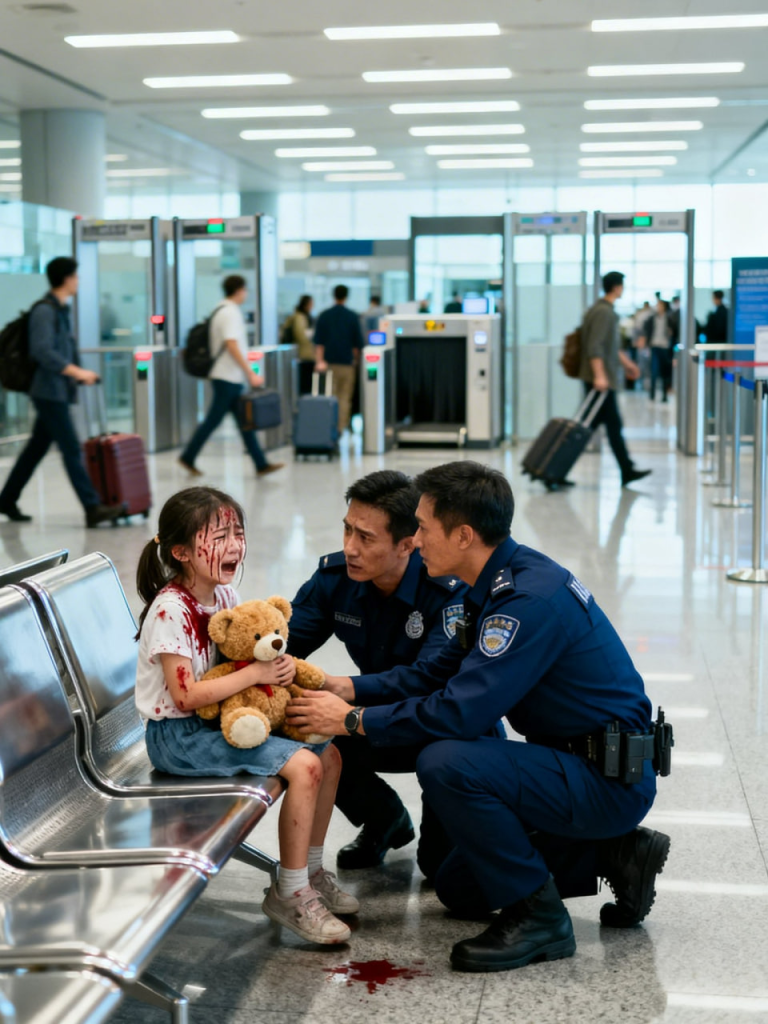
She was sitting alone on a bench near the TSA entrance, her bunny limp in her lap, her little shoulders hunched. A uniformed airport security officer stood over her, speaking gently. Another officer nearby was holding a clipboard.
Lily’s face was streaked with tears.
The moment I saw her, the world narrowed to a single bright line of panic.
“Lily!” I ran to her.
She looked up like she’d been drowning and finally found air.
“Mommy!” she cried, launching herself off the bench and into my arms.
I scooped her up, clutching her so tightly I felt her ribs move as she sobbed. Her little fingers locked around my neck.
“Ma’am,” the closest security officer said, calm but firm. “Are you the child’s mother?”
“Yes,” I panted. “Yes, I am. What—what happened? Where are my parents?”
The officer’s expression hardened slightly. “This child has been unattended for a while. She told us her grandparents left her here.”
My mouth went dry. “Left her?”
“We were questioning her because she was crying and said her family was gone,” the officer continued. “We’re trying to locate the adults responsible for her.”
I looked down at Lily. Her cheeks were wet, her nose red. She clung to me like she was afraid I’d evaporate.
“Baby,” I whispered, trying to keep my voice steady. “What happened? Where did Grandma and Grandpa go?”
Lily’s lips trembled. She glanced at the officers, then pressed her face into my shoulder.
I pulled back slightly so I could see her eyes. “Lily, sweetheart, you’re not in trouble. Just tell me.”
She sniffed hard, then whispered, “Grandma and grandpa left me here… to test if you’d really come back for me.”
For a second, I didn’t understand the sentence. My brain refused to accept it as real.
Then it hit me.
My stomach dropped so hard it felt like freefall.
“They… what?” I whispered.
Lily’s voice cracked. “Grandma said… ‘We’re going to see if your mom cares enough to come back.’ Grandpa said, ‘Don’t be dramatic. She’ll come if she’s worth anything.’”
The officers exchanged looks.
My vision blurred—not from tears yet, but from shock so sharp it turned the world fuzzy around the edges.
“Did they say where they were going?” I asked, my voice shaking.
Lily shook her head quickly. “They just… walked away. I waited. And waited. And then… I got scared.”
A sound escaped me—half breath, half sob, half something feral.
The security officer’s voice softened. “Ma’am, we need identification. And we need to ensure the child is safe.”
“I have it,” I said quickly, fumbling for my wallet. My hands were clumsy. I flashed my driver’s license, then shoved the passport into view like proof I existed.
“Thank you,” the officer said, scanning it. “Do you know where your family went? Are they traveling today?”
“Yes,” I said, voice tight. “We were checking in together.”
“We can attempt to locate them,” he said, already talking into his radio.
I hugged Lily closer, rubbing her back. Her body still trembled.
I forced myself to breathe.
One thought kept repeating, pounding against my skull:
They left my six-year-old alone in an airport.
Not because of an accident.
Not because of confusion.
Because they wanted to test me.
Because to them, my daughter was a prop.
A lever.
A threat.
“Ma’am,” the officer said, “we’re going to need you to stay here while we coordinate. Also—was the child ever in immediate danger? Anyone approach her?”
Lily shook her head quickly.
“No,” I said. “Thank God, no. But she was terrified. This is insane.”
The officer nodded, his jaw set now. “Understood.”
I looked down at Lily again. “Sweetheart, do you want to sit with the officer while Mommy finds Grandma and Grandpa? Or do you want to come with me?”
Lily wrapped her arms tighter around my neck. “Don’t leave me.”
My heart cracked.
“I won’t,” I whispered. “I swear. You are staying with me.”
I turned to the security officer, voice suddenly steady in a way that surprised me.
“I’m going to find them,” I said. “They can’t just—do this.”
The officer nodded. “We have staff searching. If you see them, do not escalate. Get an officer.”
I almost laughed. Do not escalate. Like I could keep my rage contained. Like I wasn’t watching my childhood replay itself, now aimed at my child.
But I nodded anyway.
“Okay,” I said. “Okay.”
I carried Lily toward the security checkpoint, scanning faces. My family was impossible to miss when they wanted to be seen—my mother’s white jacket, my father’s stern posture, Kelsey’s perfect blowout.
I pushed through the crowd, pulse thundering.
And then I saw them—past the TSA line, past the stanchions—near the entrance to the airport shops.
They were together, calm, laughing at something on Kelsey’s phone.
Like they hadn’t left a crying child alone.
Like my daughter’s tears were background noise.
I marched toward them with Lily on my hip.
My mother spotted me first.
Her eyes flicked to Lily, then to me, and something like irritation flashed across her face—annoyance that the scene had become inconvenient.
My father’s face tightened. Kelsey’s smile turned sharp.
“Well,” my mother said lightly, as if we’d been separated by accident. “There you are.”
I stopped a few feet away, my body vibrating with fury.
“Where were you?” I demanded.
My father’s gaze slid over Lily like she was a suitcase. “We had things to do.”
“Things to do?” My voice rose. “You left my child alone. Security was questioning her.”
My mother’s lips pressed together. “We didn’t ‘leave’ her. She was sitting.”
“She was crying,” I snapped. “She said you abandoned her to test me.”
Kelsey made an exaggerated sigh. “Oh my God, she told you that? Dad, I told you she’d make it a big thing.”
My father’s eyes narrowed. “Lower your voice.”
I stared at him, stunned by the audacity. “Lower my voice? You left my six-year-old alone in an airport.”
My dad’s expression didn’t soften. If anything, it hardened into something colder.
“Sorry,” he said, flat. “We don’t want deadweight on this trip.”
The words hit me like ice water.
For a second I couldn’t speak.
Then my mother stepped in, her tone crisp, almost bored. “Your sister’s perfect kids don’t want her ruining their vacation.”
Kelsey’s kids—both staring at their tablets, oblivious—didn’t even look up.
Kelsey took a step forward, chin lifted like she was delivering a decree.
“And if you want to keep being included,” she said loudly, drawing glances from nearby travelers, “send us five thousand more or she’ll be abandoned here again!”
My blood went cold.
Not because I was scared of her.
Because she’d said it out loud.
Like it was normal.
Like extortion was a casual family request.
Lily clung to me tighter. I felt her trembling start again.
I turned slightly so my body shielded her from their faces.
My voice came out low and dangerously calm.
“You’re threatening to abandon my child,” I said.
Kelsey shrugged. “Call it motivation. You’re always dragging everyone down with your… issues. You want to be part of a vacation? Pay your share.”
“My share?” I repeated, incredulous. “I paid for my ticket. I paid for Lily’s. I paid for the rental car—”
My father snapped, “And you’re lucky we let you. Frankly, Avery, you should be grateful your sister even invited you.”
Kelsey smiled thinly. “You’re welcome.”
I stared at them—my parents, my sister—three people who shared my DNA but not my humanity.
Lily’s voice came small against my shoulder. “Mommy, can we go home?”
My throat tightened.
I wanted to scream. I wanted to slap my father’s hand away before it could ever grab anyone again. I wanted to tell my mother exactly what kind of woman she’d chosen to be.
But Lily was watching.
And she’d already been used as a pawn once today.
I wasn’t going to let my family see me unravel. Not in front of her.
So I stayed completely silent.
My mother’s eyebrows lifted. “That’s better.”
Kelsey smirked. “She knows when she’s beat.”
My dad nodded once, satisfied. “Good. Now—”
I pulled my phone out.
And I made one call.
Not to plead.
Not to bargain.
Not to send money.
I hit speaker.
“911, what’s your emergency?” a calm operator answered.
My mother’s smile vanished.
My father stiffened.
Kelsey’s mouth fell open like she couldn’t believe I’d just done something outside the script.
I kept my voice steady and clear.
“Hi,” I said. “I’m at O’Hare International Airport, Terminal 3. My six-year-old daughter was abandoned unattended by her grandparents. Airport security was already questioning her. I’m now with the adults who left her, and my sister is threatening to abandon her again unless I pay five thousand dollars. I need airport police immediately.”
The world went quiet around us, like the air itself stopped to listen.
My father’s face went white.
Kelsey sputtered, “Are you—are you serious?”
My mom’s voice turned frantic. “Hang up. Avery, hang up right now.”
I didn’t.
I held Lily tighter and kept speaking.
“My name is Avery Carter,” I said. “My daughter is Lily Carter. We’re near the shops just past TSA. My parents are Richard and Diane Carter. My sister is Kelsey Morgan.”
Kelsey lunged forward like she might grab my phone.
My father’s hand shot out toward my wrist—
—and before he could touch me, a male voice cut through behind us.
“Ma’am?”
An airport police officer had approached, drawn by the sound of speakerphone and the sudden tension. Behind him, another officer moved quickly, hand resting near his belt.
The first officer looked at me, then at Lily, then at my parents’ faces.
“I’m Officer Hernandez,” he said. “Is everything alright?”
I kept my gaze steady. “No,” I said. “It isn’t. They abandoned my child. Security already has the report. And my sister just threatened to abandon her again unless I pay her.”
Officer Hernandez’s expression hardened.
My mother tried to laugh, high and brittle. “Oh, this is a misunderstanding. Avery’s… emotional.”
Kelsey’s voice sharpened. “She’s lying. She’s always lying to get attention.”
Officer Hernandez didn’t blink. “Ma’am, step back.”
He turned slightly. “Dispatch, I need a unit over here and I need TSA to hold this family. Possible child endangerment.”
My father’s voice rose, angry now. “You can’t—”
Officer Hernandez raised a hand. “Sir. Stop talking.”
My father stopped talking.
Because he’d spent his life using his voice as a weapon, and for the first time, it wasn’t working.
Kelsey’s face twisted. “You’re going to ruin our vacation because you’re broke?”
I finally looked directly at her, calm as stone.
“You ruined your vacation the moment you decided my child was disposable,” I said.
Kelsey’s eyes flashed. “She’s not disposable. She’s—”
“A tool,” I finished. “You said it. Out loud.”
My mother stepped forward, voice pleading now. “Avery, sweetheart, please. Don’t do this. Think about the family.”
I almost laughed again, but it came out as a shaky exhale.
“The family?” I repeated softly. “You left Lily alone to test me.”
My father’s jaw clenched. “It was a lesson.”
Officer Hernandez’s eyes snapped to him. “A lesson?” he repeated, disbelief sharpening his tone. “Sir, you left a six-year-old unattended in a public terminal.”
“She wasn’t in danger,” my father snapped. “There are cameras.”
Officer Hernandez’s voice turned icy. “Cameras don’t babysit.”
Behind him, two more airport police officers arrived. One spoke briefly into a radio. The other stepped closer, eyes scanning my parents and sister like they were already halfway to cuffs.
Kelsey’s bravado started cracking. “This is ridiculous. Our flight—”
Officer Hernandez cut her off. “Ma’am, I don’t care about your flight.”
My mother’s hands fluttered uselessly. “We were only gone a few minutes.”
I looked at her. “An hour,” I said flatly. “She sat alone for an hour.”
Lily’s little voice broke in, trembling. “Grandma told me if Mommy didn’t come back, I was gonna have to be brave by myself.”
The words hit the air like a slap.
Officer Hernandez’s face changed—something like anger, real anger, flaring in his eyes.
He crouched slightly to Lily’s level, voice gentler. “Sweetheart, you did the right thing staying where you were. Are you okay?”
Lily shook her head, tears spilling again.
I kissed her hair. “She’s scared,” I said.
Officer Hernandez stood and looked at my parents. “You’re coming with us.”
My father’s chin lifted. “On what grounds?”
Officer Hernandez’s tone stayed even. “Child abandonment. Potential child endangerment. And extortion threats were reported.”
Kelsey’s face went gray. “Extortion? I was joking!”
I stared at her. “You weren’t joking,” I said quietly. “You were negotiating like you always do.”
Kelsey’s mouth opened and closed like a fish.
My father took a step back. “This is insane,” he muttered. “She’s trying to punish us.”
Officer Hernandez didn’t move. “Sir, turn around.”
My mother’s voice went shrill. “You can’t arrest us! We’re her parents!”
Officer Hernandez’s eyes didn’t soften. “That doesn’t give you the right to endanger a child.”
My father hesitated one second too long.
Another officer stepped in. “Sir, now.”
And just like that, the man who’d controlled every room for decades had to comply.
My father turned around.
My mother began crying, loud enough to draw attention.
Kelsey started arguing, voice rising into that familiar “I’m the victim” pitch.
People around us slowed, watching. Phones came out. A child in a stroller stared like he was witnessing a magic trick.
My dad’s wrists disappeared behind his back as an officer guided his hands together.
Kelsey’s face finally shattered into real fear.
She looked at me, eyes wide. “Avery… stop. Please. You can’t—”
I didn’t say anything.
Because there was nothing left to explain.
My mother’s voice cracked. “Avery, baby, please—think of Christmas.”
I looked down at Lily—my daughter’s tear-streaked face, her small body trembling against mine.
Then I looked back at my mother.
“I am thinking of my child,” I said.
Officer Hernandez nodded toward another officer. “Ma’am,” he said to me, “we’re going to take statements. TSA has footage, and airport security already has a report. Do you have somewhere safe to go?”
“I’m going home,” I said.
He glanced at Lily. “Good.”
Kelsey started crying now too, makeup smearing. “This is—this is her fault,” she babbled. “She’s always been jealous of me.”
No one responded.
No one cared.
Because jealousy wasn’t the story here.
Cruelty was.
The officers escorted my parents and sister away, their luggage abandoned near the shops like forgotten props. My mother sobbed about embarrassment. Kelsey ranted about money. My father said nothing, but his face looked like stone cracking from the inside.
And as they disappeared down the corridor, Officer Hernandez returned to me.
“I’m sorry you and your daughter experienced that,” he said quietly.
I swallowed hard. “Me too.”
He offered a small, sympathetic nod. “We’ll need your statement. And we can connect you with a victim advocate, if you’d like.”
Victim advocate. The phrase felt surreal. Like it belonged to someone else’s life.
But when Lily’s small hand reached up and clutched my collar, I knew it belonged to ours now.
“Okay,” I said. “Whatever Lily needs.”
The statement took time.
We sat in a small office near the checkpoint, fluorescent lights buzzing overhead. Lily curled in my lap like a sleepy kitten, still holding her bunny. A kind airport employee brought her a juice box and some crackers, and Lily ate like she’d been holding her breath for an hour.
I answered questions: names, dates, what was said, where I’d been, what Lily reported.
I didn’t sugarcoat anything.
Because sugarcoating was what my family relied on—layers of politeness and “family values” covering the rot underneath.
When the officer asked, “Have they done anything like this before?” I hesitated.
Not like this, no. Not so blatant, not so public.
But the pattern—the way they treated me like an accessory, the way they treated my needs like inconveniences, the way they demanded money like it was my role to provide it—had been there for years.
“It’s always been emotional manipulation,” I admitted. “But today… today they used my child.”
The officer nodded, expression grim. “That matters.”
When we finished, Officer Hernandez walked me out.
“I don’t know what will happen next,” he said. “But they’ll be interviewed. There will likely be charges.”
I stared down at Lily, who leaned her head against my shoulder. “I just want her safe,” I said.
“You did the right thing calling,” he replied.
I swallowed hard. “I almost didn’t. I almost—”
“Almost isn’t what matters,” he said. “You did.”
Outside the office, the terminal was still moving, still loud, still full of travelers chasing flights and vacations and lives that didn’t involve handcuffs.
I felt like I’d stepped into a different universe than everyone around me.
I carried Lily toward the exit, my suitcase wheels clacking behind me.
When we reached the sliding doors, Lily spoke softly.
“Mommy?”
“Yeah, baby?”
“Are Grandma and Grandpa mad at me?”
The question pierced me. Not because it was irrational, but because it made heartbreaking sense. Lily thought she had caused this. She thought the adults’ cruelty was a reflection of her worth.
I stopped in the doorway, crouched down, and held her face gently between my hands.
“No,” I said firmly. “Listen to me. This isn’t your fault. You didn’t do anything wrong.”
Lily’s eyes filled with tears again. “But Grandma said I was… heavy.”
My chest tightened so hard I could barely breathe.
“Grandma was wrong,” I said, voice steady with effort. “You are not heavy. You are not deadweight. You are my favorite person in the whole world.”
Lily’s lower lip trembled. “Really?”
“Really,” I said, kissing her forehead. “And no one—no one—gets to treat you like you’re less than precious. Not even family.”
She nodded slowly, as if trying to memorize the words.
Then she whispered, “I’m glad you came back.”
I hugged her fiercely. “I will always come back,” I said into her hair. “Always.”
The next few days were a blur of phone calls I never expected to make.
A detective. A child services representative—not accusatory, but careful, because they had to ensure Lily’s safety. An airline rep, because the tickets were a mess.
The tickets, it turned out, were in my name.
Kelsey had insisted I book everything because “you’re better at paperwork.” Translation: she wanted me to be responsible when something went wrong.
When I called the airline to explain the situation, the representative’s tone turned very serious.
“Ma’am,” she said, “we’re so sorry. We can document this incident. If those passengers were removed by airport police, their tickets may be voided depending on circumstances.”
“I don’t care about their tickets,” I said, voice tight. “I just need to make sure Lily and I aren’t charged for changes.”
“We’ll take care of you,” the rep said, kindness in her voice.
For the first time since the airport, I felt something like relief loosen in my chest.
Because for once, someone on the other end of a phone wasn’t demanding I sacrifice myself to keep them comfortable.
A week later, a court hearing was scheduled for a temporary protective order.
I sat in a small courtroom with Lily’s stuffed bunny in my purse like a talisman. My hands were cold, but my spine stayed straight.
My parents appeared across the room looking smaller than they ever had. My father’s anger was muted by the fact that a judge didn’t care about his authority. My mother’s eyes were red from crying.
Kelsey arrived late, like she always did, wearing sunglasses indoors like she was a celebrity being hounded.
When the judge asked why the order was requested, the prosecutor summarized the police report: child abandonment, coercion, extortion threat, and emotional distress of a minor.
Kelsey scoffed loudly. “Extortion? That’s insane.”
The judge looked at her over the bench. “Ms. Morgan, you were recorded by multiple witnesses and potentially on airport security audio. This is not a debate.”
Kelsey’s mouth snapped shut.
My father tried to speak. “Your Honor, this is being exaggerated. We were teaching Avery responsibility.”
The judge’s gaze sharpened. “By abandoning a six-year-old child in an airport?”
My father’s jaw clenched.
The judge continued, “You don’t teach responsibility through endangerment. And you don’t ‘test’ someone’s love by traumatizing a child.”
I stared at my hands, forcing myself not to shake.
Then the judge looked at me. “Ms. Carter, is the child in therapy?”
“Not yet,” I said softly. “But I’m arranging it.”
“Good,” the judge said. “This court grants a temporary protective order. No contact, directly or indirectly, with Ms. Carter or the child. Violations will have consequences.”
My mother made a small sound—like she’d been struck.
Kelsey’s sunglasses hid her eyes, but her posture screamed outrage.
My father’s face was stone.
But for the first time in my life, their reactions didn’t dictate mine.
Because I wasn’t doing this for revenge.
I was doing it for Lily.
In the weeks that followed, Lily started asking questions at unexpected moments.
At bedtime, when the room was dark and her thoughts got loud.
In the grocery store, when she saw an older couple laughing with their grandchild.
In the car, when a song came on that reminded her of “vacation music.”
“Why didn’t Grandma want me?” she asked one night, voice small.
I paused, my hand resting on her back as I tucked her blanket.
“Grandma has… problems,” I said carefully, choosing words like stepping stones across water. “And sometimes people with problems hurt others instead of fixing themselves.”
Lily blinked. “Like when I get mad and I throw my crayons?”
A sad laugh escaped me.
“Sort of,” I said gently. “But you’re learning not to throw crayons. Grandma and Grandpa never learned.”
Lily stared at the ceiling for a moment. “Will they leave me again?”
“No,” I said, more firmly than anything else I’d said in years. “They can’t. And I won’t let them.”
Her eyes drifted toward me. “Promise?”
I took her little hand and pressed it to my cheek.
“Promise,” I whispered.
Three months later, on a sunny Saturday morning, Lily and I went to the beach anyway.
Not Mexico. Not a resort. Just a quiet stretch of Lake Michigan where the sand was soft and the water glittered.
Lily ran toward the shoreline squealing, her bunny tucked under her arm, and then she stopped and looked back at me.
“Mom!” she shouted. “Come with me!”
And I did.
I ran after her, laughing, my shoes sinking into sand, my hair whipping in the wind.
For a moment, everything felt light.
Not because the past was erased, but because I had chosen what would define us.
Not their cruelty.
Not their demands.
Not their cold, poisonous idea of “deadweight.”
Us.
Lily’s laughter.
My arms around her.
The quiet knowledge that when someone tries to use love as a test, the right answer isn’t to prove yourself.
It’s to protect what matters and walk away from what doesn’t.
That night, after Lily fell asleep with her bunny pressed to her chest, I sat at my kitchen table and stared at my phone.
There were no missed calls.
No guilt texts.
No fake apologies.
Just silence.
And for the first time, silence felt like peace.
I thought about the moment at the airport when Kelsey demanded money, confident I’d fold like I always had.
I thought about my mother saying Lily would “ruin” the vacation.
I thought about my father calling my child deadweight.
And I thought about the one call that ended it.
Not because it was clever.
Because it was truth.
Truth spoken out loud in a place with cameras and consequences and people who didn’t care about family hierarchy.
Truth that snapped the spell.
I stood, walked down the hall, and peeked into Lily’s room.
She was asleep, safe, small chest rising and falling steadily. Moonlight fell across her blanket.
I whispered, barely audible, “I came back.”
Then I added, with quiet certainty, “And I’ll never let anyone leave you again.”

Leave a Reply