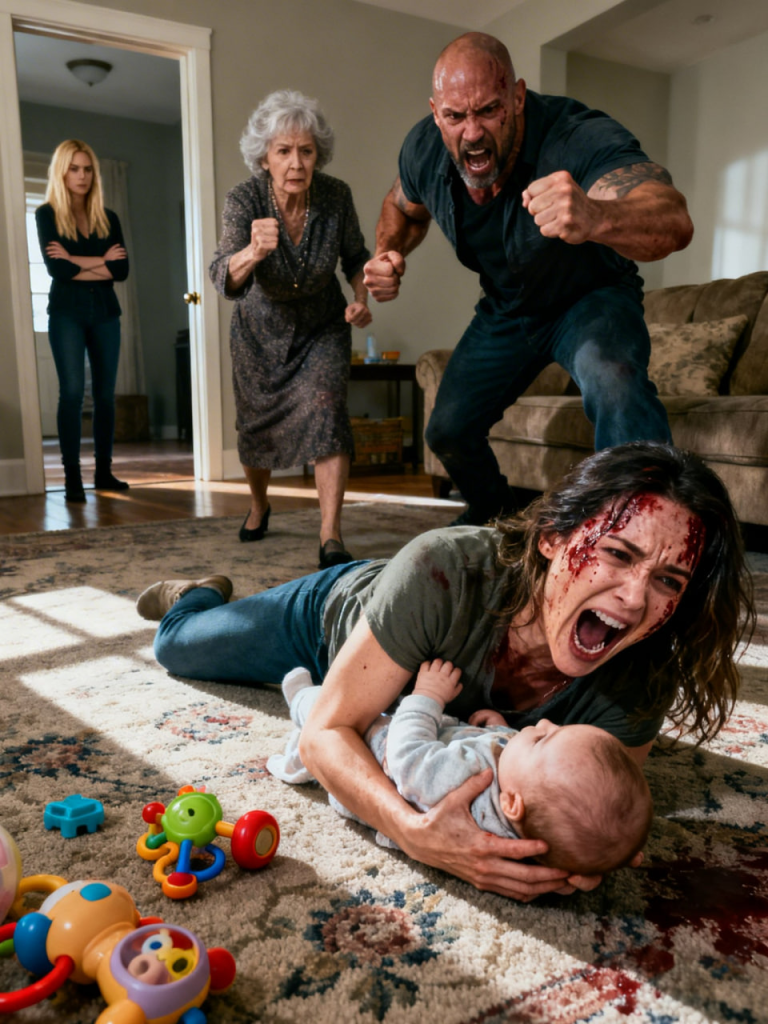
One second I was standing in my mother-in-law’s living room, trying to keep my hands from shaking, trying to breathe through the tightness in my chest. The next, my cheek exploded with heat and I hit the floor like my knees had been cut out from under me.
“Oh my God,” my sister-in-law breathed, but it wasn’t sympathy. It was the kind of sound someone makes when drama is finally entertaining.
My mother-in-law—Deborah Whitmore—stood over me with her chest heaving, her mouth pulled into something feral. Her wedding ring caught the light as her hand hovered in the air, like she was ready to do it again.
“You lying woman!” she screeched. “That baby belongs to some random man!”
My face throbbed. I tasted metal. I blinked up at the ceiling fan spinning slowly, like it had all the time in the world.
I forced myself to sit up. My palms scraped the hardwood. My stomach clenched—not just from fear, but from instinct.
Protect the baby.
I turned my head slightly, careful, and looked at my husband.
Logan Whitmore wasn’t rushing to help me. He wasn’t asking if I was okay. He wasn’t furious at the woman who’d just hit his pregnant wife.
He was furious at me.
His eyes were wild, jaw tight, as if the slap had confirmed something he’d secretly wanted to believe.
“Pack your sh!t,” he snapped, voice loud enough to bounce off the walls, “and d.i.e somewhere else!”
The words made my body go cold. Not the dramatic kind of cold you get in movies. A real, heavy cold that settled in my organs, turning everything inside me numb.
Deborah’s mouth curled upward, satisfied. Like she’d been waiting for him to say it. Like she’d planted the seed and now she was watching it bloom.
Then she turned to Logan’s younger sister, Sienna, who was perched on the couch with both hands on her own baby bump.
Sienna’s pregnancy was the golden event of the family. Five months along. Everyone called her “Mama” already, even though she was twenty-two and still didn’t pay her own phone bill.
Deborah leaned toward her, voice syrupy and cruel. “Don’t worry,” she sneered. “You’ll give birth to the first real grandchild.”
Sienna smiled.
It wasn’t an accident. It wasn’t awkward laughter. It was a smile that said she agreed.
My cheek burned. My heart pounded like it wanted to escape my ribs.
And still—somehow—I stayed silent.
Not because I was weak.
Because I knew Deborah. I knew this family. I knew the second I spoke, they’d twist my words into proof I was “guilty,” “hysterical,” “unstable.”
So I did the only thing I could do in that moment: I swallowed my pain and stood up slowly.
Deborah watched me with the smug stillness of someone who believed she’d won. Logan’s arms were crossed. His body angled away from me like I was contagious.
“Get out,” he said again. “Now.”
I looked at him—really looked at him—and realized something that felt like a second slap:
He wanted to believe them.
Because believing I’d betrayed him meant he didn’t have to question anything else. Not his mother’s control. Not his own cowardice. Not the fact that he’d always chosen comfort over me.
I nodded once, like I understood.
Then I turned and walked toward the front door.
Behind me, Deborah’s voice followed like a poison cloud. “And don’t think you can trap him with a fake pregnancy! We’re not paying for your mistakes.”
Fake pregnancy.
I pressed a hand to my stomach as I stepped outside into the bright afternoon sunlight. The air smelled like cut grass and someone’s barbecue down the street. Normal. Almost offensive.
I walked to my car in a daze, got in, and sat there with my hands gripping the steering wheel until my knuckles went white.
Then I started shaking.
Not the quiet kind. The kind that made my teeth chatter.
I wasn’t just being kicked out of a house.
I was being erased.
And the baby inside me—my baby—was being erased with me.
I drove without knowing where I was going until I ended up in a Walmart parking lot twenty minutes away, sitting under the harsh glare of a light pole. My phone buzzed nonstop.
Logan.
Deborah.
Sienna, once.
I didn’t answer.
I stared at the screen until the battery dropped, then I turned the phone off.
For a long time, I just breathed.
Then reality hit like a wave.
I was seven weeks pregnant.
I had no job—because Logan had insisted I quit my marketing position “for now,” while he “built his business.” His business, which was mostly him golfing with clients and coming home complaining.
My name was on the apartment lease, but Logan paid the rent from “his” account—an account I’d been added to and quietly removed from months ago, under the excuse of “bank paperwork.”
My family lived in Michigan. We were in suburban Dallas, Texas, because Logan said he “needed the market.”
My cheek still stung. When I touched it, my fingers came away slightly damp.
Tears.
I wiped them away fast, angry at myself for crying over people who didn’t deserve even one more drop of me.
I did the next sane thing I could think of.
I called my sister.
Nina answered on the second ring. “Maya?”
The moment I heard her voice, my throat collapsed. “Nina,” I croaked.
“What’s wrong?” she asked, instantly sharp. “Where are you?”
I tried to speak and broke. My words came out in messy fragments—slap, baby, Logan, “die somewhere else,” disbelief.
Silence on her end for two seconds. Then: “Okay. Listen to me. You’re going to breathe. You’re going to tell me exactly where you are. And you’re not going back there.”
I gave her the location. She didn’t hesitate.
“I’m booking a flight right now,” she said. “I’ll be there tonight.”
“Nina, you don’t have to—”
“Yes,” she said, voice like steel. “I do.”
When I hung up, the shaking eased a little. Not because things were better, but because I wasn’t alone anymore.
I drove to a cheap motel off the highway, the kind with faded curtains and a front desk clerk who didn’t ask questions. I paid for a week with the credit card Logan didn’t know I still had.
In the mirror over the sink, my cheek was already swelling, a red handprint blooming like a bruise-shaped signature.
I stared at it until my jaw clenched.
Then I whispered to my reflection, “I’m not going to beg.”
I didn’t know exactly what I would do.
But I knew what I wouldn’t do.
Nina arrived after midnight with her hair in a messy bun and the same stubborn glare she used to give bullies in middle school.
The moment she saw my face, her expression changed—rage sharpening her features.
“Oh, Maya,” she breathed, then wrapped me in a hug so tight my ribs protested.
I tried to be strong. Tried to stay silent like I had in Deborah’s living room.
But in Nina’s arms, the strength cracked, and the tears came anyway.
Nina didn’t tell me to calm down. She didn’t say “Maybe they didn’t mean it,” or “It’s complicated.”
She just held me.
When I finally pulled back, she looked me dead in the eyes. “We’re going to a doctor tomorrow,” she said. “We’re documenting everything. And then we’re getting a lawyer.”
“A lawyer?” I whispered, because part of me still couldn’t accept that my marriage had just… turned into a battlefield.
“Yes,” Nina said. “Because if they’re willing to hit you and throw you out while you’re pregnant, they’re willing to do worse.”
I swallowed hard. “Logan wouldn’t—”
Nina lifted a brow. “Maya. He already did.”
That silenced me.
The next morning, we went to urgent care. The nurse took one look at my cheek and asked, gently, “Do you feel safe at home?”
I hesitated.
Nina leaned in. “No,” she said for me. “She doesn’t.”
They documented the injury. Took photos. Asked questions. I told the truth, calmly, like reading from a script.
A part of me felt like I was floating above my body watching it all happen.
Then, because Nina insisted, we went to my OB’s office—yes, I had one, because after the positive test I’d been both terrified and excited enough to schedule an appointment immediately.
The ultrasound screen flickered, grainy and gray.
And then—a tiny pulse.
The technician smiled softly. “There’s the heartbeat.”
Something inside me unclenched so violently I almost sobbed again.
Nina squeezed my hand. “Told you,” she whispered.
Afterward, sitting in the parking lot, Nina looked at me with that practical intensity she always had. “Okay,” she said. “Now. We need to decide what you want.”
I stared down at my hands. They were steady now.
“I want the truth,” I said.
Nina nodded. “About the baby?”
“About everything,” I said.
Because Deborah’s accusation wasn’t random. It wasn’t just cruelty.
It was strategy.
They wanted to discredit me.
To make me look like the villain.
So they could justify anything they did next.
And suddenly, I realized I was missing a piece.
Logan had never questioned me like that before. He’d been… anxious, sure. Distant, yes.
But the speed with which he believed Deborah—the speed with which he turned on me—felt rehearsed.
Like he’d been primed.
I lifted my chin. “I want a prenatal paternity test,” I said.
Nina didn’t blink. “Okay. We’ll do it.”
It was expensive. The kind of expensive that made my stomach knot. But Nina had money saved. And she was relentless.
“This isn’t just to prove something to them,” she said. “This is for you. For court. For your peace.”
So I did it. Blood draw. Paperwork. A quiet room where the nurse treated me like a person instead of a problem.
Then we waited.
And that was the week when everything finally seemed like it couldn’t possibly get worse.
Three days after the slap, Logan filed for divorce.
Not even a conversation. Not even a message.
A process server showed up at the motel while Nina and I were eating microwaved oatmeal.
The papers felt heavy in my hands, like printed proof that my life was being dismantled with legal ink.
“On grounds of adultery,” Nina read aloud, incredulous.
My throat went tight. “He’s… accusing me.”
Nina’s eyes flashed. “He’s setting you up.”
Then came the second blow: Logan had emptied our joint savings account.
The small emergency fund I’d built from my own paychecks before I quit? Gone.
I called the bank. My name wasn’t on the account anymore.
The representative sounded apologetic. “Ma’am, you were removed as an authorized user five months ago.”
Five months.
Right around the time Deborah started making “jokes” about how I’d “probably trap Logan” with a baby.
My hand trembled around the phone.
Nina mouthed, I told you.
My stomach churned with nausea—not just pregnancy nausea. Betrayal nausea.
That night, as if the universe was piling on for sport, Sienna posted a photo on Instagram.
Her hand on her belly. Deborah’s hand on top of it. Logan standing beside them with a stiff smile.
Caption: “Family is everything. So blessed for new beginnings.”
I stared at the photo until my vision blurred.
Nina gently took my phone and turned it face down. “Don’t,” she said.
I swallowed, jaw shaking. “He replaced me,” I whispered.
Nina’s voice was quiet but brutal. “He didn’t replace you,” she said. “He revealed himself.”
The next morning, I got a voicemail from Deborah.
Her tone was sweet—too sweet.
“Maya, honey,” she said, “this doesn’t have to get ugly. If you just sign away your rights, Logan will be generous. You can start fresh. We’ll even help you get back to Michigan. But if you keep lying about that baby… well. Courts don’t like liars.”
I listened to it twice.
Then I deleted it—and saved a copy.
Because Nina was right.
This was strategy.
And that meant I needed one thing more than comfort.
I needed proof.
So we built a file.
Photos of my bruised face.
Medical documentation.
Screenshots of Deborah’s texts (because yes, she’d been texting too—little digs, little threats disguised as “concern”).
Bank statements.
Social media posts.
Everything.
Every piece of their cruelty turned into evidence.
Then, on the seventh day after the slap, Nina’s phone buzzed.
She glanced at the caller ID. Then looked at me.
“It’s your paternity test results,” she said.
My heart stopped.
For a second, all I could hear was blood rushing in my ears.
Nina put the call on speaker.
The nurse’s voice was calm, professional. “Hi, Maya. We have the results. Would you like me to read them to you?”
My voice came out small. “Yes.”
A pause, the sound of paper.
“The results indicate a 99.99% probability that Logan Whitmore is the biological father.”
Silence.
My lungs filled like they’d been empty for days.
Then Nina let out a sharp laugh—half relief, half fury. “Oh, I cannot wait,” she said through her teeth.
I pressed my hand to my stomach, trembling.
Not from fear.
From vindication.
The baby was Logan’s.
Deborah had slapped me for nothing.
Logan had thrown me out for nothing.
Sienna had smiled for nothing.
I felt something in me harden into clarity.
I wasn’t going to beg them to believe me.
I was going to make them choke on the truth.
Two days later, we sat in a lawyer’s office.
Her name was Danielle Ross, and she wore a navy blazer and lipstick that looked like confidence. She listened without interrupting, eyes sharp.
When we finished, she leaned back. “Okay,” she said. “First: you’re going to stop thinking of this as ‘family drama.’ This is abuse. Financial abuse, emotional abuse, and physical assault.”
My throat tightened at the word assault.
Danielle continued, “Second: the paternity test is powerful. Third: the divorce filing on grounds of adultery? That’s strategic, but it’s also risky for him if it’s provably false. We can counter.”
Nina slid the folder forward. “We have documentation,” she said.
Danielle flipped through it, nodding slowly. “Good,” she said. “Very good.”
I swallowed. “What happens now?”
Danielle’s gaze met mine. “Now,” she said, “you take your power back.”
We filed for a protective order against Deborah.
We filed an emergency motion for financial disclosure.
We filed a response disputing the adultery claim and included the paternity results.
And then Danielle did something I didn’t expect.
She advised we send one message—one—and nothing else.
A formal notice to Logan: all communication through counsel. No contact.
It felt surreal.
Like my marriage had turned into a lawsuit.
But as I signed the paperwork, a calm settled over me.
Because finally, I wasn’t reacting.
I was moving.
The first time Logan saw the paternity results, he didn’t call me.
He showed up.
He appeared in the motel parking lot like a ghost from my old life, eyes bloodshot, hair messy, wearing the same hoodie he always wore on Sundays.
Nina spotted him from the window and went still. “He’s here.”
My pulse spiked.
Danielle had warned us this might happen—men like Logan, men who needed control, often tried to reclaim it when legal pressure appeared.
I stood up slowly, my hands cold.
“I’m not talking to him,” I said.
Nina nodded. “You don’t have to.”
Logan knocked on the door hard.
Nina opened it but stayed in the frame, blocking him. “You’re not welcome,” she said.
Logan’s gaze darted past her, landing on me. “Maya,” he said, voice hoarse. “I need to talk to you.”
I didn’t move.
He swallowed. “My lawyer sent me your—your test. That—” He blinked fast. “That can’t be right.”
Nina laughed once, sharp. “It’s literally science, Logan.”
Logan’s face twisted. “My mom—she said—”
“Your mom slapped your pregnant wife,” Nina snapped. “And you told her to go die.”
Logan flinched as if the words physically hit him.
He stepped forward, but Nina didn’t budge. “Please,” he said, voice cracking. “Maya. I didn’t know what to think. Mom said you’d been—”
I cut in, voice quiet but steady. “You didn’t trust me.”
Logan’s eyes filled. “I was angry. I was scared.”
I nodded once. “You were cruel,” I said.
He stared at me, mouth opening and closing like he wanted a defense but couldn’t find one that didn’t sound pathetic.
Then he tried the pivot.
“My mom didn’t mean—she just—she’s protective. You know how she gets.”
I felt a cold clarity slice through me.
“That’s your excuse?” I asked. “She assaulted me. You sided with her. You stole my money. You filed for divorce accusing me of adultery.”
Logan’s face crumpled. “I can fix it,” he said quickly. “I can—We can go home. I’ll talk to Mom. I’ll—”
“There is no home,” I said.
He shook his head rapidly, desperate. “Maya, please. I’m the father. I want to be—”
“Then you should’ve acted like it,” I said.
Logan’s voice rose, panic turning into anger—the old pattern. “So you’re just going to take my kid away?”
Nina’s eyes narrowed. “Don’t,” she warned.
I held Logan’s gaze. “I’m not taking anything,” I said. “You gave it up when you told me to die.”
His face went slack, like he finally understood there was no trick, no speech, no apology big enough to rewind time.
Nina spoke, firm. “All communication goes through our lawyer. Leave.”
Logan stood there another second, then stumbled back to his car like he was walking away from the only version of himself he liked.
He drove off.
I didn’t cry.
I just sat on the bed afterward, hands on my belly, and breathed.
The court hearing was two weeks later.
Deborah arrived in pearls and a church-lady cardigan, acting like she was there to donate casseroles instead of answer for assault.
Sienna waddled in behind her, chin up, smirking like this was still a family performance and she was the star.
Logan sat beside them, shoulders hunched, eyes avoiding mine.
Danielle sat beside me, calm and ready.
When the judge reviewed the evidence—the photos, the medical documentation, Deborah’s voicemail—Deborah’s expression cracked for the first time.
“This is ridiculous,” Deborah snapped. “I was provoked.”
The judge’s gaze sharpened. “Provoked how?”
Deborah hesitated. “She lied. She—She tried to trap my son.”
Danielle stood. “Your Honor,” she said, voice clear, “we have submitted prenatal paternity results confirming Mr. Whitmore is the biological father with 99.99% probability. Ms. Carter did not lie about the paternity. The accusation was false. The assault was not provoked.”
Deborah’s mouth tightened.
Sienna whispered something to her, eyes rolling.
Then Danielle delivered the part that made Logan’s head jerk up.
“Additionally,” Danielle said, “Mr. Whitmore filed for divorce on grounds of adultery. We have evidence those claims are false, and we will be seeking sanctions and attorney’s fees.”
Logan’s face drained.
The judge granted the protective order.
Deborah was ordered to have no contact with me.
Sienna’s smirk vanished.
Outside the courtroom, Deborah hissed at Logan, loud enough for me to hear: “You let her humiliate us!”
Logan didn’t respond.
For the first time, he looked less like a man and more like a boy who’d built his life around obedience.
Sienna shot me a look full of spite. “Enjoy being alone,” she muttered as she passed.
Nina stepped forward, but I shook my head.
Let her talk.
Words couldn’t touch me the way they used to.
Because now I had proof.
And I had a plan.
Months passed.
I moved into a small apartment paid for by Nina temporarily and, eventually, by the support Danielle secured through court once Logan was forced to disclose finances and restore what he’d stolen.
I got my job back—remote contract work at first, then full-time.
I went to prenatal appointments alone sometimes, and sometimes Nina came and made jokes to keep me from crying in the waiting room.
Logan tried to message me once through a new number.
Danielle shut it down fast.
He tried again, this time through an email that sounded like therapy homework: I’m taking accountability. I’m sorry. I want to be involved.
Danielle filed it appropriately and reminded him the boundaries were court-ordered.
He complied after that.
Not because he suddenly became a hero.
Because consequences finally existed in his world.
Sienna gave birth first.
Deborah posted photos like everything was perfect—pink balloons, matching outfits, captions about “blessings.”
But in the quiet corners of town, the story was different.
People had seen the police report. People had heard about the protective order. Deborah’s church friends smiled less warmly when she spoke.
And Logan… Logan looked smaller every time I saw him in court updates.
Then, one afternoon, my water broke early.
Not dangerously early, but early enough to scare me.
Nina drove like a maniac to the hospital, her face pale.
In the delivery room, under harsh lights, with nurses moving fast, I gripped the bed rails and thought about Deborah’s voice: That baby belongs to some random man.
I thought about Logan’s voice: Pack your sh!t and die somewhere else.
I thought about the week I’d spent in that motel, feeling like the world was closing in.
And I pushed.
Hours later, they placed my daughter on my chest.
She was tiny and red and furious at the world, her cry sharp and alive.
The nurse smiled. “She’s perfect.”
I looked down at her, overwhelmed by love so fierce it felt like pain.
“Hi,” I whispered. “I’m your mom.”
Nina cried openly beside me, laughing through tears. “Oh my God,” she whispered. “Look at her.”
My daughter’s fingers curled around mine.
And in that moment, something inside me healed—not all the way, but enough to stand.
Because this child wasn’t a weapon.
She wasn’t a rumor.
She wasn’t Deborah’s “grandchild” to rank and label.
She was mine.
Logan met his daughter for the first time two weeks later, in a supervised setting arranged through lawyers.
He walked into the room looking terrified.
I sat across from him, calm, holding my daughter in my arms.
When he saw her, his face crumpled. “She’s… she’s beautiful,” he whispered.
I didn’t respond.
He sat, hands trembling. “Maya,” he said quietly. “I’m sorry.”
I looked at him then—not with hatred, not with longing—just with truth.
“I believe you’re sorry,” I said.
Hope flickered in his eyes.
I continued, steady. “But being sorry doesn’t undo what you did.”
His shoulders sagged.
I nodded toward our daughter. “If you want to be in her life,” I said, “you earn it. With consistency. With respect. With actions.”
Logan swallowed. “I will,” he whispered.
I believed he wanted to.
But wanting wasn’t enough anymore.
He reached out tentatively, and the supervisor guided him on how to hold her safely.
Our daughter blinked up at him like he was just another shape in the world.
Logan’s eyes filled with tears.
For a second, I almost felt something for him.
Then I remembered myself on the floor.
I remembered Deborah’s handprint on my face.
And I chose the future.
Not the past.
A year later, the divorce was finalized.
Logan got structured visitation.
Deborah never came near me again. The protective order stood like a wall she couldn’t climb.
Sienna tried to stir drama once—posting something vague about “keeping families apart”—but it didn’t go far.
People like Deborah relied on shame to keep others silent.
But I wasn’t silent anymore.
On the day I signed the final papers, I walked out of Danielle’s office into sunlight and breathed deep.
Nina looped her arm through mine. “How do you feel?” she asked.
I thought about the slap.
About the accusation.
About being told to die.
About the week in the motel when I’d stared at the ceiling and wondered if I’d ever feel safe again.
Then I looked down at my daughter in her stroller, chewing on a teething ring like she owned the universe.
“I feel,” I said slowly, “like they tried to erase me.”
Nina nodded.
“And they failed,” I finished.
Because I didn’t need Deborah to call my child “real.”
I didn’t need Logan to validate the truth he’d tried to bury.
I didn’t need that family’s approval to exist.
I had my own life now—one I’d built out of pain, yes, but also out of stubborn survival and the kind of love that doesn’t come with conditions.
As we walked to the car, Nina glanced at me. “You know what the best part is?” she asked.
I raised an eyebrow.
“They thought you staying silent meant you had nothing,” Nina said. “But it was just you waiting for the right moment.”
I smiled—small, real.
“Yeah,” I said. “I was waiting.”
I buckled my daughter into her car seat, kissed her forehead, and closed the door gently.
Then I got into the driver’s seat and started the engine.
The road ahead was open.
And for the first time in a long time, I wasn’t driving away from something.
I was driving toward myself.
Leave a Reply