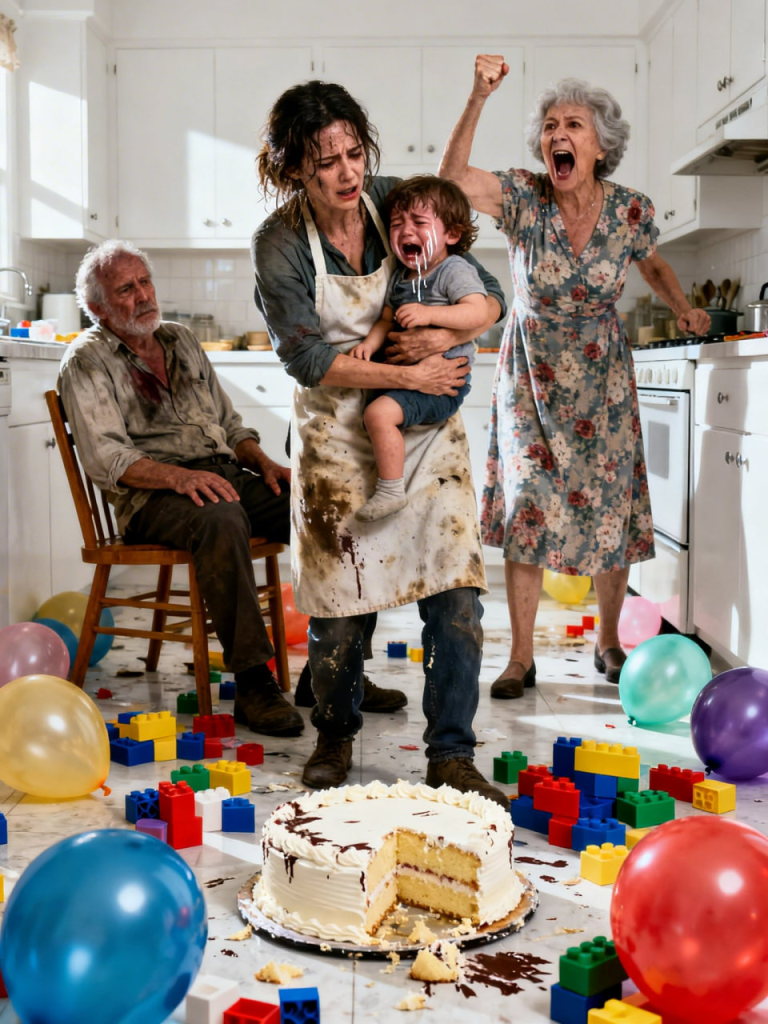
By the time the pink balloons started sagging against the ceiling fan, I’d already told myself a dozen times to breathe.
It was just a birthday party.
Two years old. Two candles. A cake shaped like a bunny because Mia loved anything with long ears. A folding table in my parents’ dining room covered in a plastic tablecloth printed with confetti and the words HAPPY BIRTHDAY in loud, cheerful letters.
And still—my chest felt tight, like I’d swallowed a handful of ice.
Mia sat in her little booster seat, legs swinging, holding a plastic spoon like it was a microphone. She tapped it against the tray and looked up at me with those big, serious eyes that always made me feel like she understood more than the world gave her credit for.
“Ready, baby?” I asked.
Mia opened her mouth, made a soft sound—half hum, half breath—and then smiled. She didn’t say ready. She didn’t say much of anything yet.
But she communicated in a thousand other ways: a tug on my sleeve, a point toward the kitchen, the way she pressed her forehead against mine when she wanted comfort. She had signs, too—little hands learning little meanings. More. Milk. Mama.
Slow-speaking, the pediatrician called it. Expressive delay. Nothing that meant she was broken. Nothing that meant she wasn’t brilliant in her own quiet, determined way.
But my family didn’t speak that language. They spoke in verdicts.
My mom, Linda, had insisted the party be at their house “so we don’t have to cram into your apartment.” My dad, Ron, had nodded along like it was generous instead of controlling. And my sister, Kendra—my older sister, my parents’ favorite—had texted me a single thumbs-up when I reminded her the party started at two.
I should’ve known that meant she was coming with a knife hidden behind her smile.
By one-thirty, guests were arriving: my aunt with her loud perfume, my parents’ neighbors with their gift bag and polite small talk, a couple cousins I barely recognized. The whole room filled with the warm, messy noise of people congratulating each other for showing up.
My husband, Mark, moved through the crowd with paper plates, trying to keep things smooth. He’d offered—twice—to host at our place anyway, even if it was small, even if it meant squeezing. But I’d said yes to my parents because part of me still believed—stupidly—that if I kept the peace long enough, they’d finally treat me like I deserved it.
Mia clung to my hip as I circulated, her fingers twisted in the fabric of my blouse. When someone spoke directly to her—“Hi, sweetheart!”—she stared at them, then buried her face in my neck. Not fear. Just her way of measuring the world before stepping into it.
“She’s shy,” I told people, smiling.
“She’s precious,” my aunt said.
“Such a good baby,” someone else cooed.
I wanted to freeze time right there, in that fragile pocket where nothing had been said yet that couldn’t be taken back.
Then the front door opened with a gust of cold air and the sound of boots.
Kendra’s voice cut through the room like a bell you didn’t ask to hear.
“Well, look at this,” she said, loud enough for every head to turn. “A whole party.”
She walked in wearing a fitted coat and too much confidence, cheeks flushed from the cold—or maybe from whatever she’d been drinking. Her hair was perfect, her lipstick was perfect, and her eyes were already scanning for weak spots.
My mom brightened instantly. “Kendra! There you are.”
My dad grunted something like hello.
Kendra handed my mom a gift bag without looking at it. Then she spotted Mia in my arms.
“There’s my niece,” she said, smiling wide as she approached. “Hi, Mia.”
Mia watched her, quiet, thumb near her mouth.
Kendra tilted her head like she was studying an insect pinned to cardboard. “So,” she said, drawing the word out, “are you going to say hi to Auntie Ken?”
Mia blinked.
I forced a light laugh. “She’s warming up.”
Kendra’s smile didn’t move. “Warming up,” she repeated.
Then, with the casual cruelty of someone tossing trash over their shoulder, she added, “Or is she still… you know. Mute.”
The word hit the room like a plate shattering.
For a second, I honestly thought I’d misheard her.
Mute.
She said it like a punchline.
People laughed—small, uncertain laughs, the kind that happen when no one knows whether to treat it as a joke or a warning. A few guests shifted their weight. Someone coughed.
Mia’s face changed. Not fully into tears yet—just that confused, tight expression toddlers get when they sense the adults’ tone turning sharp but don’t understand why.
My mouth went dry. “Kendra,” I said quietly, “don’t.”
She lifted her hands innocently. “What? I’m asking. It’s not like she’s ever answered.”
My mom’s voice chimed in, bright and dismissive, like she was smoothing over a spill. “Oh, don’t be so sensitive.”
I stared at her. “Mom—”
My dad stepped forward, coffee cup in hand, already irritated by the fact that this moment required emotional labor. “It’s the truth,” he said, like that settled it. “Don’t be so sensitive!”
Kendra’s smile sharpened, emboldened by the backup. “Yeah. It’s the truth.”
Mia made a soft sound—more of a whine—then turned her face into my shoulder, gripping my collar.
I felt my heart pounding hard enough to hurt.
“She’s two,” I said, my voice shaking now. “She’s developing at her own pace.”
My dad’s eyebrows lifted like I’d insulted him. “Some kids just don’t develop right!”
The room went quiet in that awful way where the silence isn’t peace—it’s people holding their breath to see what happens next.
Mia’s lip trembled. Then the tears came, sudden and big. She let out a cry that was more frustration than pain, and her little fists clenched against my shirt.
Instinct took over. I rocked her, murmuring, “It’s okay, it’s okay, Mama’s here.”
And that’s when Kendra laughed.
Not a little laugh. Not a nervous laugh.
A loud, delighted laugh, like Mia’s crying was entertainment.
“See?” Kendra said, laughing louder. “Can’t even defend herself!”
Something in me snapped—not into violence, not into screaming. Into clarity.
I turned away from Kendra, focusing on Mia, wiping her cheeks with my thumb. “Hey,” I whispered, “you’re safe.”
My mom moved fast—faster than I’d seen her move in years.
Her hand cracked across my face.
The slap rang in my ears, hot and shocking. For a second I didn’t even feel pain—just disbelief.
The room erupted in gasps.
My cheek burned. Mia’s crying hiccupped in fear at the sudden movement.
My mother leaned in, eyes bright with that familiar anger she always reserved for me when I stopped being convenient.
“Stop coddling the defective one!” she hissed. “She doesn’t deserve to celebrate!”
The words hit deeper than the slap.
My vision blurred. Not from tears yet—just from the sheer brutality of it, the way she said it like Mia was a broken appliance, not a child with frosting on her fingers.
Mark pushed through the crowd. “What the hell?” he demanded, staring at my mother.
Kendra shrugged, smug as a cat knocking over a glass. “Drama. Always drama with her.”
My dad set his cup down like he was done being inconvenienced by my existence. “If you can’t handle the truth, don’t host a party,” he muttered.
That was it.
Not because of the slap—though that alone should’ve been enough.
Because in that moment, with my daughter crying in my arms and my family calling her defective, I understood something I’d avoided my whole life:
They weren’t going to change.
And if I stayed, I was choosing them over her.
I turned to Mark. “We’re leaving,” I said.
Mark looked at me, then at Mia, then at my parents. His jaw tightened. “Okay.”
My mom scoffed. “Don’t you dare make a scene.”
Kendra laughed again. “Oh my God, she’s doing the martyr walk. Classic.”
I didn’t answer. I didn’t argue. I didn’t beg for decency.
I picked up Mia’s little pink jacket, slid it on her trembling arms, and held her tight against me.
“Let’s go, baby,” I whispered.
As we moved toward the door, I heard my aunt say, “Linda, that was—”
“Stay out of it,” my mom snapped.
One of the neighbors—Mrs. Porter, a kind older woman—stepped forward. “Honey,” she said softly to me, “are you okay?”
I looked at her, cheek still burning, and for the first time I didn’t try to pretend. “No,” I said. “But I will be.”
Mark opened the door. Cold air rushed in.
Behind me, my dad barked, “You’ll regret this!”
I didn’t turn around.
Mia’s sobs quieted as we stepped outside, the shock of the cold and the change making her cling harder.
Mark guided us to the car. He buckled Mia in while I stood there shaking—not from the temperature, but from adrenaline and grief.
When Mia was strapped into her seat, she looked up at me with wet lashes and that serious little face.
Her fingers lifted, clumsy and precious.
She signed: Mama.
Just once. Clear as daylight.
I swallowed a sob.
“I’m here,” I told her. “I’m always here.”
Mark climbed into the driver’s seat, started the engine, and pulled away from my parents’ house.
In the rearview mirror, I saw my mother in the doorway, arms crossed, furious that her control had slipped.
Kendra stood behind her, smiling like she’d won.
But as the house disappeared, something loosened inside me.
Not peace yet.
Just the first breath of freedom.
The Aftermath Was Loud
The first text came before we reached the highway.
Mom: You embarrassed us in front of everyone.
The second came from my dad.
Dad: If you think you can punish us by leaving, you’re wrong. You’re being hysterical.
Then Kendra:
Kendra: She’s gonna be two forever if you keep babying her lol.
I stared at the screen until the words blurred.
Mark glanced at me. “Don’t answer,” he said.
I nodded, but my fingers were shaking.
We drove home to our apartment and carried Mia inside. The familiar smallness—our cramped living room, the couch we’d gotten secondhand—felt like sanctuary.
Mia calmed down quickly once we were in her space. She toddled to her basket of stuffed animals and grabbed her favorite bunny, pressing it to her chest. Her breath steadied. Her world made sense again.
Mine didn’t.
In the bathroom, I stared at myself in the mirror. A red handprint bloomed along my cheekbone.
I touched it and flinched.
Mark stood behind me. “We’re not going back,” he said.
I swallowed. “They’ll say it was my fault.”
Mark’s eyes hardened. “Let them. They hit you. They called our child defective.”
Hearing him say our child like a shield made my throat tighten.
I slid down to sit on the edge of the tub, suddenly exhausted.
“I always knew they were mean,” I whispered. “I just… thought they’d never do it to her.”
Mark crouched in front of me. “They did. And now we know.”
I nodded slowly.
That night, after Mia fell asleep with her bunny tucked under her chin, I did something I’d never done before.
I blocked my sister’s number.
Then I blocked my dad.
Then my mom.
My hands hovered over the screen, trembling, as if I was cutting a wire that might explode.
When the last name disappeared into the blocked list, I felt a rush of nausea.
And then—quiet.
No buzzing phone. No incoming cruelty.
Just silence.
I lay in bed beside Mark, staring at the ceiling.
“What if they show up?” I asked.
“Then we don’t open the door,” Mark said. “And if they don’t leave, we call the police.”
The word police made me flinch. It felt dramatic. It felt like the kind of thing that happened to other people.
Mark read my face. “They assaulted you,” he said. “That’s not dramatic. That’s real.”
I swallowed. “I don’t want Mia to grow up thinking this is normal.”
Mark reached across the pillow and took my hand. “Then we make sure she doesn’t.”
The Next Move Was Mine
The next morning, I took Mia to her pediatrician.
Not because I thought she needed fixing.
Because I needed something my parents couldn’t twist: reality from someone who wasn’t invested in tearing us down.
Dr. Patel listened quietly while I explained what happened at the party. I didn’t even mention the slap at first—just Kendra’s “mute,” my parents agreeing, the cruel comments.
Dr. Patel’s expression tightened.
“She’s not mute,” Dr. Patel said firmly. “She has an expressive delay. That’s not uncommon at two. She understands language well, she’s socially engaged, and she’s already using signs. That’s communication.”
My eyes burned. “They said she’s defective.”
Dr. Patel’s voice softened. “Your daughter is not defective.”
I nodded, swallowing hard.
Dr. Patel leaned forward. “Do you feel safe around your family?”
The question landed like a weight.
I thought about my mother’s hand across my face. About Kendra laughing while my toddler cried.
“No,” I said quietly. “I don’t.”
Dr. Patel nodded once, as if she’d expected that. “Then trust that feeling.”
She printed out a referral for early intervention speech services—something we’d already been discussing—and handed it to me.
“This isn’t because she’s broken,” Dr. Patel said, as if she could read my fear. “It’s support. Like glasses for eyesight. Like physical therapy for a sprain. It helps her find her voice.”
I held the paper like it was a lifeline.
When we got home, Mia climbed into my lap and pressed her forehead against my shoulder, the way she did when she sensed I was heavy inside.
I kissed the top of her head. “We’re okay,” I whispered. “We’re okay.”
She pulled back and looked at me.
Then she made a sound—soft, careful.
“Ma…ma.”
It wasn’t perfect.
It wasn’t loud.
But it was there.
I froze, tears spilling before I could stop them.
Mark, in the kitchen, turned. “What?” he asked, alarmed.
I laughed through tears. “She—she said it.”
Mark rushed over, eyes wide. “Mia,” he said gently.
Mia looked at him, then at me, then signed more and smiled.
Mark covered his mouth, and for a second I saw him as a little boy too—someone who’d been raised with kindness and couldn’t understand how anyone could call a child defective.
He knelt and kissed Mia’s forehead. “Hi, baby,” he whispered. “Hi.”
I looked at my daughter and thought: If my family could hear that and still choose cruelty… they don’t deserve to be near her.
They Didn’t Apologize. They Escalated.
Two days later, my mom showed up at our apartment.
I didn’t know until the knocking started—hard, impatient.
Mark looked through the peephole. “It’s your mom.”
My heart jumped. I grabbed Mia and moved her into the bedroom with her toys, turning on her little music machine so she wouldn’t hear.
Then Mark and I stood in the hallway, facing the door like it was a line in the sand.
My mom knocked again. “Open up!”
Mark didn’t. He called through the door. “You need to leave.”
My mom’s voice rose. “I am her mother. She can’t keep my granddaughter from me!”
I swallowed, voice shaking but clear. “You hit me, Mom.”
Silence.
Then her laugh—cold, disbelieving. “Oh my God. You’re still on that? That was nothing. You needed a wake-up call.”
Mark’s eyes narrowed. “Leave. Now.”
My mom’s voice turned sharp. “You’re letting him control you. You’re letting him turn you against your family.”
I leaned closer to the door, feeling anger crawl up my throat like heat. “You called my daughter defective.”
My mom snapped, “Because you’re acting like she’s normal! She’s not! And you’re making it worse!”
I closed my eyes.
Behind me, from the bedroom, I heard Mia’s music and her little hum.
I opened my eyes and spoke slowly, like I was reading a rule that couldn’t be negotiated.
“You are not welcome here,” I said. “If you don’t leave, we’re calling the police.”
My mom’s breath caught, outraged. “You wouldn’t.”
Mark pulled out his phone. “Watch us.”
My mom started pounding again. “This is insane! You can’t do this to me!”
I trembled, but I didn’t move.
After a long minute, her footsteps retreated.
I waited until the building’s main door slammed before I exhaled.
Mark turned to me. “You did it,” he said.
I shook my head, still shaking. “I feel like I’m going to throw up.”
Mark wrapped his arms around me. “That’s what standing up to abuse feels like the first time.”
The word abuse made me flinch.
And then I realized: flinching didn’t make it less true.
The Second Birthday We Should’ve Had
A week after the party disaster, Mark and I threw a redo.
Not big. Not fancy.
Just us, Mia, and a few people who’d proven they were safe: Mrs. Porter from my parents’ neighborhood, my coworker Jasmine who’d brought soup the night after the slap, and Mark’s cousin Danielle who’d FaceTimed Mia every few days just to smile at her.
We hung the same pink balloons in our tiny living room. The cake was smaller—store-bought, not bunny-shaped—but Mia didn’t care.
She cared that no one was looking at her like she was a problem.
She cared that when she touched the frosting, someone laughed with her, not at her.
When we sang “Happy Birthday,” Mia didn’t sing the words. But she clapped—hard and proud—and squealed in that bright toddler voice that didn’t need language to be joy.
I watched her blow out the candles with Mark’s help.
And I realized something: celebration isn’t a location. It’s a feeling.
After cake, Mia waddled over to Mrs. Porter and held up her bunny.
Mrs. Porter leaned down. “Oh, thank you, sweetheart,” she said, acting like being chosen by a toddler was the highest honor in the world.
Mia beamed.
Jasmine glanced at me and lowered her voice. “How are you holding up?”
I looked around my little apartment. The people. The warmth. The safety.
“I’m grieving,” I admitted. “But I’m also… relieved.”
Jasmine nodded like she understood. “Sometimes grief is just your heart making room for something better.”
When the guests left, Mark washed dishes while I sat on the floor with Mia. She crawled into my lap and pressed her forehead against mine.
“Mama,” I whispered.
Mia looked at my mouth.
Then she said it again, clearer this time:
“Ma…ma.”
I laughed, breathless. “Yes,” I said. “That’s me.”
Mark turned from the sink, water dripping from his hands. “Did she—?”
I nodded, tears in my eyes.
Mark dropped the towel, knelt beside us, and Mia looked at him with solemn toddler seriousness.
“Da,” she said softly.
Mark froze like someone had hit pause on the world.
Then he laughed—one sharp, beautiful sound—and pulled both of us into his arms.
Mia squirmed, giggling.
And in that moment, the voices from my parents’ house—mute, defective, doesn’t deserve to celebrate—lost their grip.
Not because they hadn’t happened.
But because they weren’t the truth.
The truth was in my daughter’s small voice finding its way out, one syllable at a time, in a home where no one demanded she perform to earn love.
Clear Ending
Two months later, my parents sent a letter.
Not an apology.
A demand.
They wanted access to Mia. They wanted “a conversation.” They wanted me to “stop overreacting.” My dad added, in his familiar blunt handwriting, that “family is family whether you like it or not.”
I read it once, then I tore it in half and threw it away.
Mark and I documented everything after that—the slap, the messages, the apartment visit. We spoke to a lawyer about protecting ourselves if they tried to escalate. We told Mia’s daycare that only Mark or I could pick her up. We built boundaries like walls—not to keep love out, but to keep cruelty away.
Kendra tried to message me from a new number. I blocked it without reading past the first line.
And slowly—day by day—my nervous system stopped bracing for impact.
Mia started speech sessions. She learned new signs. New sounds. New words. Not because she was forced. Because she was supported.
One night, as I tucked her into bed, she touched my cheek—the same cheek my mother had slapped.
Her fingers were gentle, curious.
I held her hand and kissed it.
Mia looked at me, eyes heavy with sleep, and whispered, “Mama… happy.”
I froze.
“Happy,” I repeated, voice breaking.
Mia nodded once, satisfied, and curled around her bunny.
I sat beside her bed in the dim light and let the meaning sink in:
The people who should’ve protected her didn’t.
So I did.
And my daughter was still happy.
Not because the world was kind.
Because I finally chose her over the people who never would be.

Leave a Reply