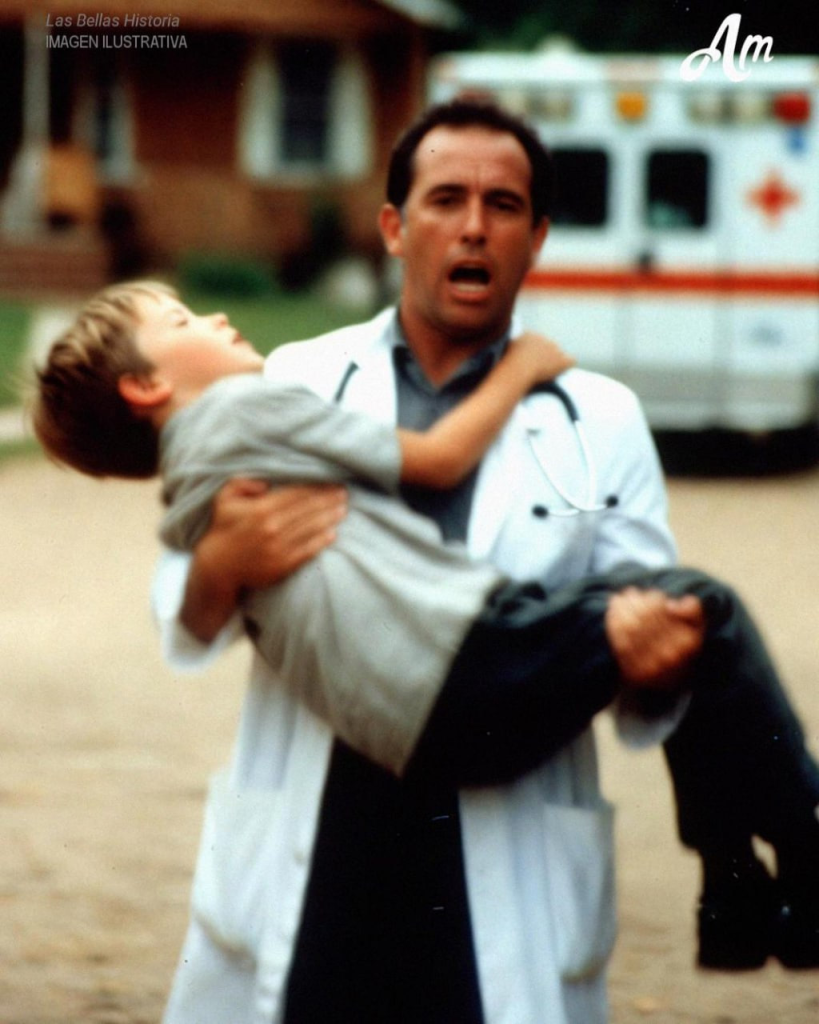
I thought I had everything under control: my job, my marriage, my children. But the night my wife fainted, and the morning I blocked an ambulance in traffic, I learned how blind I truly was. I didn’t know the child they were carrying was my own son.
My wife, Miranda, works from home as a freelance editor. I run a consulting firm, so my work is demanding, but I earn a good living.
We have three children: Luke, nine years old; Clara, seven; and little Max, five.
Until recently, I thought I had my life under control. I believed I was the stable one, the provider, the rock.
I was wrong.
I thought I had my life under control.
It all really started with the argument about the nanny.
One night, after another chaotic dinner, Miranda said, “Nathan, we need a nanny. I can’t handle work, the house, and the kids on my own.”
I laughed. “A nanny? Come on, Miranda. They’re expensive. It’s not worth it, honey.”
“Please, Nathan. I mean it,” she pleaded. “Even though they’re older, I can’t do it alone.”
It all really started with the argument about the nanny.
“No, not at all,” I replied firmly. “My mother raised me alone, juggling two jobs, and I turned out fine. You just have to be firmer with discipline after school. That’s all.”
Miranda let out a long sigh, but didn’t insist any further.
A few days later, the real warning shot came.
I was in a meeting when my phone buzzed with an incoming call from Luke.
A few days later, the real warning shot came.
I usually ignore their calls unless it’s about school, but the meeting was boring, so I left the conference room and answered on the second ring.
“Dad? Mom has fainted,” Luke’s little voice trembled. “She was standing in the living room and she fell. Should I call 911?”
My first instinct told me to take care of it myself.
“No, Luke! Don’t call 911,” I told him.
My first instinct told me to take care of it myself.
“I want you to call Mara, our neighbor. She’ll know what to do.”
Mara is a night shift nurse at the large downtown hospital.
By the time I wrecked my front door, Mara had everything under control.
“How are you, Mara? What happened?” I asked.
Mara stood up and moved away from Miranda. “She’s conscious now, but fainting like that isn’t normal. She needs to see a doctor.”
“You need to see a doctor.”
“No doctors,” I said, crossing my arms tightly against my chest. “I don’t trust them. My mother was misdiagnosed as a child, and doctors constantly dismissed her complaints about my abusive father. We’ll get some blood tests done at an independent lab, but that’s it.”
Mara frowned. “Nathan, she needs proper medical attention, not a blood test. You’re making a fool of yourself.”
“Maybe so, but that’s how things are,” I blurted out.
“No doctors! I don’t trust them.”
It turned out that Miranda had anemia.
She recovered quickly and soon brought up the subject of the nanny again.
“I need help, Nathan, so I can rest when I need to. It could have been much worse.”
I squeezed his hand. “You just need to manage your schedule better. We’ll survive.”
Why did I think surviving was the same as thriving? I can’t answer that, but I was about to receive a wake-up call that would change me forever.
I was about to receive a wake-up call that changed me forever.
I was already late for an important meeting with a client, and the traffic was a nightmare.
Then I heard the growing wail of the sirens.
I looked in the rearview mirror and saw an ambulance, its red lights flashing, zigzagging between the stuck cars behind me, desperate to find a way.
I froze. And then, I did the unthinkable.
I did the unthinkable.
I didn’t move.
I had just enough space to step away, but I didn’t. I was only thinking about my meeting, my ego, and the ten minutes I’d already wasted.
The ambulance couldn’t get through. It honked its horn repeatedly, but I didn’t move.
Finally, the ambulance driver, a silver-haired man, got out and walked straight to my window.
The ambulance driver got out and walked straight to my window.
“Move it! What are you doing? Move the car!” the driver shouted.
“I’m not moving. I’m already late for a very important meeting, I don’t need this either.”
His face went from urgency to surprise, and then to pure rage. “Sir, there’s a child inside this ambulance who needs urgent attention!”
I burst out laughing, a cynical and unpleasant laugh. I stared at him, and the bitterness and distrust I felt toward the world of medicine poured out of me.
The bitterness and distrust I felt towards the world of medicine came from me.
“Anyway, the doctors can’t help him, so what does it matter?”
The driver’s face paled, a mixture of disbelief and horror in his eyes. He returned to the ambulance and eventually drove onto the sidewalk to pass by my SUV.
I watched, irritated, thinking about my meeting, completely unaware that my son, Luke, was inside that ambulance.
Completely unaware that my son was inside that ambulance.
I had finally entered the conference room for my meeting when Miranda called.
I hung up and put my phone on silent. It kept vibrating in my pocket, but I ignored it.
Later I checked my phone and saw the text message.
“Luke is in the hospital. He’s had emergency surgery. Call me NOW.”
“Luke’s in the hospital! He’s had emergency surgery. Call me NOW!”
My blood ran cold.
I didn’t call. I ran out of the doctor’s office and drove to the hospital like a madman. Every red light was like a knife twisting in my chest.
When I arrived at the hospital, Miranda was sitting in a plastic chair, her face covered in tears. Clara and Max were clinging to her legs, their faces terrified and streaked with tears.
“What happened? Where is he?” I asked.
My blood ran cold.
Miranda gave me a look that chilled me to the bone.
“She’s in surgery. We don’t know yet if…” Her voice trembled. “She fell in the park and hit her head. She was bleeding a lot.”
I knelt down and gathered my family.
“Calm down, calm down, everything is going to be alright,” I whispered, even though inside a panic attack was rising in my throat.
I knelt down and gathered my family in a tight embrace.
I couldn’t control my life at all. I couldn’t even keep my son safe.
Hours later, the agonizing wait finally ended when the surgeon emerged, looking exhausted. He approached us with a serious expression.
We both got up from our seats.
Miranda grabbed my hand so tightly that I thought her fingers would break.
The surgeon approached with a serious expression.
“She’s stable,” the surgeon said. “The operation went well, and she’s now recovering in the ICU. They arrived just in time.”
“Just in time?” I repeated the words, stunned.
“Yes,” the doctor confirmed. “There was a nasty traffic jam on the main road that delayed the ambulance. If it had taken much longer, the outcome could have been different.”
“They’ve arrived just in time.”
The implication hit me like a wrecking ball: traffic jam on the main road. The ambulance. Me .
I had blocked the only vehicle that could save him because I was worried about a deal and distrusted the doctors.
I had almost killed my own son.
I let go of Miranda’s hand and stumbled backward, falling into the nearest plastic chair. Tears began to stream down my face, hot and humiliating.
I had almost killed my own son.
Miranda rushed to put her arms around me, and my two young children quickly joined in the embrace, but it did nothing to stop the agonizing guilt that gnawed at my heart.
Luke woke up an hour later.
He was dazed and drowsy. He was fine. The relief was a powerful and beautiful wave, but the guilt didn’t disappear.
That same afternoon, I asked the nurse on duty if I could speak to the ambulance driver who had brought Luke.
I asked if I could speak to the ambulance driver.
I had to face him. I had to apologize.
I had to see the man who, despite my stupid cruelty, had saved my son’s life.
A while later, he came into the waiting room. I stood up, shaking my head and running my hands over my face.
He gave me a cold look that seemed to pierce right through me.
“You!” he pointed his finger at me.
“You!” he pointed at me.
“Weren’t you the one who didn’t want to move your car?” he asked.
I nodded and started crying again.
“I am, and I’m so sorry. I was an idiot. A complete, heartless idiot.” I took a step toward him. “That child was my son. Thank you for saving him.”
I reached out to hug him. At first, his arms remained stiff at his sides, but then they slowly wrapped around me.
“Thank you for saving him.”
“I was just doing my job, sir,” he murmured into my shoulder. “I’m so glad you’re safe. I really am.”
I stepped away and dried my eyes.
That’s it. The arrogance is over. I’m done refusing to help.
“James,” I said, looking him in the eye, “I have an offer for you. I want to hire you. Right now. I’ll pay you what you’re earning now, plus a huge bonus. I need a personal driver. I need someone competent. I need someone who really knows what’s important in life.”
“I have an offer for you.”
He agreed, and during the following months, James, the former ambulance driver, became my confidant and the moral compass I desperately needed.
His wife, Helena, who had been struggling to find a good job, also came to work for us as a nanny, giving Miranda the extra help she needed.
I realized how foolish I’d been for so long. I’ve finally allowed good, strong, and selfless people to help me put the pieces back together.
I hope that after reading this, you will avoid the kinds of mistakes I made.
I hope that after reading this, you will avoid the kinds of mistakes I made.
What do you think will happen to these characters next? Share your opinion in the Facebook comments.

Leave a Reply