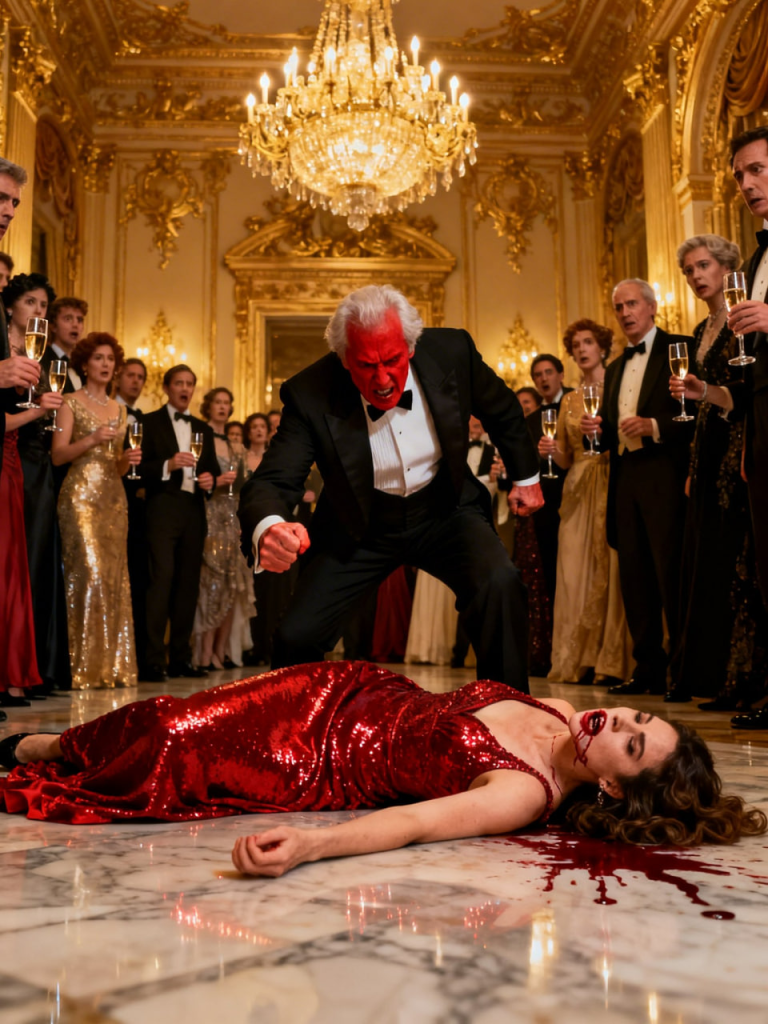
Have you ever watched your life split in half in a room full of people who suddenly pretend they don’t see?
The first half of mine ended under the chandeliers.
The second half began on the marble.
It was the kind of marble Boston likes to brag about—white, veined like money, polished until it reflected you back the way a good family portrait does: softened, expensive, and untrue. The museum’s grand hall smelled faintly of lilies and old stone, with that clean chill that makes you feel like you should whisper even when you’re just breathing. Everywhere I looked there were familiar names: stitched into handbags, embroidered on lapels, printed on the program in tasteful serif fonts.
The Harradens. The Winslows. The Pike-Sinclair Foundation.
My family.
Our foundation’s annual winter gala was a hymn Boston’s elite sang to themselves—proof they were generous, proof they were civilized, proof they could take a city built on grit and turn it into a jeweled box they kept locked. If you were inside the box, you smiled. If you weren’t, you served the champagne.
I’d spent my whole life learning the smile.
My mother had chosen my dress. Of course she had. She said it wasn’t choosing; it was “curating.” A black silk column that made me look like a statement instead of a person. A single diamond at my throat, not because I liked it, but because my mother liked the way it caught the light when I turned my head at the right angle.
“Not too warm,” she’d said while fastening it, her fingers cool and efficient. “Warmth reads as need.”
Need was the only thing we weren’t allowed to show.
My father had barely glanced at me before we left Beacon Hill, his attention caught in the gravity of his own reflection. He wore his tuxedo like a uniform and his reputation like armor. On the drive to the museum, he’d talked about donors, board members, which judge’s wife had been drinking again, which senator would want a photo, which reporter had been sniffing around the foundation’s finances as if the numbers were a crime scene.
The reporter’s name was Trent Halloway, and I’d seen his email subject lines on my father’s iPad by accident—innocent questions wrapped in sharp politeness. Requests for comment. Requests for documents. Requests for the kind of truth rich people called “misunderstandings” until they became indictments.
“You’ll be on the dais tonight,” my father said, adjusting his cufflinks. “You’ll say three lines. You will not freelance. You will not be clever.”
“I’m not trying to be clever,” I said.
He turned his head slowly, like a man granting an audience. “Nora. Your job is to be proof. That’s all.”
Proof of what?
That they’d raised me right. That the foundation was clean. That the Pike-Sinclair name was still sacred even after a decade of whispers about backroom deals, zoning favors, and money that moved like it had legs.
I stared out the window at the Common, the bare trees black against the winter sky. I’d once loved Boston the way you love a parent when you’re still young enough to believe they’re the whole world. Now the city felt like a stage set—brick facades and history plaques hiding the wires.
When we arrived, the museum’s entrance glowed with camera flashes. Valets in black coats opened doors like they were unwrapping gifts. Inside, the hall was already filled with music, laughter that sounded like glass clinking, and the soft, synchronized hum of people pretending not to be hungry.
Hungry for money, for power, for each other.
My mother slid her hand through my arm with perfect pressure. Not too tight—nothing that could be called controlling. Just firm enough to remind me that every step I took was part of her choreography.
“Remember,” she murmured as we moved through the crowd, “tonight is about stability.”
That word, stability, was what Boston’s old families used when they meant obedience.
We stopped at tables like planets caught in orbit—people drawn to my father’s gravity, my mother’s polish, the foundation’s money. I nodded at compliments, laughed at jokes that weren’t funny, accepted kisses on my cheek from women who smelled like expensive roses and quiet contempt.
Then I saw Trent Halloway across the room.
He didn’t look like the others. Not because he was poorly dressed—his suit was tailored, his tie understated—but because he stood like he expected the room to notice him and hated himself a little for it. He held a notebook instead of a flute of champagne. His eyes weren’t hunting status; they were hunting cracks.
And he was walking toward us.
My father’s smile locked into place so fast it might as well have been welded.
“Mr. Halloway,” my father said, as if saying the name out loud made it harmless. “Enjoying the evening?”
“Very much,” Trent replied. His gaze flicked to me, then back to my father. “Beautiful event.”
“Thank you.”
Trent’s smile was polite enough to pass through security. “I’m working on a piece about nonprofit transparency. The Pike-Sinclair Foundation is one of the largest in Massachusetts, so—”
My father’s eyes sharpened. “I’ve already told you we’ll respond through our counsel.”
“Of course,” Trent said. “I just wanted to confirm one detail for the record. The foundation’s property acquisitions on the waterfront—specifically the Seaport parcels purchased through Westward Holdings—those were funded with restricted donor funds, correct?”
The air around us seemed to thin. The music continued, but suddenly it sounded far away, like the whole hall had been submerged.
My father didn’t blink. “You’re misunderstanding how our investments—”
“I have documents,” Trent said. Still polite. Still calm. “And I have a donor who’s very concerned about their money being used to buy property that later appears connected to political contributions.”
That word—political—was a match near gasoline.
My mother’s nails pressed lightly into my arm. A warning, disguised as affection.
My father’s gaze flicked to me for half a second, as if checking whether I might betray him just by breathing wrong.
And then my mother leaned close, lips near my ear, her perfume wrapping around the words like silk around a blade.
Five words, soft as a lullaby:
“Smile, darling. Bleed for us.”
I felt my body go cold in a way that had nothing to do with winter.
The meaning arrived all at once, brutal and clear: this was not a misunderstanding to fix. This was a fire to feed. And I was the kindling.
My father turned back to Trent, and the smile on his face didn’t change, but his eyes did. They went hard, flat, like a door slamming shut.
“My daughter handles communications for the foundation,” he said. “Nora will follow up with you.”
I opened my mouth—instinct, maybe, or the last stubborn piece of me that still believed I could be treated like a human being.
“I—”
My father’s hand landed on my upper arm, not as a touch, but as a grip. His fingers dug in. “Nora,” he said, quiet.
The room pressed closer. People were watching without watching, leaning in behind their laughter.
Trent’s eyes narrowed slightly, catching the tension like a camera catching a shadow.
“I’d appreciate a timeline,” Trent said.
That’s when I made the mistake of turning my head toward my mother, searching her face for a sign that she hadn’t meant it.
Her expression was serene. Almost bored.
That serenity broke something inside me.
“Why are you doing this?” I asked her, my voice low but shaking. “You told me to handle the press. You told me—”
My father’s grip tightened. “Stop,” he hissed.
But the words had already spilled into the space between us, and I saw it then: the fear behind his eyes, the calculation, the fact that he wasn’t afraid of Trent.
He was afraid of me.
Because I knew things. Because I’d signed off on statements. Because I’d been told what to say and what not to ask.
Because if the foundation fell, someone needed to be underneath it when it crashed.
Trent shifted his weight. “Ms. Pike-Sinclair, are you alright?”
I should’ve said yes. I should’ve laughed. I should’ve told him I’d email.
Instead, I looked at my father and said, “What did you buy with it?”
It was a simple question. It wasn’t even an accusation.
But it hit him like a slap.
His hand moved.
Not to cover my mouth. Not to pull me close. Not to guide me away.
He shoved.
It happened fast, and yet I remember details like my brain was desperate to catalog the betrayal: the sudden release of his fingers and then the push, the jolt through my shoulder, the way my heel slipped on the polished floor as my body pitched backward. The world tipped—chandeliers streaking into light, faces blurring into masks.
Then the marble rose up to meet me.
My cheek hit first.
The sound wasn’t dramatic. It was just… final. Like a book closing.
Pain flared hot and immediate, and I tasted blood—metallic, intimate. Somewhere in the room a woman made a small gasp that she immediately swallowed. Someone laughed too loudly at a joke that hadn’t been told. The music kept going.
The marble was cold against my skin, and for one suspended moment I stared at the ceiling and wondered if this was what my life had always been building toward: a quiet, public violence no one would acknowledge.
My father stood above me, his face arranged into concern.
“My God,” he said, loud enough for people to hear. “Nora—are you alright? She slipped.”
My mother’s hand hovered at her throat like a painting of sympathy.
Trent stepped forward, instinct overcoming etiquette. “She didn’t slip.”
My father’s smile sharpened. “Watch your tone.”
My cheek pulsed. My lip was split. I could feel warm blood tracking down toward my jawline. My vision tunneled for a second, and in that tunnel I saw the truth with an ugly clarity:
They would hurt me in public because they knew no one would stop them.
Because everyone here had seen something like this before, in one form or another, and learned the same lesson: don’t interfere with power.
I pushed myself up on my palms, ignoring the sting in my face, ignoring the way my dress pulled at my knees.
And then I did what my mother had told me to do.
I smiled.
It was not a sweet smile. It was not polite.
It was the kind of smile you give right before you set a match.
“I’m fine,” I said, voice thick with blood. I looked at Trent. “I slipped.”
My father exhaled, relieved. His hand extended as if to help me up, to complete the performance.
I stared at his hand for a beat, then took it.
His grip was firm, proprietary, a reminder that he believed he still owned me.
I let him believe it.
As he pulled me to my feet, my mother leaned in, her breath brushing my ear again, her voice soft enough to be mistaken for comfort.
“Good girl,” she whispered.
I met her eyes, and in that moment I decided something that felt like stepping off a cliff:
I would be their good girl.
I would be perfect.
And I would ruin them.
The bathroom was a marble echo chamber of other women’s perfume. I locked myself in a stall, pressed toilet paper to my lip, and tried not to shake.
When I came out, my reflection looked like a stranger—cheek reddening, blood smeared near my mouth, eyes too bright. A woman at the mirror glanced at me and then away, as if my injury might infect her.
I washed my hands until the water ran pink and then clear. I reapplied lipstick over the split, careful, methodical.
Stability, I thought. Warmth reads as need.
I walked back into the gala as if nothing had happened.
My parents were already surrounded by people again, their concern fading into charm. Trent was gone—either pulled away by a handler or smart enough to retreat.
My father caught my eye and gave me a look that was almost affectionate, like a man congratulating a well-trained dog.
There was a moment, a flicker, when my younger self might’ve craved that approval.
Instead, I cataloged it.
That look would be useful later.
I made it through the rest of the night on muscle memory. Smiling. Nodding. Pretending my face wasn’t throbbing. Delivering my three lines on the dais exactly as my father wanted, my voice steady even as my heartbeat hammered in my skull.
Then, after the applause and the auction and the last round of staged generosity, my parents ushered me into the car without asking if I needed ice.
The silence on the drive home was thick.
When we reached the townhouse, my father finally spoke, his voice calm in the way calm people are right before they do something cruel.
“What were you thinking?” he asked.
My mother removed her earrings, placing them in their velvet box like she was putting away weapons. “Not now,” she said without looking at me. “She’ll make it about herself.”
My father’s gaze snapped to her. “It was already about her.”
I sat in the entryway under the portrait of my great-grandfather—stern, white-haired, painted as if morality could be inherited. The chandelier above us cast light like judgment.
“I asked a question,” I said.
“You challenged me,” my father replied. “In public.”
“I didn’t mean to—”
“Meaning doesn’t matter,” my mother said, finally looking at me. Her eyes were pale and flat. “Perception matters.”
My lip pulsed again, and I tasted the memory of blood. “You told me to bleed.”
A beat of silence.
Then my mother smiled. Not warmly. Not kindly.
“Did you?” she asked.
My stomach turned. “Why would you—”
“Because you need to learn,” she said, as if explaining table manners. “You’ve been allowed too much… imagination lately.”
My father stepped closer. “You are not a normal girl who gets to have opinions and tantrums. You are the face of this family. Of this foundation.”
“And if the foundation is dirty?” I asked.
The air changed.
My father’s eyes narrowed. “What did you see?”
I blinked. “What?”
“You’ve been in the office more,” he said. “You’ve been asking questions about accounts. About vendors. Who have you talked to?”
I realized then that they weren’t just angry.
They were afraid.
And that fear tasted like power in my mouth.
“I haven’t talked to anyone,” I lied smoothly.
My mother’s gaze was a scalpel. “You will not make us regret bringing you into this family.”
There it was. The sentence that always hovered at the edge of our life, finally spoken out loud.
Bringing you into this family.
Not born into. Not raised in.
Brought.
My chest tightened. “What does that mean?”
My father’s jaw flexed. “Don’t play games.”
“I’m not—”
My mother’s voice sharpened. “Enough. Go upstairs. Clean yourself up. And tomorrow you will call that reporter and you will tell him whatever our attorney instructs. You will not deviate. You will not moralize.”
I stood slowly, my cheek aching.
My father watched me like I was a threat wearing silk.
As I reached the stairs, he added, almost casually, “And Nora? If you ever put me in that position again—if you ever force me to correct you in public—next time I won’t be gentle.”
The word gentle made my skin crawl.
In my bedroom, I locked the door and stood in the dark, listening to the house settle, listening to my heart thud against my ribs like it wanted out.
Then I did something I hadn’t done in years.
I cried.
Not loudly. Not dramatically.
Silently, with my hand over my mouth, because even alone I’d been trained not to make noise.
When the tears stopped, what was left wasn’t softness.
It was clarity.
I went to my desk, opened my laptop, and logged into the foundation’s server the way I always did, using credentials my father had insisted I keep “for emergencies.” I’d never questioned it. It had felt like trust.
Now I understood.
It wasn’t trust.
It was proximity. A leash long enough to make me feel free, tight enough to yank when needed.
I didn’t start with the big accounts. That would’ve been obvious. I started with the kind of details people overlook: reimbursement forms, vendor payments, small transfers that didn’t quite match their descriptions. I searched Westward Holdings. I searched Seaport parcels. I searched the names I’d heard in half-finished conversations.
A web began to appear, delicate and ugly. Restricted donor funds moved through shell companies like water through pipes. Consulting fees paid to people who didn’t exist. Political contributions disguised as “community outreach.” Property purchased, then sold, then purchased again, each time at a price that didn’t make sense unless the point wasn’t property.
Unless the point was washing.
My throat tightened as the pieces aligned.
This wasn’t sloppy. This was engineered.
And I was sitting at the center of it, the smiling daughter, the communications director who’d signed statements declaring transparency, the convenient scapegoat if anything ever came to light.
My mother’s five words echoed again:
Smile, darling. Bleed for us.
They weren’t asking.
They were telling me my role.
Fine, I thought.
I’ll play it.
But I’ll change the ending.
The next morning, I went to the office with an ice pack under my makeup and a smile sharp enough to cut glass.
People glanced at my bruised cheek and immediately looked away, as if acknowledging it would require questions they didn’t want answered. The receptionist offered me a sympathetic look that she disguised as a cough.
I walked into my glass-walled office and closed the door.
Then I called the one person I trusted outside this world.
His name was Mateo Sullivan, and he’d grown up three streets over from the apartment building I’d been born in—before I was “brought” into Beacon Hill. He was a public defender now, all stubborn ethics and tired eyes, the kind of man my parents dismissed as “wasted potential.”
We’d met again by accident two years ago at a coffee shop near Government Center. Recognition had hit like a punch—his face older, mine sculpted by wealth, but something in his gaze still the same: a refusal to be impressed.
We’d kept in touch quietly, in stolen pockets of time that felt like oxygen.
When he answered, his voice was immediate concern. “Nora? What’s wrong?”
“I need you to listen,” I said. “And I need you not to interrupt until I’m done.”
Silence. Then, “Okay.”
I told him about the gala. About my father’s shove. About my mother’s words. About the accounts.
When I finished, my voice sounded strange to my own ears—too calm, too controlled.
Mateo exhaled slowly. “Jesus.”
“I’m not imagining it,” I said.
“I know,” he replied. “You wouldn’t call me if you were.”
I swallowed. “If this breaks, they’ll bury me under it.”
“They’ll try,” he said. “But you’re not alone.”
Those four words did something to my chest that hurt more than my bruised cheek.
Mateo continued, “You need to document everything. Quietly. And you need someone on the outside.”
“I know.”
“And Nora?” His voice gentled. “If he put his hands on you—”
“I’m fine,” I said automatically.
“No,” he said. “You’re not. But fine isn’t the goal right now. Survival is.”
Survival.
I stared at the glass wall of my office, at the hallway beyond where people moved like ants inside a beautiful colony.
“I’m going to set a trap,” I said.
Mateo was quiet for a beat. “What kind of trap?”
“The kind they won’t see,” I said. “Because they think I’m still theirs.”
I hung up and started building.
The first part was boring, which is how real traps always are. I copied files. I exported emails. I took screenshots of ledger entries. I created encrypted backups and sent them to a secure drive Mateo set up for me under a name that wasn’t mine.
I learned which transfers happened on Fridays when the accountants left early. Which shell companies shared mailing addresses. Which board members asked questions and which ones looked away.
I also learned something else.
There was a file labeled ORIGIN.
It wasn’t on the foundation server. It was on the family server, buried under legal documents and estate plans. I only found it because my father used the same lazy password pattern for everything—control disguised as simplicity.
My hands shook as I opened it.
Adoption paperwork. Hospital records. A birth certificate with a mother’s name I didn’t recognize: Elena Marquez.
Cause of relinquishment: deceased.
Deceased.
I stared at the word until it blurred.
I searched her name through internal documents. Nothing.
So I searched the old way: the city records portal, newspaper archives, anything I could reach without alerting my parents.
And there she was, small and brutal in a three-paragraph article from twenty-seven years ago:
A fire in Dorchester. A young woman dead. A building owned by a development company later acquired by—my father’s business.
My stomach dropped so hard I thought I might vomit.
I sat back in my chair, breathing shallowly.
They hadn’t just brought me into the family.
They had taken me out of somewhere.
And the price had been a woman’s life.
By the time my father called me into his office that afternoon, I was already a different person.
He didn’t ask about my face. He didn’t apologize. He didn’t even pretend.
He gestured for me to sit, then slid a piece of paper across the desk.
A statement. Prepared by counsel. Cold, clean language denying any misuse of funds, asserting “ongoing commitment to transparency,” dismissing Trent Halloway’s inquiry as “sensationalism.”
“You’ll send this to Halloway,” my father said. “Then you’ll schedule a friendly interview with someone we can control. We’ll drown his story in our story.”
“And if he has documents?” I asked, carefully.
My father’s eyes hardened. “Documents can be discredited.”
“And if he has sources?”
“Sources can be bought.”
“And if he can’t be bought?”
My father leaned forward slightly. “Then you’ll make him look like a liar.”
I nodded, obedient.
Inside, something quiet and vicious smiled.
“I understand,” I said.
My father relaxed a fraction. “Good. I knew you’d come back to yourself.”
Back to yourself.
As if the self I’d been forming—curious, angry, human—was an illness.
I took the statement, left the office, and instead of emailing Trent, I walked down two floors to the foundation’s legal wing.
There, behind a frosted glass door, sat Marjorie Vale, the foundation’s compliance officer. She was older, sharp-eyed, the kind of woman my parents tolerated because she made things run smoothly. She didn’t attend galas. She didn’t flirt with donors. She knew the law like scripture.
I knocked.
She glanced up, her eyes catching my bruised cheek. Something flickered there—recognition, maybe, or suspicion.
“Ms. Pike-Sinclair,” she said. “What can I do for you?”
I closed the door behind me and set the statement on her desk.
“I need to ask you a question,” I said. “Off the record.”
Marjorie’s gaze moved from my face to the paper. “There is no off the record in compliance.”
“Then on the record,” I said. “If restricted donor funds are used to purchase property through a shell company, what happens?”
Marjorie’s expression went very still. “Why are you asking me that?”
“Because I think it’s happening,” I said. “And I think I’m being positioned as the fall.”
The words tasted like acid.
Marjorie studied me for a long beat. Then she stood, locked her door, and lowered her voice.
“Who else have you spoken to?” she asked.
“No one,” I said. “Yet.”
Marjorie’s jaw tightened. “Do you have proof?”
“Yes,” I said. “And I can get more.”
“Do you understand what you’re saying?” she murmured. “If this is true, it’s not a PR issue. It’s criminal.”
“I understand,” I said. “That’s why I’m here.”
Marjorie’s eyes narrowed. “Why now?”
Because I finally bled in public, I thought.
“Because I’m done,” I said simply.
Marjorie exhaled slowly, then reached for her phone.
“I’m going to make a call,” she said. “But hear me clearly: once this starts, you cannot control where it ends.”
I met her gaze. “That’s the point.”
The trap took shape over the next two weeks, and it was both simpler and uglier than I expected.
My parents moved like predators who believed the room belonged to them. They kept hosting dinners, attending fundraisers, shaking hands. They acted as if the shove had never happened, as if my bruised cheek was a minor inconvenience.
My mother even kissed me on the forehead one morning, her lips barely touching my skin.
“You’re handling this beautifully,” she murmured.
I smiled back. “I learned from you.”
I watched something like satisfaction bloom in her eyes.
They didn’t know that every email they sent was being copied.
They didn’t know that Marjorie Vale was quietly flagging transactions.
They didn’t know that Mateo had connected me with a federal investigator who’d been circling nonprofit fraud cases for years, hungry for an entry point into Boston’s untouchable class.
They didn’t know that Trent Halloway—after receiving my carefully worded anonymous tip—had stopped chasing me and started chasing them.
And they definitely didn’t know about Elena Marquez.
That part was mine.
I spent nights digging through records, tracking the building fire, tracing ownership changes, searching for court filings, insurance claims, anything that might connect my father to the death on paper. There were gaps—of course there were gaps. Wealth doesn’t erase crimes; it simply edits the story.
But people had memories. A retired firefighter who remembered the smell of accelerant. A neighbor who remembered a black town car parked across the street that night. A former employee of my father’s development company who remembered being told to shred files.
Each conversation was a nail.
I didn’t hammer them in yet.
I saved them.
Then came the invitation.
The foundation was hosting a private dinner at the Boston Public Library, in one of the ornate rooms they reserved for donors who wrote six-figure checks and wanted to feel like patrons of history. My father was thrilled. A senator was attending. A judge. Two developers. A man from an investment firm who smiled like a shark.
My parents wanted me there—visible, poised, proof of stability.
I wanted them all in one room.
Before the dinner, my father pulled me aside.
“You’ve been very… cooperative,” he said, as if cooperation were a currency.
“I understand what’s at stake,” I replied.
He nodded, pleased. “Good. Tonight you’ll give a short toast. Something personal. People love you. Use that.”
People love the idea of me, I thought.
My mother adjusted my necklace. “Remember,” she whispered, her breath sweet with mint. “Warmth reads as need.”
I looked at her and thought of Elena Marquez, a young woman dying in a fire while my mother—probably in a clean kitchen somewhere—chose china patterns.
“Yes,” I said softly. “No warmth.”
The dinner began like all their dinners did: velvet voices, crystal glasses, laughter that never went too high. Everyone performed, including me.
When my father stood to introduce me for the toast, his hand settled on my shoulder in a gesture meant to signal affection.
It also signaled ownership.
I rose, lifting my glass.
The room quieted.
I could feel the weight of their eyes—expectation, curiosity, the faint thrill of watching a young woman play her role.
I smiled. The same smile I’d worn on the marble.
“Thank you all for being here,” I began. “My parents taught me something very early: that a name is a promise.”
My father’s expression softened, proud.
“And that promises require sacrifice,” I continued.
A few chuckles. Agreement. People loved a moral.
I looked at the senator, at the judge, at the donors. Then back at my parents.
“And sometimes,” I said, voice smooth, “the sacrifice is a person.”
The air shifted slightly, like a draft through an old building.
My father’s hand tightened on my shoulder.
I kept smiling.
“I used to think that was noble,” I went on. “That it was leadership. But lately I’ve learned something else.”
My mother’s eyes sharpened.
“Lately,” I said, “I’ve learned that sacrifice is often just another word for theft.”
Silence, now. Real silence.
I set my glass down carefully. My heart thudded, but my voice stayed steady because I’d practiced this moment in my head until it felt inevitable.
“I’d like to thank my parents for teaching me how to smile,” I said. “Even when it hurts.”
My father’s voice cut in, low and dangerous. “Nora.”
I turned slightly, meeting his eyes.
And I did the warmest thing I’d ever done in that room:
I told the truth.
“At our gala two weeks ago,” I said, loud enough for everyone to hear, “my father shoved me to the floor.”
A collective inhale, like the room had been punched.
My mother’s face went still, porcelain cracking from the inside.
“That’s not—” my father started, his voice tight.
I touched my cheek lightly, as if reminding the room where the bruise had been.
“On marble,” I said. “In front of all of you.”
People stared. Some looked down. Some looked horrified. One woman’s mouth opened and closed like she wanted to say something and didn’t know how without risking her seat at the table.
My father’s hand left my shoulder, hovering as if he might grab me again.
He didn’t.
Because now the room was watching.
Trent Halloway stood near the back, notebook in hand, eyes bright as a knife.
I continued, voice soft, deadly. “Afterwards, my mother whispered to me: ‘Smile, darling. Bleed for us.’”
A murmur rippled through the donors like wind through dry leaves.
My father’s face flushed. “This is not the time—”
“Oh, it is,” I said.
Then I reached into my clutch and pulled out a small remote.
I clicked.
The screens in the room—meant to display the foundation’s glossy slideshow of charity work—flickered.
And then the numbers appeared.
Transfers. Dates. Shell companies. Restricted funds. Properties. A neat, ugly map of corruption.
Marjorie Vale had done her work well.
A gasp. Someone whispered “Jesus.”
My father took a step forward, but two men in plain suits appeared at the doorway, moving with the calm efficiency of people who didn’t need to bluff.
The investigator Mateo had introduced me to stood with them, badge visible.
“Arthur Pike-Sinclair,” he said, voice clear. “We need to speak with you.”
My mother’s hand flew to her throat. “This is outrageous—”
The investigator didn’t look at her yet. “Evelyn Pike-Sinclair. You as well.”
The senator stood abruptly, chair scraping. “What the hell is this?”
Trent’s pen moved fast.
My father’s eyes found mine, wide with disbelief.
He’d always thought the trap would be for me.
He’d never considered I could build one for him.
“You,” he said, voice shaking with rage and something else—fear. “You did this.”
I stepped closer, lowering my voice so only he and my mother could hear, still smiling for the room.
“I learned from the best,” I murmured. “You taught me how to curate reality.”
My mother’s eyes burned. “You ungrateful—”
I leaned in, sweet as venom. “Tell me,” I whispered, “did Elena Marquez bleed quietly too?”
My mother’s face went white.
My father froze.
In that frozen second, I saw it: the recognition. The buried memory. The knowledge that I wasn’t just exposing fraud—I was reaching for the deeper rot.
Trent must’ve noticed the change in their faces, because his gaze sharpened like he’d just smelled a second story.
The investigator turned slightly. “Ms. Pike-Sinclair,” he said to me, “are you safe?”
Safe.
The word didn’t mean what it used to. It didn’t mean protected. It meant free.
“Yes,” I said. “I am now.”
My father’s voice cracked. “Nora—please. We can fix this.”
Fix this.
Like my bruised cheek had been a wrinkle in fabric.
I looked at him, really looked, and felt something I didn’t expect.
Not hatred.
Not even anger.
Just a clean, cold detachment.
“You shouldn’t have pushed me,” I said quietly.
His mouth opened.
No sound came out.
My mother’s voice, sharp with panic, tried to regain control. “She’s unstable. She’s emotional. She fell—”
I turned to the room, lifting my chin.
“I didn’t fall,” I said.
And because the room needed permission to believe what it had seen, I gave it.
“My father shoved me,” I repeated, louder. “And my mother told me to bleed.”
The donors’ faces shifted, morality waking up now that it had witnesses.
The judge’s wife stood, eyes wide. “Arthur—how could you—”
The senator backed away like corruption was contagious.
The investigator stepped forward. “We’re leaving,” he said to my parents. Not asking.
My father’s hands curled into fists. “You can’t do this,” he hissed at me. “You think you’ve won? You think anyone will stand by you after you’ve done this to your own family?”
I smiled again, but this time it wasn’t for them.
It was for me.
“I’m not your family,” I said. “I’m your evidence.”
My parents were escorted out through a side door, their scandal bundled neatly by men who didn’t care about their name.
The room erupted into whispers, phones appearing like weapons, alliances shifting in real time. People who’d ignored my bruised cheek now looked at me with a new kind of attention—fearful, fascinated, calculating.
Trent approached slowly, as if I might disappear.
“Ms. Pike-Sinclair,” he said, voice low. “Nora. Can we talk?”
I studied him. He wasn’t kind, exactly. He was hungry.
But hunger could be useful.
“You can write whatever story you want,” I said. “Just don’t call it a tragedy.”
His brows lifted. “What would you call it?”
I thought of marble. Of blood. Of my mother’s five words.
“A correction,” I said.
He nodded once, then glanced toward the door my parents had been taken through. “And the fire?” he asked softly, like he wasn’t sure he should.
My breath caught.
So he had noticed.
I met his gaze. “That story isn’t finished,” I said.
Outside, Boston’s winter air hit my face like a slap, cold and clean. Snow dusted the steps of the library. The city lights shimmered on wet pavement, and for the first time in my life, the world didn’t feel like a curated room I had to perform inside.
Mateo stood across the street near a lamppost, hands in his coat pockets. When he saw me, relief softened his features.
I walked toward him, my heels clicking on stone like punctuation.
He searched my face. “You okay?”
I touched my lip, now healed enough that it didn’t sting. “I will be.”
He nodded, then hesitated. “What happens now?”
I looked back at the library, at the glowing windows full of people rearranging their loyalties, at the city that had watched me bleed and only cared once it was inconvenient.
“Now,” I said, “I tell the rest.”
Because I wasn’t just a daughter who had been shoved.
I was a woman who had been taken.
And somewhere beneath Boston’s polished marble, a dead girl’s name waited like a match.
I exhaled, and the breath came out white in the cold.
“Let’s go,” I told Mateo.
He fell into step beside me, not leading, not pulling—just walking with me like I was allowed to choose my own direction.
And behind us, in the warm rooms where Boston’s elite pretended they’d always been righteous, the trap finished closing.

Leave a Reply