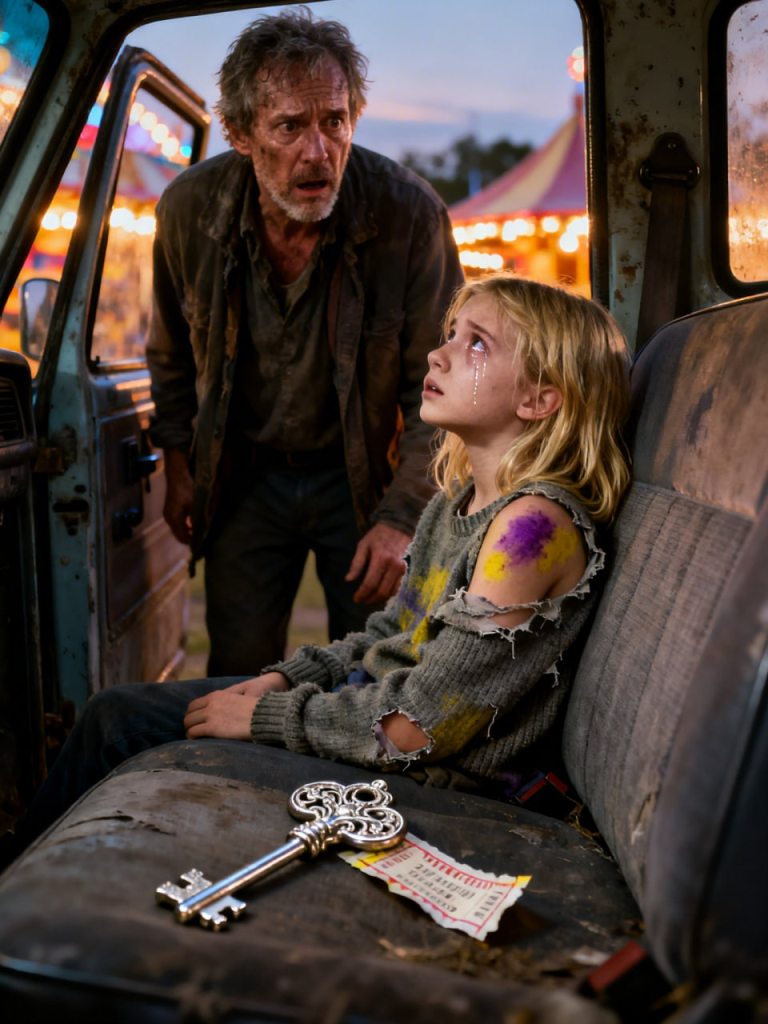
The fall carnival at Maplewood Elementary always looked the same from the outside: strings of orange lights tangled in the trees, the tinny soundtrack of a rented speaker playing songs nobody actually listened to, the smell of buttered popcorn and wet leaves. It was the kind of community tradition you didn’t question, the kind you brought your kid to because it was what decent parents did on decent Tuesday evenings in October.
I was standing by the ring toss booth with a paper cup of cider warming my hands, pretending I wasn’t exhausted, pretending I wasn’t counting the days until my next paycheck cleared. A few feet away, my daughter Lily moved through the crowd like a shadow trying to be polite. She was eight, small for her age, with hair that never stayed in its ponytail and eyes that were too observant for a child who still slept with a stuffed fox.
She didn’t run toward the inflatable slide like the other kids.
She didn’t beg for cotton candy.
She didn’t laugh when the clown—some teenager in a rented wig—tripped over his own oversized shoes and fell into a pile of foam blocks.
She stood close to me, fingers curled into the cuff of my jacket, scanning faces like she was memorizing exits.
I’d noticed it more and more lately—this quiet tension in her. Not tantrum tension, not “I’m mad I can’t have another toy” tension. Something older. Something like she was bracing for impact.
“You want to try the duck pond?” I asked, lifting my cup toward the booth with the floating plastic ducks. “You can win one of those little glow bracelets.”
Lily nodded too quickly, the way kids do when they’re trying to make you happy instead of answering honestly.
We walked toward the booth. The volunteer—a mom I recognized vaguely from the PTA emails—smiled at Lily. “Pick a duck, sweetie!”
Lily reached into the water and pulled out a duck without looking. Her hand shook. She handed it to the volunteer, who read the number and offered a prize.
“A vampire eraser, or a spider ring.”
Lily glanced at both like they were explosive devices.
“The eraser,” she whispered.
I tried to laugh like this was normal. “Good choice. Practical.”
She tucked the eraser into her pocket like she was hiding it.
It was stupid, but it tugged something in my chest. Lily used to love little silly prizes. She used to hold them up like trophies. Now she treated them like evidence.
“Hey,” I said, bending closer, keeping my voice light. “You okay? You’re being kind of quiet tonight.”
She blinked up at me, and I saw the moment she almost told me something.
Then she swallowed it.
“I’m fine,” she said.
It wasn’t the words that alarmed me.
It was the way she said them like she’d practiced.
The rest of the carnival blurred into a string of small moments that didn’t add up: Lily flinching when a teacher called her name too loudly; Lily refusing to climb into the bounce house; Lily watching the adults more than the games.
When the sky darkened and the temperature dropped, the crowd shifted closer together. Parents started saying goodbye, kids started whining for one last treat, and the lights began to look harsh against the deepening evening.
That’s when Lily tugged my jacket again.
Harder this time.
“Dad,” she whispered.
I looked down. Her face was pale, her lips pressed together like she was holding her breath.
“Yeah, bug?”
Her eyes flicked past me toward the main walkway where families were funneling out. “Can we just go home? Please?”
Something cold slid down my spine.
“Sure,” I said immediately. “Of course. We can go.”
Relief hit her so fast it looked like pain leaving. She didn’t argue. She didn’t ask why we couldn’t stay for the raffle. She didn’t hesitate.
She just grabbed my hand and started pulling.
I kept my pace calm, because I didn’t want to spook her, but my mind started sprinting. Kids get tired. Kids get overwhelmed. Maybe the noise was too much. Maybe she’d had a rough day.
But Lily wasn’t just tired.
She was afraid.
We walked through the parking lot toward my truck. The wind pushed at the carnival music behind us like it was trying to follow. Lily climbed into the passenger seat without her usual chatter. She stared straight ahead, hands in her lap, knuckles white.
I opened my door, tossed my keys into the cup holder, and shut the door. The sound was loud in the quiet of the lot.
“Lily,” I said softly, “talk to me.”
Her shoulders rose, then fell. “Can we just go?”
“We will,” I promised. “But… did something happen tonight? Did someone say something to you?”
Her eyes stayed on the windshield. “No.”
I waited. The windshield wipers clicked on automatically even though it wasn’t raining, scraping dust like nervous fingers.
Then Lily turned her head a fraction and said, “Dad… if I show you something, you can’t get mad. Okay?”
My throat tightened. “I’m not mad at you. Never at you.”
She nodded as if she didn’t fully believe me.
Then she reached down, grabbed the hem of her sweater, and lifted it.
For a second my brain refused to process what I was seeing—like it was an optical illusion, like the shadows from the dashboard lights were playing tricks.
Then the blood drained out of my face.
Bruises.
Dark purple bruises, clustered across her ribs and spreading toward her hip like storm clouds. Some were older, yellowing at the edges. Some were fresh, bruised so deep they looked almost black.
I couldn’t breathe.
The world narrowed to Lily’s small body and those violent marks.
My hands went numb on the steering wheel.
“How,” I whispered, but it came out like air leaking from a tire. “Lily—how did this happen?”
She dropped the sweater fast, like she’d shown me something forbidden. Her voice came out thin.
“I fell.”
The lie was immediate. Automatic. Too clean.
I stared at her. “Lily.”
Her eyes filled with tears. She pressed her hands against her stomach like she was trying to hold herself together.
“Dad, please,” she said, the words spilling out like she couldn’t stop them. “Please don’t… please don’t make it worse.”
I felt something in me shift. A hard, dangerous clarity.
“Who did this,” I said, very quietly.
Lily shook her head. Tears slid down her cheeks. “It’s not—”
“Lily.” I forced my voice to stay steady. “Look at me.”
She looked, and the fear in her eyes wasn’t fear of getting in trouble.
It was fear of consequences.
Fear of retaliation.
Fear of the thing adults call “what happens after.”
“Sweetheart,” I said, “I need you to tell me the truth. I can handle it. I promise.”
Her lips trembled. “You can’t.”
I reached across the center console, not touching her bruises, just taking her hand. It was cold.
“Try me.”
For a moment she resisted.
Then she whispered a name that changed everything.
“Marla.”
My ex-wife.
The woman who used to laugh too loudly at restaurants and call Lily “my little miracle.” The woman who had smiled in court and told the judge she’d “support Lily’s relationship with her father.”
Marla.
My stomach twisted hard enough to hurt.
“No,” I said, and I hated how desperate I sounded. “No, Marla wouldn’t—”
Lily flinched at the way I said her mother’s name.
“She didn’t mean to,” Lily rushed out. “She just… she just gets mad. And then Todd says I’m being dramatic and—”
Todd.
Marla’s boyfriend. The one she’d moved in after “just a few months.” The one who wore polite smiles and used words like “structure” and “discipline.” The one who’d shaken my hand at a custody exchange like we were coworkers.
My grip tightened on Lily’s hand. I forced myself to loosen it immediately.
“Okay,” I said, voice low. “Okay. You’re safe. You’re with me.”
Lily stared at her lap, crying silently. “Please don’t call her. Please don’t tell her I showed you. She’ll… she’ll be so mad.”
A memory punched me: Lily coming home from her mom’s house quieter than before, refusing hugs at first like they hurt, wearing long sleeves when it was warm. Me chalking it up to “adjustment.”
I had been looking at a fire and calling it smoke.
I swallowed hard. “Listen to me, Lily. You did the right thing. You were brave. And nobody gets to hurt you. Not your mom. Not Todd. Not anybody.”
She shook her head again. “You don’t understand.”
“I understand enough,” I said. My voice cracked. I hated it. I wanted to be steel for her. “I’m going to keep you safe.”
She whispered, “They’ll take me back.”
The sentence hit me like a fist.
Because in her mind, the system wasn’t a shield.
It was a boomerang.
I took a slow breath. I couldn’t spiral. Not in front of her. Not now.
“Hey,” I said gently. “We’re going to do this the right way. Okay? There are rules. And people who help.”
Lily’s eyes flicked up. “Do they?”
“Yes,” I said, even though part of me wasn’t sure. “They do.”
I drove home with my hands shaking on the wheel and my heart pounding like I was racing something. Lily sat curled into the seat, staring out the window, as if she expected headlights to appear behind us and drag her back.
The moment we got inside my apartment, I locked the door. Then I locked it again. Then I checked the chain.
Lily stood in the hallway like she wasn’t sure she was allowed to exist.
“Bathroom,” I said. “I’m going to run you a warm bath, okay? Then we’ll get you in pajamas.”
She hesitated. “You’re not going to—”
“I’m not going to leave,” I promised. “I’ll be right here.”
While the tub filled, I kept my voice calm and asked questions the way you might coax a frightened animal out from under a porch.
“Has this happened before?”
Lily nodded, barely.
“How long?”
She stared at the tile. “Since… since summer.”
My chest went tight. “Does Todd—”
She shook her head fast. “He doesn’t hit me. He just… he tells Mom I’m lying when I cry. He says I make things up to get attention. He says if I was a better kid she wouldn’t get so stressed.”
Rage rose so fast it blurred my vision.
I swallowed it back. Rage could wait.
Lily needed me present.
“Okay,” I said. “Thank you for telling me. I’m proud of you.”
Her eyes widened slightly, like she didn’t recognize the phrase.
After her bath, I helped her into pajamas carefully, avoiding her bruises. When I saw them again under the bathroom light, they looked even worse—finger-shaped marks along her ribs, the kind that didn’t come from a fall.
I took photos. My hands trembled so badly I had to steady my phone against the sink. I hated myself for doing it, hated that I had to document my child’s pain like it was paperwork, but I knew—instinctively—if I didn’t, someone would call it a “he said, she said.”
I tucked Lily into bed and sat on the edge, smoothing her hair back.
“Dad?” she whispered.
“Yeah, bug.”
“Are you going to hate Mom?”
My throat burned. “No. But I’m not going to let her hurt you.”
Lily stared at the ceiling. “Sometimes she says you made her this way.”
My hands clenched into fists in my lap.
“That’s not true,” I said gently. “Nobody makes someone hurt their kid.”
Lily’s eyelids fluttered, exhaustion dragging her down. “If they ask me questions… I don’t want to—”
“I know,” I said. “We’ll do it together. And you only tell the truth. That’s all you have to do.”
When she finally fell asleep, I sat in the dark living room with my phone in my hand, staring at the bruises on the screen like they were a map I should’ve learned years ago.
I didn’t call Marla.
I didn’t text her.
If I gave her even a hint, she’d start building her story before I could tell ours.
Instead, I called the police non-emergency line.
My voice sounded too calm, like it belonged to someone else.
“My daughter has bruises,” I said. “She disclosed physical abuse at her mother’s home. I need to report it.”
The dispatcher’s tone changed immediately. She gave me instructions. She told me to take Lily to the ER for a medical evaluation. She said an officer would meet us there. She said CPS would be notified.
CPS.
Three letters that carried both hope and terror.
At the hospital, fluorescent lights washed everything into sterile brightness. Lily clung to my hand while we waited. A nurse brought us back quickly, her face serious.
When the doctor examined Lily, she spoke softly, asking permission before touching, explaining each step. Lily’s breath hitched when the doctor pressed gently near her ribs, and she winced.
The doctor’s eyes sharpened—not in judgment, but in recognition.
“These bruises are concerning,” she said quietly to me when Lily was distracted by a stuffed bear someone had brought in. “Some appear consistent with grabbing.”
My jaw clenched. “Can you document everything?”
“We will,” she said. “Photographs, notes, measurements. And we will file a report.”
A police officer arrived—a woman with tired eyes and a calm voice. She spoke to Lily gently, asked her simple questions. Lily answered in whispers. Sometimes she looked at me like she needed permission to exist.
After Lily spoke, the officer pulled me aside.
“Given the injury pattern and the disclosure,” she said, “we’re contacting CPS tonight. Your daughter stays with you for now.”
“For now?” I repeated, my stomach dropping.
The officer held my gaze. “The system moves in steps. But this is serious. You did the right thing.”
I wanted to believe her. I wanted a guarantee. I wanted someone to tell me my child would never be hurt again.
Instead I got reality: forms, procedures, timelines.
We got home close to midnight. Lily fell asleep almost instantly, like her body had been running on fear for months and had finally been allowed to shut down.
I didn’t sleep.
I sat at my kitchen table with my laptop open, digging through old court documents, custody schedules, emails where I’d tried to express “concern” without sounding “accusatory.” I found messages from Marla about Lily being “difficult,” about needing “discipline,” about how Lily was “manipulative like her father.”
I read them with new eyes and felt sick.
At three in the morning, my phone lit up.
Marla.
I didn’t answer.
It rang again.
And again.
Then a text:
Why is Lily not back yet? You better not be pulling something.
My hands shook as I put the phone face down.
Another text:
If you’re trying to keep her from me, I swear to God I’ll ruin you.
Ruin you.
That was the language of someone who saw custody as possession, not protection.
I took screenshots.
Evidence.
At eight a.m., CPS called.
A caseworker named Denise said she’d be coming to my apartment to interview me and Lily. She spoke professionally, but not coldly.
When Denise arrived, she sat on my couch with a notebook and a gentle voice. She talked to Lily first, in Lily’s room, the door partially open so Lily could see me.
I listened to the cadence of Denise’s questions and Lily’s small answers, and my heart broke in slow motion.
Afterwards, Denise sat with me at the kitchen table.
“I can’t discuss every detail,” she said carefully, “but your daughter’s disclosure aligns with the medical findings. We’re opening an investigation. We will also make contact with the mother’s household today.”
My pulse spiked. “Do you have to tell her Lily told?”
Denise’s expression softened. “We don’t reveal everything a child says. But—yes—your ex-wife will know there was a report.”
Fear rose in me, but beneath it, something fiercer.
“Marla’s going to retaliate,” I said.
Denise nodded, like she’d heard it a thousand times. “Document everything. Do not engage in arguments. And if she shows up here, call the police.”
“What about Lily?” I asked, voice raw. “Do I have to send her back this weekend?”
Denise looked at her notes, then at me.
“Given the safety concerns,” she said, “we’re going to request an emergency protective plan. That means Lily remains with you while we assess.”
I exhaled so hard it felt like my lungs collapsed.
Lily, from the hallway, peeked in. “Am I in trouble?”
Denise turned and smiled gently. “No, honey. You’re very brave.”
Lily’s eyes watered. She nodded once, like she was trying not to fall apart.
And then she did something that sliced me open.
She stepped forward and hugged me tight around the waist.
Not tentative. Not careful.
A real hug.
Like she was finally letting herself believe I could hold the line.
Marla exploded by noon.
She showed up at my building, pounding on my door like she wanted to knock it off its hinges. Lily froze behind me, and I felt her fear like a hand closing around my throat.
I didn’t open the door.
“OPEN UP!” Marla screamed through the wood. “YOU CAN’T STEAL MY CHILD!”
I called the police with calm fingers and a racing heart.
While we waited, Marla kept yelling, cycling through rage and victimhood like it was a performance she’d practiced.
“You’re doing this because you hate me!”
“You’re poisoning her against me!”
“She’s lying! She always lies!”
When the police arrived, Marla’s tone shifted instantly—softer, tearful, wounded. Like flipping a switch.
One officer asked her to step away from the door. Another took my statement in the hallway, voice low so Lily couldn’t hear every word.
Marla pointed at me like I was the criminal. “He’s manipulating everyone! He’s always been abusive!”
The officer’s eyes flicked to me, assessing.
I held my phone out with the screenshots of her texts and the CPS notice.
“I’m not trying to win anything,” I said evenly. “I’m trying to keep my daughter safe.”
The officer looked at Marla. “Ma’am, you need to leave. There’s an active child welfare investigation, and you’re violating the safety plan.”
Marla’s face twisted. “This is ridiculous. This is—”
“Leave,” the officer repeated, firmer.
Marla stormed off, but not before she shouted one last thing toward the door:
“You’re going to regret this, Lily!”
Lily flinched so hard it was like someone had struck her.
I shut the door and slid down against it, breathing through the fury and the fear.
Lily came to sit beside me, knees hugged to her chest.
“She always says that,” she whispered.
I swallowed. “Not anymore.”
The next weeks were a grind of appointments, interviews, and Lily slowly learning that peace wasn’t a trick.
Denise visited again. Lily spoke again. The hospital report moved through channels I couldn’t see. A court date was set for an emergency custody hearing.
At night, Lily had nightmares. She’d wake up sweating, whispering, “I’m sorry, I’m sorry,” like apology was a reflex.
I’d sit on the edge of her bed, rubbing her back, fighting tears.
“You don’t have to be sorry,” I’d tell her. “You didn’t do anything wrong.”
One night, she asked quietly, “Why didn’t you know?”
The question wasn’t accusation.
It was confusion.
And it gutted me.
I took a shaky breath. “Because I wanted to believe people wouldn’t do that. And because I didn’t see what I should’ve seen.”
Lily stared at her blanket. “I tried to tell you once.”
My heart lurched. “When?”
“Last spring,” she whispered. “I said I didn’t want to go, and you said it was important to be fair.”
The memory came back like a slap—Lily crying before a custody exchange, me kneeling and telling her, “It’s just two days, bug. Your mom loves you.”
I’d thought I was teaching resilience.
I’d been handing her back into danger.
“I’m sorry,” I said, voice breaking. “I’m so sorry.”
Lily looked up, eyes wet. “Are you going to send me back?”
“No,” I said. “Never again.”
I meant it in a way I’d never meant anything.
The hearing arrived on a gray Thursday morning.
Courtrooms aren’t built for children. They’re built for decisions that change children anyway.
Marla arrived with a lawyer and a face that looked almost serene. Todd sat behind her, jaw tight, eyes darting.
When Lily saw him, she shrank behind me.
The judge listened to the CPS summary, the medical findings, the officer’s report. My lawyer presented the photographs, the documented bruises, the text messages, the police call logs.
Marla’s lawyer tried to paint Lily as “emotional,” tried to imply she’d been “coached,” tried to turn my concern into manipulation.
The judge’s expression didn’t change, but her questions were sharp.
“Mrs. Hart,” the judge said to Marla, “why does the medical report indicate bruising consistent with grabbing?”
Marla dabbed at her eyes with a tissue. “She’s clumsy. She plays rough. She falls.”
“And the older bruises?” the judge asked. “And the child’s disclosure?”
Marla looked toward Todd, like she needed backup. Todd stared at the floor.
“I would never hurt my child,” Marla said, voice trembling.
The judge turned to Denise, who was present as part of the investigation. “Ms. Reyes, do you have safety concerns?”
Denise’s voice was steady. “Yes, Your Honor.”
Silence filled the room like a held breath.
Then the judge spoke.
“Temporary sole physical custody is granted to Mr. Hart pending the outcome of the investigation. Mrs. Hart will have supervised visitation only, arranged through an approved center.”
Marla’s face went white.
“What?” she breathed, like she couldn’t understand a world where her actions had weight.
The judge’s voice didn’t soften. “This is about the child’s safety.”
Marla snapped her head toward me, hatred leaking through her mask. Todd finally looked up, and for a brief moment, I saw fear there too.
Because consequences had entered the room.
Outside the courthouse, Lily squeezed my hand so tight it hurt.
“Does that mean…” she whispered.
“It means you’re staying with me,” I said.
Her shoulders sagged like she’d been carrying a backpack full of rocks for months and someone had finally taken it off.
She started crying—not loud, not dramatic. Quiet, shaking sobs.
I crouched down and held her carefully.
“You’re okay,” I murmured. “You’re okay.”
Supervised visits began at a visitation center with beige walls and toys that looked sanitized. Lily dreaded them. She’d go silent on the drive there, eyes fixed forward, body stiff.
Marla arrived each time with a new performance: apologetic, loving, wounded. She tried to hug Lily immediately.
Lily stepped back.
A supervisor watched everything, clipboard in hand.
Marla’s smile would twitch when Lily didn’t respond the way she wanted, and that twitch was everything—proof that her love came with conditions.
After one visit, Lily climbed into my truck and whispered, “She told me to stop making things up.”
My jaw clenched.
I filed another report. Another note. Another piece of the record.
Slowly, the investigation expanded. Todd was interviewed separately. Neighbors were contacted. School staff were asked if they’d noticed changes. Lily’s teacher admitted Lily had been quieter, more jumpy, more withdrawn.
A counselor at school spoke with Lily and documented her anxiety.
The story stopped being “one dad accusing one mom.”
It became a pattern with witnesses.
And patterns are harder to lie around.
Months passed. Lily’s bruises faded, but her body still remembered. Sudden loud voices made her flinch. Fast movements made her tense. She apologized for things she didn’t do—spilled milk, wrong answers, breathing too loudly.
We started therapy together. In the waiting room, Lily drew pictures with crayons while I sat with my hands clasped, trying to swallow the guilt that had nowhere to go.
One afternoon, after a session where Lily spoke more than I’d ever heard her speak about her mom’s house, she got into the truck and said softly, “I think I’m not broken anymore.”
I pulled over because my eyes suddenly went blurry.
“You were never broken,” I said, voice thick. “You were hurt.”
Lily stared out at the road. “I didn’t think anyone would believe me.”
I gripped the steering wheel hard. “I believe you. Always.”
The final court decision came in late spring.
Marla’s face in the courtroom looked older now, like her rage had aged her faster than time. Todd wasn’t with her.
I learned later he’d left—quietly, conveniently—when the scrutiny got too bright. The kind of man who liked “discipline” until it came with accountability.
The judge reviewed the full findings: the medical documentation, Lily’s consistent disclosures, the therapy notes, the supervised visit reports, Marla’s violations of visitation boundaries.
When the ruling came down, it was firm.
I was granted primary custody. Marla’s visitation remained supervised and contingent on completing parenting classes, counseling, and anger management.
Marla didn’t cry this time.
She just stared at Lily with an expression that looked like ownership denied.
As we left the courthouse, Lily glanced back once.
Then she turned forward and kept walking.
In the truck, she was quiet for a long time. Not fearful quiet. Thinking quiet.
Then she said, almost casually, “Dad?”
“Yeah, bug.”
“Can we go get ice cream?”
I laughed, and it came out shaky. “Yeah. We can get ice cream.”
Lily looked out the window, the sunlight warm on her face.
“Just… normal ice cream,” she added. “No carnival. No crowds.”
I nodded. “Normal ice cream it is.”
We went to a little place with cracked vinyl booths and a bell that jingled when you opened the door. Lily ordered a chocolate cone and ate it slowly, like she was savoring the fact that nothing bad happened afterward.
Halfway through, she looked at me and said, “I’m glad I showed you.”
I swallowed hard. “Me too.”
Outside, the world kept turning. People went to work. Kids went to school. The carnival lights would come back next fall, glowing harmlessly for families who didn’t know what darkness could hide under sweaters.
But for us, that Tuesday night had become something else.
Not the night everything broke.
The night the truth finally had somewhere safe to land.
And as Lily licked the last bit of chocolate off her fingers and smiled at me—small, genuine, unguarded—I realized I was breathing easier than I had in months.
Not because the past was gone.
But because the future had changed shape.
Because my daughter had learned she could speak, and be believed.
Because I had learned that love isn’t a feeling you claim—it’s a protection you provide.
And I would spend the rest of my life proving it.
THE END

Leave a Reply