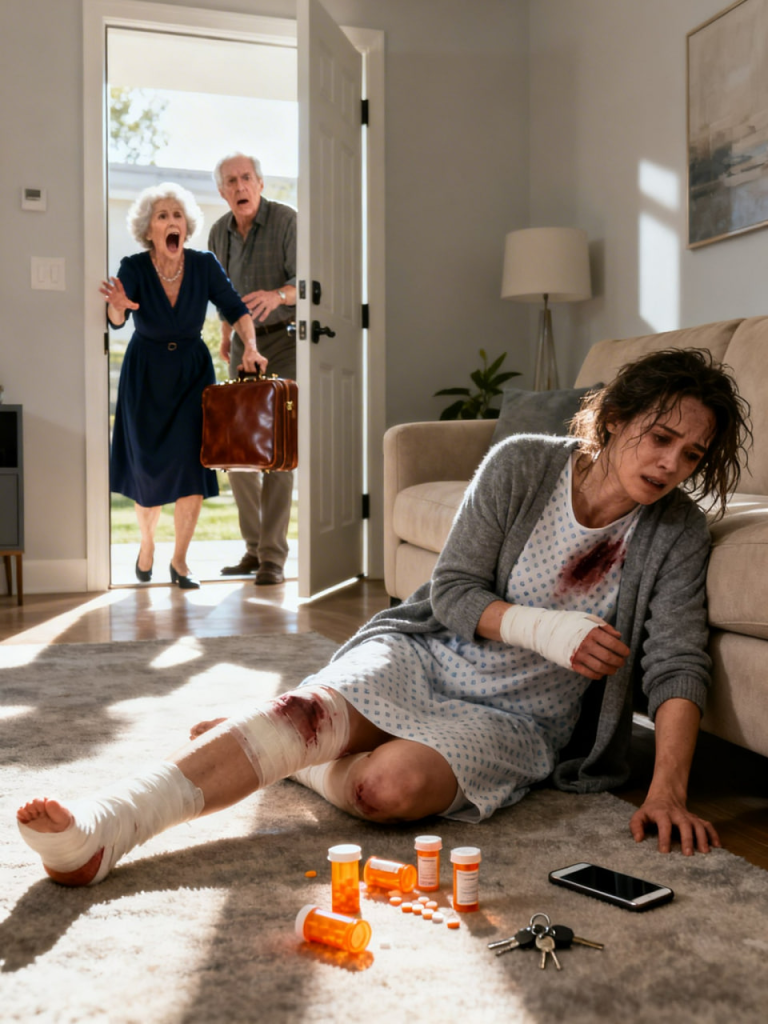
My Mom Forced Me Out of the Hospital to “Save Money”—Then Took a Luxury Vacation With My Settlement and Came Home to a Stranger Opening My Door
I woke to the sound of a monitor arguing with my heartbeat.
A soft, rhythmic beep—steady enough to be comforting, sharp enough to be annoying—pulled me out of a dream that tasted like headlights and rain. My mouth was cotton. My tongue felt too big for my teeth. Every breath pressed against something sore inside my ribs, and when I tried to shift, pain flared like a match struck under my skin.
I blinked until the ceiling stopped shimmering.
White tiles. Fluorescent lights. A curtain track. A faint chemical smell that said hospital the way pine says forest.
A nurse noticed my eyes and appeared in my peripheral vision like she’d been waiting at the edge of a stage. She had a badge with a cartoon fox on it and tired, kind eyes.
“Emily?” she said gently. “Can you hear me?”
I tried to answer, and my throat scraped. The sound that came out was a ghost of a word.
She reached for my hand and squeezed. “You’re safe. You were in a car accident. You’ve been in surgery, and you’ve been asleep for a while. You’re doing really well.”
The word accident fell into my brain and splintered.
I remembered wet pavement. The whine of tires. The way my steering wheel felt suddenly weightless, like it had detached from reality. I remembered the oncoming glare, too bright, too close, a sun that had decided to hit me instead of rise.
My chest tightened. I tried to sit up, and the pain punished me instantly.
“Hey, hey—don’t do that,” the nurse said, pressing a button, adjusting my bed. “You’ve got fractures. Bruised lungs. A concussion. We need you to rest.”
Fractures. Bruised lungs. Concussion.
A concussion sounded like something you got from slipping on a stair.
Bruised lungs sounded like something that happened to people in movies.
Fractures sounded like a word that belonged to strangers.
I swallowed slowly, tasting metal. “My… phone?”
“You’re not going to like me,” she said with a little apology, “but we’re limiting screen time until your headache improves. I can call someone for you. Do you want me to call your emergency contact?”
My emergency contact. I’d set it years ago without thinking, the way you check a box on a form because it’s there.
Mom.
I nodded because that’s what I always did. I nodded because I was still too drugged to remember that nodding was how my life got decided by other people.
The nurse stepped out. The beeping continued.
I stared at my hands. There were bruises like ink blooms under my skin. My left arm had an IV; my right had a bandage that went up toward my elbow. My knuckles were scraped raw.
A few minutes later, the curtain shushed open.
My mother entered like she owned the room. Her hair was perfect. Her lipstick was on. Her expression was a practiced blend of concern and irritation, as if she was annoyed by the inconvenience of me being injured but aware that she should look worried for the audience.
Behind her were my sister, Kara, and my stepfather, Don.
Kara’s face was set in that familiar half-smile, the one she wore when she’d already decided the story and was waiting for everyone else to agree.
Don carried a paper cup of coffee like it was a shield.
Mom rushed to my bedside and took my hand—carefully, as if she didn’t want any of my damage touching her.
“Oh, Emily,” she breathed, and her eyes did that watery thing that convinced strangers she was the loving mother in a tragic story. “You gave us such a scare.”
I tried to speak. My head felt stuffed with fog.
Mom leaned closer. Her perfume cut through the antiseptic. It was floral and expensive and wrong in a room where people cried quietly at night.
“We’ve been here,” she whispered, too loud for a whisper. “We’ve been waiting for you to wake up.”
Kara stood near the foot of the bed and looked me over the way you look at a dent in your car—calculating what it might cost.
Don cleared his throat. “Doc said you’re stable. That’s good.”
My nurse appeared again, her friendly fox badge bobbing. “Hi, I’m Talia. Emily is awake and oriented. We’re going to keep monitoring her—”
Mom cut her off with a bright, brittle smile. “Wonderful. Now, we need to talk about discharge.”
Talia blinked. “Discharge… is not on the table today.”
Mom’s smile didn’t move. “We need to know when it will be.”
“Your daughter just woke up after surgery,” Talia said, still gentle but firmer now. “She has multiple injuries. She needs observation. The doctor will—”
Mom patted my hand. “Emily hates hospitals,” she told Talia like I wasn’t there. “She’ll recover better at home.”
Kara nodded like an assistant to the narrative. “She always does better when she’s comfortable.”
I tried to shake my head. My skull responded with a pulse of pain.
Talia looked at me. “Emily, do you feel ready to go home?”
I opened my mouth and nothing coherent came out. Just air and a small sound of panic.
Mom squeezed my fingers harder. “She’s exhausted. Of course she wants to go home.”
Talia’s gaze sharpened. “I’ll get the doctor.”
Mom’s expression chilled the instant Talia turned away.
Then she leaned in so close I could see the tiny lines at the corner of her eyes.
“Listen to me,” she hissed, the softness gone, the mask dropped. “This hospital is going to bleed us dry. You are not staying here another night. Do you understand?”
Us.
My mother said us the way she said the family, which usually meant me paying and everyone else benefiting.
“I…” My throat burned.
Mom’s nails pressed into my skin. “You have insurance, don’t you?”
“Yes,” I croaked. “Through… work.”
“And you’ll lose your job if you stay in here too long,” Kara added, voice syrupy. “They’ll replace you.”
“That’s not true,” Talia called from outside the curtain, voice to someone else. “She’s not leaving.”
Mom’s grip tightened. “Emily, for once, don’t be dramatic.”
The word landed in my chest like a stone.
My eyes stung. “I’m… not—”
“Just sign what they put in front of you,” Mom said. “You’re a grown woman. You can choose to leave. We’ll take you home, put you in bed, and you’ll rest. It’s fine.”
Don shifted his coffee cup. “It’ll be cheaper.”
Cheaper.
My body felt like it had been hit by a truck—because it had—and they were measuring my pain in dollars.
The doctor arrived soon after. Dr. Patel, calm and direct, with a voice that didn’t bend for anyone.
He explained the injuries in words that made my stomach sink: fractured clavicle, two broken ribs, pulmonary contusion, lacerations, concussion, and a surgery I barely remembered consenting to.
“I strongly recommend inpatient observation for at least forty-eight hours,” he said. “You’re at risk for complications. Especially with bruised lungs. We want to manage your pain, monitor your oxygen, watch for neurological changes.”
Mom clasped her hands like she was praying. “Doctor, she’s very strong. She’s always recovered quickly.”
“Strength is not the issue,” Dr. Patel said. “Physiology is.”
Mom’s eyes flashed. “We can’t afford this.”
Dr. Patel looked at her as if she’d spoken a foreign language. “Your daughter’s health is not a negotiable expense.”
“She has insurance,” Kara said quickly, “but it doesn’t cover everything.”
“It will cover more if she stays and receives appropriate care,” Dr. Patel replied. “Leaving against medical advice could complicate coverage.”
Mom’s lips tightened. “So you’re saying you’ll punish us if we take her home.”
“I’m saying there are consequences to refusing care,” Dr. Patel said, unshaken. He turned to me. “Emily, do you understand what I’m recommending?”
I tried to focus through the fog. I wanted to nod yes. I wanted to say, Please keep me here. Please don’t send me back into the world with a body that feels like it’s falling apart.
But my mother’s hand was still on mine, heavy as a paperweight.
I heard her voice in my head like it had lived there my entire life: Don’t cause trouble. Don’t be difficult. Don’t be dramatic. Don’t cost us money.
So I did what I always did.
I whispered, “I… can go home.”
Dr. Patel’s jaw tightened. “I can’t stop you. But I want it documented that you’re leaving against medical advice.”
Mom smiled, triumphant. “Thank you, Doctor. We appreciate your concern.”
Talia looked like she wanted to argue until her lungs gave out.
The paperwork appeared. A clipboard. A pen.
My hand trembled as I signed. My signature looked like someone else’s name.
Dr. Patel spoke to me directly, ignoring my family. “If you experience shortness of breath, increased pain, dizziness, vomiting, confusion, fever—anything—return immediately. Do not wait. Do you understand?”
I nodded. I understood the words. I didn’t yet understand what it would cost me.
They wheeled me out within the hour.
In the parking lot, rain had stopped, leaving the world slick and shining. The air was cold and smelled like wet asphalt.
Mom helped me into the backseat of Don’s SUV as if she were doing charity work.
“Home,” she said briskly. “We’ll get you settled.”
I lived just outside Portland in a small rented house with a peeling white porch and a backyard where the grass grew too fast. It wasn’t fancy, but it was mine—quiet, controlled, predictable. I liked predictable.
When we arrived, Mom marched inside first, flicking on lights, making faces at clutter that had existed harmlessly before she saw it.
Kara went straight to the kitchen and opened my cabinets.
Don carried my overnight bag like it was heavy with blame.
Mom guided me to the couch, then frowned as if the couch offended her. “You should be in bed.”
“I… can’t climb stairs,” I murmured. My ribs screamed when I breathed too deep.
Mom sighed as if I’d chosen this to inconvenience her. “Fine. Sleep here.”
Kara appeared with my pill bottles. “These are expensive,” she said, turning them over. “Did they really give you all this?”
“Pain… meds,” I said.
“Well, don’t take too many,” Mom snapped. “You’ll get addicted.”
Talia’s kind eyes flashed in my memory. Dr. Patel’s calm warning. Manage your pain. Watch for changes.
Mom pulled out her phone. “I’m calling the insurance.”
I closed my eyes.
The couch smelled like detergent and home and fear.
That night, I woke coughing.
It wasn’t a normal cough. It was deep, wet, and it felt like it came from bruises inside my lungs. Each cough sent bolts of pain through my ribs. I tried to breathe quietly to avoid it, and that made my chest tighten until panic rose.
I fumbled for my phone. The screen hurt my eyes.
I called Mom.
It went to voicemail.
I called Kara.
Voicemail.
I called Don.
Voicemail.
My hands shook as I tried to sit up. My breath sounded wrong—thin and whistling.
Dr. Patel’s words echoed: Do not wait.
I pressed 911.
When the paramedics arrived, their faces tightened the moment they saw me. They checked my oxygen. It was low.
“You should be in the hospital,” one of them said.
“I was,” I rasped. “My mom… made me leave.”
He didn’t respond to that. He just helped me onto the stretcher and rolled me out into the night.
In the ambulance, oxygen filled my nose with cold air.
At the ER, a new doctor scowled at my chart. “You signed out AMA?”
My cheeks burned. “I… did.”
He looked at me in a way that wasn’t judgment—more like disappointment aimed at the universe. “We’re admitting you.”
They admitted me.
Again.
When my mother arrived the next morning, she was furious.
She stormed into my room like I’d committed betrayal. “Emily! What the hell is this?”
I tried to speak, but my throat still hurt from coughing.
“You called an ambulance?” she demanded. “Do you know what that costs?”
“I couldn’t… breathe,” I whispered.
Mom threw her hands up. “You always do this. You always find a way to make it bigger.”
Kara stood behind her, scrolling on her phone like this was boring.
Dr. Patel was not on shift, but a different attending appeared—Dr. Hernandez, with sharp eyes and a no-nonsense voice.
“She is staying,” Dr. Hernandez said flatly. “No discussion.”
Mom squared her shoulders. “You people are scam artists.”
Dr. Hernandez didn’t even blink. “If you interfere with her care, I will have security escort you out.”
For a moment, my mother looked genuinely shocked.
Then she turned to me and lowered her voice. “Emily. Tell her you want to leave.”
My mouth went dry.
I stared at my mother and realized something with sudden clarity:
She wasn’t worried about me.
She was worried about the bill.
And because I was awake now—because I could potentially say something different—she needed me to perform the role I always performed.
Quiet. Responsible. Low-maintenance.
Easy.
I thought about the cough that had felt like drowning.
I thought about the oxygen.
I thought about the terror of waking alone.
Then I did something that made Kara’s head snap up.
I said, “No.”
It came out small. But it was there.
Mom’s eyes narrowed. “Excuse me?”
“I’m staying,” I whispered.
The room went silent except for the monitor’s argument-beep.
Dr. Hernandez nodded like she’d seen this story before. “Good. We’ll continue your care.”
Mom’s face changed—tightening, hardening, rearranging itself into something sharper.
“Fine,” she said coldly. “Stay. But don’t come crying to me when you see the bills.”
She turned and left.
Kara followed, rolling her eyes in my direction like I’d embarrassed her.
Don lingered at the door, looking uncomfortable, then left too.
Talia wasn’t there this time. But another nurse—a broad-shouldered woman named June—adjusted my blanket and murmured, “You did the right thing.”
I wanted to believe her.
I stayed four more days.
They monitored my oxygen. They managed my pain. They checked my head. They taught me breathing exercises that felt like trying to inflate a balloon inside broken glass.
When I was finally discharged—properly, with instructions and follow-up appointments—I was exhausted but stable.
June walked me to the exit in a wheelchair and handed me a paper bag with my prescriptions.
“Do you have someone at home?” she asked.
I hesitated. The truth pressed against my teeth.
“My mom,” I lied automatically.
June’s gaze held mine for a long moment. “If that changes,” she said quietly, “call the hospital social worker. You don’t have to do this alone.”
I nodded, throat tight.
Outside, the air smelled like pine and distant rain. Portland air always carried both.
Mom was waiting in the parking lot, leaning against her car like she’d been inconvenienced by my survival.
She didn’t hug me. She didn’t ask how I felt.
She said, “Get in.”
The ride home was silent except for the turn signal and Kara’s occasional laughter from the passenger seat as she scrolled through something on her phone.
When we arrived at my house, Mom helped me to the couch again, then immediately began talking about finances.
“We had to put the deductible on a credit card,” she said. “Do you know what interest is?”
“I… didn’t ask you to.”
Mom’s head snapped toward me. “Excuse me?”
I swallowed. My ribs ached. My head throbbed.
Kara sat on the armchair and crossed her legs. “Just be grateful,” she said. “A lot of people would leave you.”
The audacity of that sentence was so stunning I almost laughed.
Almost.
Mom continued, “You’ll need to pay us back. We can’t carry you.”
“I didn’t ask—”
“Emily,” Mom interrupted, voice sharpening, “you are not a child. You’re twenty-nine. You make decent money. You can handle it.”
My decent money went to rent, utilities, groceries, student loans, car payments, and the quiet emergency fund I’d built because I’d learned early that no one would catch me if I fell.
I looked at my mother—at her perfect hair, her expensive purse, her impatience—and felt something inside me shift.
“I’ll… figure it out,” I whispered.
That was the safe answer. The answer that ended the conversation.
Mom nodded, satisfied.
Then she said, casually, as if discussing weather, “We’re going to Maui.”
The word didn’t fit in my brain. “What?”
Kara grinned. “Mom deserves it. This week has been exhausting.”
Exhausting.
Mom smiled like she’d earned a medal. “We already booked it. Non-refundable. Your stepdad’s bonus came through.”
Don, in the kitchen, made a noncommittal sound.
I stared at them, genuinely confused. “But… I’m not— I can’t be alone.”
Mom waved her hand. “You’ll be fine. You can heat soup. You can watch TV. You’re not helpless.”
I felt my chest tighten. “I still— I’m not supposed to— Dr. Hernandez said—”
Mom’s face hardened. “Doctors always exaggerate. They want you dependent. You’re strong, remember?”
Kara leaned forward, eyes bright with something cruel. “Besides, you’re always saying you like being alone.”
I did like being alone.
I liked solitude. I liked silence. I liked not being shouted at, judged, monitored.
But being alone by choice was different than being abandoned because I wasn’t worth rearranging a vacation.
Mom picked up her purse. “We leave Tuesday morning. I’ll leave you some groceries.”
My voice came out small, and I hated it. “Please don’t.”
Mom’s expression shifted into fake concern. “Emily, don’t do this. Don’t make it dramatic.”
The familiar phrase.
The old leash.
Kara sighed. “Here we go.”
I opened my mouth. My ribs hurt. My head hurt. My heart hurt.
But my mother was already turning away, already deciding the story.
So Tuesday morning, I watched them load suitcases into the SUV.
Mom kissed Kara’s cheek. Don adjusted his sunglasses. Kara took a selfie in my driveway with a peace sign, my house behind her like a prop.
Mom came inside for a moment and set a bag of groceries on the counter.
“Try not to fall,” she said, like it was a joke.
Then she left.
The door clicked shut.
Their car backed out.
And I was alone.
At first, it felt almost peaceful.
The house was quiet. No criticism. No sharp comments. No forced gratitude.
I lay on the couch under a blanket and listened to the refrigerator hum. I watched dust float in the sunbeam like slow snow.
Then the afternoon came, and the quiet changed shape.
Pain is louder when no one is around to distract you.
The first time I needed to use the bathroom, it took me fifteen minutes just to stand up. Every movement was negotiation. Every step was a bargain with my ribs: If I move slowly, please don’t punish me.
I made it to the bathroom, sat carefully, and stared at my pale face in the mirror.
Under my eyes were bruises like shadows.
I looked like someone who’d been in a crash.
And I felt like someone who’d been left behind.
That night, I tried to cook soup. The can opener slipped in my weak hand, and the sudden jerk sent pain tearing through my clavicle. I dropped the can, and it rolled across the floor, leaving a trail of metallic shame.
I sat down on the kitchen tiles and cried.
Not loud. Not dramatic.
Just silent tears that slid down because there was no one to tell me I was overreacting.
On the third day alone, my phone buzzed with a text from Kara.
A photo of her on a beach, smiling, holding a drink with a tiny umbrella.
Caption: “Healing vibes! Hope you’re resting ”
I stared at the image until my vision blurred.
Then, because I was still the quiet, responsible one—the one who cleaned up messes—I typed back:
“Looks nice. I’m okay.”
The lie tasted bitter.
That afternoon, my neighbor knocked.
Mrs. Alvarez lived next door, a woman in her sixties who wore bright scarves and watered her plants like they were children. We’d exchanged polite hellos. She’d once brought me tamales at Christmas.
Now she stood on my porch with a concerned expression. “Emily? Honey, I saw their car leave. Are you alone?”
I tried to smile and failed. “Just… for a few days.”
Her eyes narrowed. “You look like you’re in pain.”
“I’m… fine.”
She made a sound that said she didn’t believe me. “Do you have food?”
“Yes.”
“Are you taking your medicine?”
“Yes.”
“Are you breathing okay?”
I hesitated.
Mrs. Alvarez didn’t wait for my lie. She stepped inside, uninvited in the way loving people can be, and put a hand on my shoulder gently.
“You need help,” she said.
The words cracked something inside me.
Tears came fast, embarrassing and hot.
Mrs. Alvarez guided me back to the couch, tucked the blanket around me like I was a child, and went to my kitchen.
She returned with a glass of water and a plate of crackers.
“You don’t owe me explanations,” she said softly. “But you are not going to be alone in this neighborhood if I can help it.”
I tried to speak. My throat tightened.
She patted my hand. “I’m going to call my niece. She is a nurse. She will tell me what to watch for. And I’m going to bring you real food tonight.”
I wanted to protest. I wanted to be low-maintenance.
But the truth was I was tired—tired of being low-maintenance to people who treated that as permission to neglect me.
So I whispered, “Okay.”
Mrs. Alvarez smiled. “Good.”
That night, she brought caldo de pollo—chicken soup that smelled like comfort and garlic. Her niece called and asked me questions about my breathing, my pain, my dizziness, my medication.
For the first time since the accident, someone spoke to me like my body mattered.
When we hung up, Mrs. Alvarez sat with me while I ate, and the silence between us was warm, not lonely.
After she left, I stared at my ceiling and realized something simple and devastating:
Kindness existed.
It just hadn’t been coming from my family.
The next morning, I tried to check my email.
Work had been sending messages—well-wishes, HR instructions, forms.
And then there was one email that made my stomach drop.
Subject: Claim Update: Additional Authorized Representative Added
It was from my auto insurance company.
I frowned, clicking it with shaky fingers.
The message was brief, full of formal language, but one line stood out like a bruise:
“We have added an authorized representative to your claim, per your request.”
Authorized representative?
I hadn’t requested that.
My pulse quickened. I clicked through to the claim portal, squinting through the headache.
There it was.
A name.
Linda Carter.
My mother.
The screen blurred.
I sat back slowly, pain forgotten for a moment under a wave of cold realization.
My mother hadn’t just forced me out of the hospital.
She’d inserted herself into the paperwork.
Into the money.
Care as a transaction. Always.
My hands trembled as I scrolled through the portal.
There were documents I didn’t remember signing.
Electronic signatures.
Dates that corresponded to my first hospital stay—the one I’d left against medical advice.
The one where my brain had been fog and pain and obedience.
I felt nauseous.
I grabbed my phone and called the insurance company.
A hold music played, cheerful and wrong.
When a representative finally answered, I forced my voice steady. “Hi. I’m Emily Carter. I have a claim. I need to ask about an authorized representative.”
The rep confirmed my identity with questions.
Then said, “Yes, Ms. Carter. We have Linda Carter listed as your representative. She has been communicating with us.”
“I didn’t authorize that,” I said, voice rising.
There was a pause. “We have an e-signed form on file.”
“I was in the hospital,” I whispered.
The rep’s tone changed—more careful. “If you believe the authorization was obtained improperly, we can flag your account. We can also remove the representative, but we’ll need you to submit a written statement and identity verification.”
“I want her removed. Immediately.”
“I can start the process right now,” the rep said. “We also recommend you review any disbursements made so far.”
Disbursements.
My throat went dry. “Has… money been paid out?”
“Yes,” the rep said. “A portion of the medical payment coverage was disbursed. And an advance on the bodily injury settlement was issued yesterday.”
Yesterday.
While my family was on a beach with healing vibes.
My voice came out as a thin thread. “Where was it sent?”
The rep hesitated, as if aware she was about to light a match.
“It was direct-deposited into the account on file.”
“What account?”
“A Wells Fargo account ending in 4421.”
I didn’t bank with Wells Fargo.
My heart slammed against my bruised ribs.
“That’s not my account,” I said, breathless.
The rep’s voice softened. “Ms. Carter… would you like me to escalate this to our fraud department?”
“Yes,” I said, the word sharp. “Yes, please.”
When I hung up, my hands were shaking so badly I nearly dropped the phone.
I sat on my couch, staring at my living room—the throw blanket, the chipped coffee table, the quiet life I’d built carefully like a fragile sculpture—and felt rage begin to rise in a way I’d never allowed before.
It wasn’t loud rage. It wasn’t screaming rage.
It was a deep, steady burn.
My mother had taken my pain and turned it into a payday.
I thought about the way she’d said we can’t afford this.
She could afford Maui.
Because she was paying for it with my suffering.
I didn’t cry this time.
I made calls.
I called the hospital billing department to ask what had been submitted.
I called my employer’s HR to ask about medical leave protections, just to make sure Kara’s threat about being replaced wasn’t another weapon.
And then I called the hospital social worker.
Her name was Simone. Her voice sounded like someone who had heard too many stories like mine and still chose to care anyway.
“I think my family might be… exploiting me,” I said, hating how dramatic it sounded, hating how my mother’s voice lived in my head.
Simone didn’t flinch. “Can you tell me what’s happening?”
I told her.
The forced discharge.
The added representative.
The money going to an account that wasn’t mine.
The luxury vacation.
The fact that I’d been left alone while still medically fragile.
When I finished, my chest was tight, but not from bruised lungs. From shame.
Simone was silent for a moment.
Then she said, “Emily, I’m very sorry. And I want you to hear this clearly: what you’re describing is not normal family behavior. It may be financial abuse.”
Financial abuse.
The words felt both too extreme and exactly right.
Simone continued, “I can connect you with a legal aid clinic. They can advise you on restraining orders, power of attorney issues, and fraud. I can also help you document your medical vulnerability at the time those documents were signed.”
My breath shook. “I don’t want to… ruin my family.”
Simone’s voice was gentle but firm. “It sounds like they’re doing that themselves.”
The truth of that landed hard.
I agreed to the referral.
That afternoon, Mrs. Alvarez returned with more soup and a bag of oranges, and when she saw my face, she sat down and said, “What happened?”
I told her, too.
Her eyes flashed with anger I’d never seen directed on my behalf. “Ay, Dios mío,” she muttered. “Those people.”
She didn’t tell me to be grateful.
She didn’t tell me not to be dramatic.
She said, “We are going to fix this.”
The legal aid clinic called the next day. A lawyer named Priya spoke to me like I was capable, not fragile.
“First,” she said, “we need to secure your accounts and identity. Second, we need to stop them from entering your home without your permission. Third, we need to begin a paper trail.”
“My home?” I repeated, confused.
Priya asked, “Do they have a key?”
“Yes,” I admitted. “My mom does. Kara might. I gave them spares years ago… in case of emergencies.”
Priya let out a slow breath. “We’re going to change your locks. Today, if possible.”
My stomach clenched. “That feels… extreme.”
“Emily,” Priya said, voice steady, “they left you alone after a major accident. They redirected money meant for your care into their account. Those are not people who respect your boundaries. Changing locks is not extreme. It’s basic safety.”
Safety.
The word sounded foreign in the context of family.
But I did it.
Mrs. Alvarez’s nephew—Miguel—worked for a locksmith. He came that evening, kind and quiet, and replaced every lock while I sat on the couch with a heating pad and watched.
When he handed me the new keys, my hands trembled.
It felt like holding a small piece of freedom.
Priya also advised me to place a credit freeze, change my online passwords, and file a police report—not necessarily to get anyone arrested immediately, but to document the fraud.
“You may not be ready to pursue charges,” she said, “but you deserve the option.”
Option.
Choice.
Words I hadn’t associated with my role in my family.
That night, I lay awake thinking about my mother’s face when she realized the money was gone from her control.
I imagined her anger.
And I realized I was afraid.
Not of her physically—though fear has many shapes—but of her voice. Of her ability to make me feel small enough to hand over everything.
I fell asleep with my phone in my hand.
The next morning, I checked the insurance portal again.
The authorized representative had been removed.
A fraud investigation was opened.
The account for disbursement was flagged.
A relief so intense it felt like dizziness washed over me.
Then my phone rang.
Mom.
I stared at the screen until it stopped.
A minute later, a text:
“CALL ME NOW.”
Another:
“WHAT DID YOU DO?”
Another:
“YOU ARE MAKING A HUGE MISTAKE.”
My fingers hovered over the keyboard.
The old me would have apologized.
The old me would have begged for calm.
Instead, I typed:
“I’m recovering. I’ll talk when I’m ready.”
Then I turned my phone off.
For the first time, silence felt like power.
Two days later, another email arrived—this time from my bank.
“Unusual login attempt detected.”
My stomach dropped again.
Someone had tried to access my account.
From an unfamiliar device.
I changed my passwords again, shaking with adrenaline, and called Priya.
“They’re escalating,” she said grimly. “Okay. We document everything. Don’t engage. If they show up, do not let them in. Call the police if needed.”
“If they show up,” I echoed, heart pounding.
“They have keys?” Priya asked.
“Not anymore.”
“Good. That will matter.”
On the seventh day after they’d left—after a week of beaches and drinks and spending money they hadn’t earned—I woke to the sound of a car door slamming outside.
My heart spiked.
I peeked through the living room curtain.
Don’s SUV.
Suitcases.
My mother’s hat with the wide brim.
Kara’s loud laugh.
They were back.
A ridiculous thought flashed through my mind: Maybe they’ll come in and act normal. Maybe they’ll say they missed me. Maybe they’ll finally see me.
Then Mom marched to my front door and jammed a key into the lock.
It didn’t turn.
Her body stiffened.
She tried again, harder.
Nothing.
Kara stepped closer, frowning. “Did your key break?”
Mom’s voice rose. “Emily! Open the door!”
I froze, ribs tightening. My breath hitched.
I reminded myself: They cannot come in. This is my home.
Mom hammered on the door. “Emily!”
Kara leaned toward a window. “I can see the couch. She’s probably asleep.”
Mom tried the key again and again, as if aggression could change metal.
Then, abruptly, the front door opened.
Not from my side.
From inside.
And it wasn’t me.
A woman stood in the doorway.
She was in her forties, hair pulled back, wearing a navy blazer and a calm expression that looked practiced under pressure.
For one surreal second, my brain refused to process it.
Who is that?
Mom stumbled back, eyes wide. “Who the hell are you?”
Kara’s face drained of color. “What—”
Don’s mouth fell open.
The woman held up a badge.
“Linda Carter?” she asked, voice clear. “Kara Carter? Don Marshall?”
Mom’s head snapped. “Yes. And who are you? Why are you in my daughter’s house?”
The woman didn’t flinch. “Detective Marisol Chen, Portland Police Bureau. Financial Crimes.”
My body went cold and hot at the same time.
Mrs. Alvarez’s niece had insisted I file a report. Priya had encouraged it. I’d done it trembling, thinking it might take weeks, months—thinking nothing would happen quickly.
But here was a detective standing in my doorway like reality had finally decided to show up.
Mom’s face twisted. “This is outrageous.”
Detective Chen’s gaze was steady. “We have an active investigation regarding suspected fraud related to Emily Carter’s insurance claim and banking information.”
Kara’s voice came out shrill. “This is a misunderstanding.”
Mom’s eyes blazed, searching past the detective, scanning my living room like she could will control back into existence. “Emily! Emily, get out here!”
Detective Chen’s voice didn’t rise, but it sharpened. “Emily is inside. She is recovering from serious injuries. She is not required to speak with you.”
Mom’s head snapped toward the detective. “She’s my daughter.”
Detective Chen didn’t blink. “She’s an adult.”
Mom’s breath came fast. “This is her family. We take care of her.”
My throat tightened with a bitter laugh that never became sound.
Kara stepped forward, forcing a smile. “Look, we just got back from vacation, we’re tired—”
Detective Chen held up a hand. “I’m going to ask you all to remain calm. I’m also going to inform you that the locks on this home have been changed at Emily’s request, and you no longer have permission to enter.”
Mom’s eyes widened as if slapped. “She changed the locks? That’s insane. She’s confused. She’s been on pain meds.”
There it was—the old tactic: discredit me. Make me the problem.
Detective Chen’s expression didn’t change. “We have documentation from her physician regarding her capacity and care. We also have digital records of account changes made while she was hospitalized.”
Kara’s smile vanished.
Don swallowed hard.
Mom’s face shifted again, rearranging into outrage and victimhood. “Are you accusing me of stealing from my own daughter?”
Detective Chen’s tone remained even. “I’m informing you that we are investigating alleged fraudulent authorization and the redirection of funds to an account not belonging to Emily Carter.”
Mom’s voice rose. “That money was for family expenses! We paid for her! We took care of her!”
I felt something surge inside me—an impulse to stay hidden, to avoid the confrontation, to let someone else handle it.
And then another impulse rose, stronger:
No more hiding in my own life.
I pushed myself upright slowly, grimacing as my ribs protested. I steadied my breath, like June had taught me. Inhale through the nose. Hold. Exhale.
Then I stood.
My legs trembled, but they held.
I walked toward the doorway.
Detective Chen noticed me first and stepped slightly aside, as if making space for me to exist.
Mom’s eyes locked onto mine instantly.
For a moment, the porch, the suitcases, the neighborhood, all of it fell away.
It was just my mother’s face—fury and disbelief and the desperate need to control.
“Emily,” she hissed, voice dripping with betrayal. “What did you do?”
I looked at her and felt my voice steady in a way it never had before.
“I healed,” I said.
Kara scoffed. “Oh my God.”
Mom’s eyes narrowed. “You called the police on your own mother?”
I swallowed past the lump in my throat. My clavicle ached. My head throbbed.
But I stood there anyway.
“You took my settlement advance,” I said. “You put your name on my claim without my consent. You sent money to an account that isn’t mine.”
Mom’s face twisted. “I did it for you!”
“No,” I said quietly. “You did it for you.”
Kara stepped forward, voice sharp. “You’re being dramatic. You don’t even know what you’re talking about.”
I looked at Kara—my sister who’d always been Mom’s echo, Mom’s assistant, Mom’s proof that love could be given when it was convenient.
“I know exactly what I’m talking about,” I said. “And you left me alone when I couldn’t breathe.”
For a split second, something flickered in Kara’s eyes—guilt, maybe. Or fear.
Then it hardened into resentment.
Mom’s voice rose. “We left you food. We checked on you.”
“You texted me a beach selfie,” I said.
Don finally spoke, voice uneasy. “Em, maybe we should talk inside.”
Detective Chen’s gaze snapped to him. “No one is going inside.”
Mom turned on the detective. “This is family business. Get out of the way.”
Detective Chen’s voice was calm but cold. “Ma’am, if you attempt to force entry or harass Emily, I will consider it trespassing.”
Mom’s lips trembled. “Emily, stop this. You don’t understand what you’re doing. You’re tearing us apart.”
The old guilt tried to rise.
The old fear.
But behind it, I felt something else now—support. Mrs. Alvarez’s fierce kindness. June’s quiet validation. Simone’s steady voice. Priya’s clear guidance. Detective Chen standing in my doorway like a boundary with a badge.
And I felt my own spine, newly discovered.
“I’m not tearing anything apart,” I said. “I’m just not holding it together anymore.”
Mom’s eyes went wide, as if she couldn’t comprehend that I had spoken back.
Then her face contorted with rage.
“You ungrateful—”
Detective Chen stepped forward. “That’s enough.”
Mom jabbed a finger toward me. “After everything I’ve done for you—”
I inhaled carefully. My ribs pinched, but I didn’t flinch.
“You did what benefited you,” I said. “And I let you. Because I thought that was the price of being loved.”
My voice shook, but I kept going.
“I don’t want your kind of love anymore.”
Silence fell like snow.
Kara’s mouth opened, then closed.
Don stared at the ground.
Mom’s face went pale, then flushed red.
Detective Chen spoke into her radio, requesting backup—not because anyone had attacked, but because she understood what I was only beginning to understand: that some people became dangerous the moment you stopped being useful.
Mom’s voice dropped into a hiss. “If you do this, you’ll regret it.”
I met her gaze. “I already regret what I tolerated.”
Her nostrils flared.
Then, abruptly, her face shifted again—into tears.
Not real tears. Tactical tears.
“Emily,” she sobbed loudly, turning to the neighbors who had begun to peek from porches. “I don’t know what’s happened to her. She’s confused. She’s been manipulated.”
Kara jumped in, voice trembling just enough to sound believable. “She’s not herself. We’re just trying to help.”
The performance was flawless.
It would have worked on me a month ago.
Detective Chen remained unmoved. “Ms. Carter, we can do this two ways. You can cooperate with the investigation, or we can obtain warrants for financial records and proceed accordingly.”
Mom dabbed at her eyes. “Cooperate? Of course. We have nothing to hide.”
I almost laughed.
Mom turned her gaze back to me, eyes wet, voice soft with poison. “Emily, sweetheart, please. Let’s talk. Just you and me.”
My throat tightened, a reflexive urge to step forward, to soothe, to fix.
Then I remembered sitting on my kitchen floor crying over a dropped soup can.
I remembered coughing until I couldn’t breathe.
I remembered the email about the authorized representative.
I remembered the beach selfie.
“No,” I said simply.
Mom’s face hardened again. “Fine.”
Detective Chen handed her a card. “You will be contacted. Do not attempt to access Emily Carter’s accounts or claim again. Do not return to this property without her explicit permission.”
Mom snatched the card like it offended her.
Kara grabbed a suitcase handle and yanked. “This is insane,” she muttered.
Don looked at me, his face a mix of guilt and helplessness. “Em, we—”
I cut him off gently, because I didn’t have the energy to hate him, only to stop. “Leave.”
His shoulders slumped.
Mom glared at me one last time, eyes burning with the certainty that she would rewrite this story later.
Then she turned and marched back to the SUV.
Kara followed, muttering curses under her breath.
Don hesitated, then got in.
The car pulled away.
The sound of tires on wet asphalt faded.
And for the first time, my front yard felt like mine.
Detective Chen turned to me. “Are you okay?”
I exhaled carefully. My hands were shaking.
“No,” I admitted. “But… I will be.”
She nodded. “We’ll be in touch. Make sure you keep documenting everything. And if they contact you, let us know.”
“I will.”
She glanced at my porch. “Do you have someone who can stay with you tonight?”
Mrs. Alvarez appeared as if summoned by the question, marching up my walkway with a scarf wrapped around her neck like armor.
“I’m here,” she announced. “And Miguel is on his way.”
Detective Chen’s lips twitched, almost a smile. “Good.”
After she left, Mrs. Alvarez came inside and shut the door firmly behind her.
Then she turned to me and held my face between her hands gently.
“You did it,” she said.
My throat tightened. “I feel… sick.”
“That is normal,” she said. “Your body has been hurt. Your heart has been hurt. But you did it.”
I sat down slowly, the couch catching me like an old friend.
Mrs. Alvarez went to my kitchen, humming softly, and began making tea as if reclaiming my home with simple rituals.
I stared at my living room and felt tears rise—not of shame this time, but of something like grief.
Because even when people hurt you, part of you mourns the fantasy of what they could have been.
I mourned the mother I’d wanted. The sister I’d hoped for. The family I’d tried to earn through obedience.
Then, beneath the grief, something else stirred.
Relief.
Not pure, not simple, but real.
My phone buzzed—turned back on now—and a message appeared from Priya.
“Checking in. Any updates?”
I typed back:
“They came back. Detective was here. Locks worked. I didn’t let them in.”
A moment later:
“Proud of you. Keep breathing. We’ll handle the rest.”
I set the phone down and closed my eyes.
For weeks, my life had been broken glass and paperwork and pain.
But now, in the quiet after the storm, I could feel a new shape forming.
Not the old shape of being low-maintenance.
Something sturdier.
A self.
Over the next month, the investigation moved forward.
The fraud department confirmed the authorization form had been signed from an IP address traced to my mother’s home. The bank flagged the Wells Fargo account as receiving suspicious deposits. Detective Chen obtained records. Priya filed legal motions. Simone helped me apply for a victim support program that covered some medical costs while the insurance mess untangled.
Mom left me voicemails swinging between rage and tears.
Kara posted cryptic quotes on social media about betrayal.
Don sent one text: “I’m sorry.” Nothing else.
I didn’t reply.
I focused on healing.
I went to physical therapy, wincing through shoulder exercises that felt like my body was learning to trust itself again.
I did breathing work for my lungs.
I sat in sunlight and let my nervous system remember what calm felt like.
Mrs. Alvarez checked on me every day. Sometimes she brought food. Sometimes she just sat and talked about her childhood in Mexico, about mistakes and second chances, about how family could be made, not just inherited.
One afternoon, she said, “You know, Emily, you are allowed to choose who loves you.”
The sentence lodged in me like a seed.
Weeks later, I stood at my front window and watched the rain fall in slow sheets over my yard. Portland doing what Portland does—turning the world soft and gray and alive.
My clavicle still ached sometimes. My ribs still complained when I laughed too hard. Scars on my skin pulled when I stretched.
But I was here.
I was alive.
And the door to my home—my life—opened only for people who didn’t treat my pain like a bill to be minimized.
I walked to the door and touched the new lock.
It was such a small object, such a simple thing.
Metal and mechanism.
But it represented the first boundary I’d ever enforced.
And I knew there would be more.
Not because I wanted war.
Because I wanted peace.
Real peace.
Not the kind my family joked about at my expense.
The kind you build when you stop shrinking and start standing.
I made myself tea—like Mrs. Alvarez taught me, strong and sweet—and sat on my couch.
Outside, the rain kept falling.
Inside, it was quiet.
Not lonely.
Safe.
And for the first time in my life, I didn’t mistake silence for abandonment.
I recognized it as freedom.


Leave a Reply