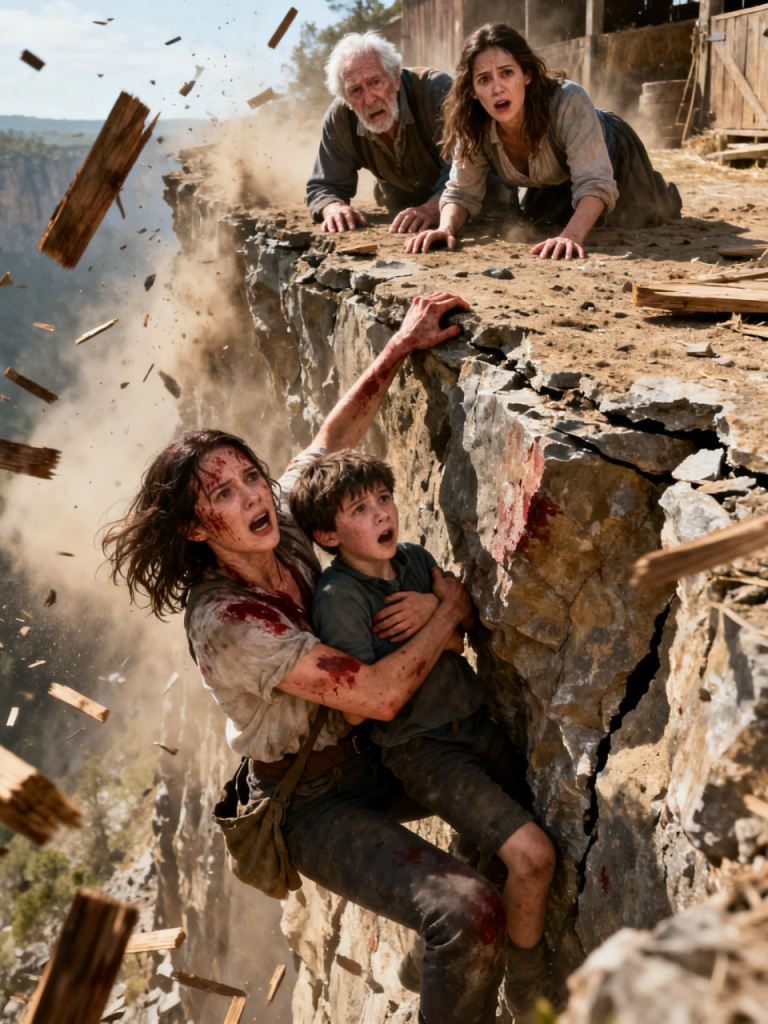
They Pushed Us Off a Cliff and Smiled—So My Six-Year-Old Son and I Played Dead, and Overheard the Words That Changed Everything Forever
Willowbrook, Ohio, looked like a place that believed in good manners the way some towns believed in God—loudly, publicly, and with the expectation that everyone else would pretend too.
You could drive down Sycamore Street and see porch swings moving like slow metronomes, white fences that had never known chipped paint, and front gardens arranged with the kind of care people usually reserved for funerals. The bakery opened at five-thirty. The library hosted quilting circles on Tuesdays. The church bells rang on Sundays. And at the center of it all, a neat little park with a gazebo where the mayor made speeches about “community values” while everyone smiled as if their teeth had been issued by the town itself.
I used to think that meant I’d chosen a safe place to raise my son.
I used to think Willowbrook’s secrets were small ones—who drank too much, who cheated on their spouse, who never paid their contractor on time. The normal kind of rot that didn’t spread.
Then my family invited us hiking without warning, and my six-year-old son taught me what pretending to be dead really meant.
My name is Mara. I’m thirty-two, a single mother, and until that day, I still carried the childlike belief that family might bruise you by accident, but wouldn’t break you on purpose.
I was wrong.
It started on a Thursday with sunshine that felt staged. The sky was too blue, the wind too gentle, the kind of day that made you forget the world ever turned cruel. I’d spent the morning packing my son Leo’s lunch, cutting his sandwich into triangles because he claimed triangles “tasted braver,” and tying his shoes twice because he liked them tight enough to feel like armor.
When I opened the door to take him to kindergarten, my parents’ SUV was parked at the curb like a surprise party you didn’t want. My mother sat in the front seat, tapping her fingernails against the window. My father was outside, arms folded, smiling in that way he’d mastered—no warmth in the eyes, just the performance of it.
And my sister, Audrey, leaned against the passenger door with her sunglasses on, lips curved like she’d already won something.
“Mara!” my mom called as if she hadn’t ignored my last eight phone calls. “We’re taking you both out today.”
I blinked. “What?”
“A family day,” my father said, as if he’d invented the idea of joy. “Hiking. Fresh air. Bonding.”
Audrey pushed her sunglasses up her nose and looked me over like I was an outfit she didn’t approve of. “You always say Leo needs more ‘nature.’ Here it is.”
Leo, holding his little dinosaur backpack, peered around my legs. “Hi, Grandpa.”
My father’s smile sharpened. “There’s my boy.”
He wasn’t his boy. He never would be. Leo was mine—my entire world built from late-night lullabies, scraped knees kissed better, and a thousand tiny sacrifices that never made it onto anyone’s list of achievements.
I should’ve shut the door. I should’ve lied and said we had plans. I should’ve listened to the itch at the base of my neck that warned me of storms before they came.
But for years, I’d trained myself to interpret my family’s attention as an opportunity—an opening, a chance to be chosen, to be loved properly this time.
And Leo’s face lit up at the word “hiking” because he’d been begging to see a real waterfall.
So I nodded, and I stepped into the trap with both of us.
We drove out of town, past the last rows of manicured houses, past cornfields stitched into the earth like a quilt. Leo chattered in the backseat, telling Audrey about his class’s pet turtle, about how he could count to one hundred, about how he wanted to be “a scientist who discovers dinosaur medicine.”
Audrey didn’t turn around once.
My mother asked me questions in a voice that sounded friendly, but her eyes stayed fixed on the road.
“How’s work?”
“Busy.”
“And… you’re still at that little rental?”
“It’s not little. It’s fine.”
My father made a noise like a scoff disguised as a cough. “Fine. Sure.”
There were a thousand things I wanted to say.
That I worked two jobs. That I didn’t have time for their judgment. That Leo didn’t need grandparents who treated his mother like a failed experiment. That I had built a life out of scraps because they’d never offered me anything whole.
But instead I said nothing, because silence was how you survived in a house like mine.
The trailhead sign read Eagle’s Rest Preserve in clean green letters. I’d never been there. It wasn’t a popular Willowbrook spot—it was further out, where cell service dropped and the trees grew dense enough to swallow sound.
My mother got out and stretched like she’d been waiting all week for this. “Isn’t it beautiful?”
Leo hopped down and looked up at the towering pines. “It smells like Christmas!”
I forced a smile. “Stay close to me, okay?”
My father clapped his hands once. “Let’s go.”
The trail began wide and easy, a path of packed dirt and scattered stones. Birds called overhead. Sunlight filtered through branches in soft, golden stripes. Leo skipped along, stopping to pick up a feather, to examine an ant hill, to point at a squirrel with delighted urgency.
I tried to let myself relax.
But my family walked in a way that felt… arranged. My father always stayed behind me, not beside. My mother drifted to my right like a shadow. Audrey moved ahead, leading us deeper, glancing back only to make sure we followed.
After fifteen minutes, the trail narrowed. After thirty, it forked, and Audrey chose the left path without hesitation.
“Isn’t the waterfall the other way?” I asked, because I’d noticed a faded map at the entrance.
Audrey didn’t slow. “This way’s prettier.”
My father’s voice came from behind me. “Don’t argue.”
Leo tugged my hand. “Mom, look! Mushrooms!”
“Don’t touch them,” my mother snapped too quickly, too sharply.
Leo recoiled, eyes widening. “Okay.”
I knelt and brushed his hair back. “It’s alright, buddy. Just look with your eyes.”
We kept going. The air cooled. The trees thickened. The path rose steadily uphill, and the sound of running water never came. I felt the forest closing in around us, branches knitting overhead, the world narrowing to dirt, leaves, and my family’s footsteps.
Then Audrey stopped.
Ahead, the trail opened onto a ridge. Not a gentle overlook with a railing and a picnic table like the parks in town. This was raw rock and a sheer drop, the land falling away into a ravine where fog hung like breath.
A cliff.
Leo stepped forward, eyes shining. “Whoa…”
I grabbed his shoulder and pulled him back. “Stay away from the edge.”
My father walked past me, calm as a man stepping into church. “Beautiful view.”
My mother joined him, hands clasped like she was pleased with something. Audrey turned, smiling.
My stomach tightened.
“Why are we here?” I asked.
Audrey’s smile sharpened. “Because it’s quiet.”
My father’s hand touched my back—not a supportive touch, not gentle. A placement. A measuring.
I took a step away. “Dad—”
“Relax,” my mother said. Her voice was smooth, like oil on water. “We just wanted to talk.”
“About what?”
Audrey tilted her head. “About you.”
Leo pressed closer to my side. “Mom?”
I crouched to his level. “It’s okay, sweetheart.”
But it wasn’t.
My father’s eyes slid to Leo like he was a piece on a board. “He’s getting bigger.”
“He’s six,” I said, defensive, automatic.
“And expensive,” Audrey added softly.
I stared at her. “What did you say?”
My mother sighed as if I was slow. “Mara, you’ve always made things difficult.”
“I’ve made things difficult?” My voice cracked. “I’m raising a child alone.”
“Because you made poor choices,” my father said, not even unkindly—just stating a fact like the weather.
Leo’s fingers tightened around mine. “Mom, can we go see the waterfall now?”
“In a minute,” I whispered.
Audrey stepped closer, her boots scraping rock. “You know what’s funny? Willowbrook loves a tragedy.”
My blood chilled. “What?”
She smiled wider. “They rally around it. They bring casseroles. They donate. They weep in public. It’s practically a sport.”
I stood up. “Audrey, stop.”
My father moved behind me again. My mother shifted to my right. Audrey stayed in front.
A triangle.
A trap.
I tried to pivot away, to put myself between Leo and the edge, but my mother’s hand landed on my arm, gripping hard.
“Mara,” she said, her voice low, “don’t make a scene.”
My heart started to hammer. “Let go.”
Audrey’s smile finally slipped, revealing something colder underneath. “This isn’t about a scene. This is about… balance.”
My father leaned close enough that I could smell his aftershave. “We’ve carried you long enough.”
“I’m not a burden,” I snapped.
“You are,” my mother said simply.
Leo began to whimper, sensing the shift in air the way animals sensed thunderstorms. “Mom?”
I looked down at him, at his small face, at the trust there, and something inside me rose up like a flood.
“Back up,” I told them. “All of you. Now.”
My father chuckled. “Or what?”
I pulled Leo behind me. “Or I scream.”
My mother’s nails dug into my arm. “No one will hear you.”
And that’s when Audrey stepped forward fast, like a dancer hitting her mark.
My father shoved.
It wasn’t dramatic. It wasn’t a movie moment with slow motion and screaming. It was a blunt force at my shoulder, a sudden loss of ground, the shock of air rushing past my face.
My foot slipped on loose gravel. I grabbed for something—anything—but my mother’s grip became a push.
And Leo, clinging to my hand, went with me.
The world tipped.
The sky vanished.
The cliff swallowed us.
I remember the sensation of falling being both endless and instant. Wind tore the sound from my throat. My mind tried to understand what my eyes saw—rock racing upward, trees spinning, a flash of my son’s terrified face.
Then impact.
Pain like lightning.
A crack inside me that felt like a tree snapping.
I hit something—an outcropping, a ledge partway down. My body slammed hard enough that my breath exploded out of me. For a moment, there was nothing but white-hot agony, and then the world rushed back in: the taste of blood, the smell of wet stone, the sound of Leo sobbing.
We hadn’t fallen all the way.
We were on a narrow shelf of rock, half-hidden by tangled brush. Above us, I heard footsteps, voices.
“Mara?” my mother called, like she was checking if a package had been delivered.
I tried to move and the pain in my side screamed. My leg felt wrong—too heavy, too disconnected. My arm burned where the skin had scraped off against rock. I tasted iron.
Leo pressed against my chest, shaking. “Mom… mom…”
I forced my eyes open. “Leo,” I rasped. “Are you… are you hurt?”
He sniffed, little hiccuping breaths. “My elbow… it’s… it hurts.”
I looked down and saw his sleeve torn, a raw scrape beneath. It was bleeding, but not pouring. His face wasn’t pale. He was breathing fine.
He was alive.
I tried to sit up and nearly blacked out.
Above us, Audrey’s voice drifted down, casual as gossip. “Do we need to check?”
My father replied, “No. They fell far enough.”
My mother’s voice, sharp: “If anyone asks, she slipped. She always was clumsy.”
Audrey laughed softly. “And Leo… well… accidents happen.”
My vision tunneled.
It wasn’t just me.
They’d meant for my son too.
Leo’s small hand pressed against my lips suddenly, gentle but firm. His eyes were wide, wet, and focused in a way no six-year-old’s should have to be.
He whispered, so quietly I barely heard: “Mom. Don’t move yet.”
I stared at him.
He swallowed, trembling. “Pretend. Like… like in hide-and-seek.”
My throat tightened so hard it hurt. “Leo…”
“Please,” he whispered. “They’re looking.”
I forced my body still, even though the pain begged me to curl up and scream. I let my eyes close halfway. I slackened my limbs as much as I could. Leo curled against me, trying to make his breathing quiet.
Footsteps crunched above.
A shadow slid over the edge.
My father leaned out, peering down. I could feel his gaze like a weight. My mother’s voice was close. “Do you see them?”
“Just rocks,” he said.
Audrey’s voice came next, bright and satisfied: “Then it’s done.”
A pause.
Then my mother, almost thoughtful: “We should get back before anyone sees us here.”
My father: “We’ll call it in. Say we heard a scream and found her things.”
Audrey: “People will cry for a day. Then they’ll forget.”
They turned away.
Their voices faded up the trail.
The forest swallowed them again.
Only then did Leo let out a shaky breath, and I realized he’d been holding it.
I opened my eyes and stared at the leaves above us, the strip of sky between branches, and felt something inside me go very cold and very clear.
This wasn’t a misunderstanding.
This was an attempt.
An execution, poorly finished.
Leo’s voice trembled. “Mom?”
I turned my head slowly, careful not to move my broken leg. “I’m here,” I whispered. “You did so good.”
He pressed his forehead against my cheek. “I was scared.”
“I know.” My voice broke. “I know, baby.”
He pulled back, his eyes searching mine. “Mom… Aunt Audrey said something before… before they pushed.”
My stomach clenched again. “What did she say?”
Leo swallowed. “She said… ‘Make sure the boy goes too. No loose ends.’”
The world narrowed to that sentence, each word a nail driven into my bones.
No loose ends.
My sister had looked at my child—my sweet, dinosaur-loving boy—and labeled him a loose end.
My hands shook. I wanted to vomit. I wanted to fly up that cliff on rage alone and tear the smile off Audrey’s face.
But I couldn’t even stand.
I forced myself to breathe through the pain, through the panic. “Okay,” I whispered. “Okay. Listen to me, Leo.”
He nodded, tears slipping down his cheeks.
“We need help,” I said. “But we can’t let them know we’re alive yet.”
Leo frowned, trying to understand. “Why?”
“Because… because if they know, they might come back.” I swallowed, tasting blood. “And they might finish it.”
His eyes widened. He looked up toward the cliff edge as if he could see them through stone.
I squeezed his hand gently. “You’re very brave. Can you be brave a little longer?”
He nodded again, small and fierce. “Yes.”
I scanned the ledge with my eyes. We were on a narrow shelf about fifteen feet below the top, hidden by brush and a bend in the rock face. Further down, the ravine dropped into darkness and trees. There was no easy way up, and going down could kill us.
But I saw something to our left—a slanted crack in the rock, like a narrow passage leading sideways. Ferns grew there, and beyond them, deeper shadow. A place to hide better. A place that might lead somewhere.
If I could move.
I tried to shift my leg and saw stars. My breath came out in a strangled sound. Leo clutched me.
“Mom!”
“I’m okay,” I lied. “Just… it hurts.”
My phone. I needed my phone.
My hand fumbled at my pocket, but my jeans had torn, and the pocket was empty.
It must’ve flown out on the fall.
I closed my eyes, fighting the rising wave of despair.
Then Leo’s little voice: “I have mine.”
I blinked. “You… you have a phone?”
He nodded and pulled a small kid’s smartwatch from his wrist—a bright blue thing I’d bought secondhand, mostly so he could call me from the playground if needed. It had an emergency button, a simple screen. I’d set it up with my number and 911.
I’d never been so grateful for a cheap piece of plastic in my life.
“Leo,” I whispered, “you’re a genius.”
He looked uncertain. “But… will it work here?”
I stared at the trees and the rock and remembered the cell service dying out. “Maybe not. But we can try. Press the emergency.”
His thumb hovered, then pressed.
The watch beeped, a tiny desperate sound.
The screen flickered.
“No signal,” Leo whispered, reading the little icon like it was a verdict.
My chest tightened.
I forced myself to think. If my family called in a “search,” it would draw attention—police, rescue teams. But they would control the story. They could claim I slipped. They could claim they tried to save us. And if someone found us alive, would my family play shocked? Would they take over again? Would Audrey smile and say, Oh thank God, then wait for the next opportunity?
We needed someone who wasn’t them.
Someone who’d believe me.
Someone who’d act fast.
My mind went to one person, and I hated that I trusted him—because trust had become a luxury I couldn’t afford.
Evan Cole.
He was Willowbrook’s park ranger—young, quiet, the kind of man who noticed details and didn’t gossip. He’d helped me once when Leo got lost near the creek behind our rental. He’d found Leo within ten minutes, carried him back, and then—when my mother had arrived later and scolded me loudly in front of everyone—Evan had looked at her with something like disgust.
I’d seen it.
I’d filed it away.
But how to reach him?
I looked at the rock passage to our left. If it led to a lower trail, maybe we could move sideways and find service, find people, find a way to signal.
But I couldn’t walk.
Leo could.
The thought made my stomach drop.
“No,” I whispered automatically, because the idea of my son going anywhere alone made me want to howl.
But then I looked at his face—small, dirty, brave in the way children are brave because they don’t understand the full shape of danger—and I realized this wasn’t about what I wanted.
This was about survival.
I swallowed hard. “Leo.”
“Yeah?”
“You’re going to do something very important.” I tried to keep my voice steady. “You’re going to be my legs, okay?”
His eyes widened. “But—”
“I can’t climb,” I said simply. “Not right now. But you can. And you can get help.”
Leo’s mouth trembled. “I don’t want to leave you.”
“I know.” I forced a smile that felt like broken glass. “But you won’t be leaving me forever. You’ll be going for help and coming back.”
He shook his head hard. “What if they come back?”
“I’ll hide.” I nodded toward the crack in the rock. “I’ll crawl in there. They won’t see me.”
He glanced at it, then back at me. “What if you need me?”
“I need you to do this,” I said, and my voice finally cracked. “You’re the reason I’m still breathing. You saved us, Leo. Now… now we finish it.”
He stared at me for a long moment, then wiped his face with his sleeve.
“Okay,” he whispered.
I wanted to kiss his forehead, to hold him so tight he’d fuse with me, but I knew we needed to move quickly.
I guided him with my eyes. “You’re going to climb up quietly, the way you do when you sneak to the fridge for strawberries.”
He almost smiled at that.
“When you get to the top, don’t go back to the car. Don’t follow the trail where they went. You go the other way. You find a grown-up. A hiker. A ranger. Anyone. You tell them your mom fell and you need help.”
He nodded.
“And if you see Grandpa or Grandma or Aunt Audrey?”
His eyes flickered. “Run.”
“Yes.” My throat tightened. “Run. And don’t let them talk to you. Don’t let them take you.”
He swallowed. “Okay.”
I pointed to his watch. “If you get signal, press emergency again. Or call me. Or call 911.”
He nodded again, then leaned in and wrapped his arms around my neck so tight it hurt—except the pain was welcome, because it reminded me I could still feel something besides terror.
“Mom,” he whispered into my ear, “I love you.”
I pressed my lips to his hair. “I love you more than anything. Now go.”
He climbed.
I watched him scramble up the rock like a determined little spider, fingers searching for holds, feet finding ledges. My heart stopped each time gravel slid. Each time he paused, breathing hard. But he kept going—quiet, careful, brave.
When his head finally disappeared over the edge, I forced myself not to scream his name.
I crawled toward the rock crack, dragging my broken leg behind me with shallow, shaking breaths. The pain was a wild animal in my body, biting and clawing. I bit my own lip until I tasted blood again to keep from crying out.
Inside the crack, the world became damp and dark. Moss lined the stone. The smell was earth and mineral, like the inside of a cave. I tucked myself in as far as I could, pulling brush over the opening. From outside, it would look like nothing but tangled leaves.
Then I waited.
Time stretched until it didn’t feel like time anymore—just a series of breaths I had to bargain myself into taking.
I listened for footsteps above.
For voices.
For the sound of my son returning.
Instead, after what felt like hours but might’ve been twenty minutes, I heard something else: a distant shout.
A man’s voice, calling, “Hello? Is anyone there?”
My heart slammed.
Then another voice—higher, frantic.
Leo.
“This way! My mom is down here! Please!”
Relief hit so hard I sobbed silently into my sleeve.
Footsteps rushed to the cliff edge. I heard someone curse softly. “Jesus—kid, stay back!”
“I’m not going to fall,” Leo insisted, stubborn even through panic. “My mom is hurt!”
A different voice joined—female, older. “We need to call this in right now.”
I strained to listen.
A phone beeped.
“No service,” the woman said, voice tight. “Damn it.”
“We’ll have to run back toward the trailhead,” the man replied. “Ranger station might have radio.”
Leo’s voice broke. “But my mom—”
“We’ll come back,” the man said quickly. “I promise. What’s your name?”
“Leo,” he whispered.
“Leo,” the man said, firm and kind, “you did exactly the right thing. Now we’re going to get your mom help. Stay with us.”
I pressed my forehead to the stone, shaking. Help was here. Real help. Not my family’s staged sympathy.
But then I heard something that froze my blood again.
Another set of footsteps.
Familiar.
Audrey’s voice, bright with false concern. “Oh my God! We heard someone shouting—Leo? Is that you?”
Leo’s breath hitched. “Aunt Audrey—”
“No, sweetheart,” Audrey said softly, dangerously. “Come here. Come to me. Where’s your mother?”
The man’s voice turned sharp. “Ma’am, who are you?”
Audrey laughed a little. “I’m his aunt. We were hiking as a family and—” Her voice wavered into a performance of grief. “—and Mara slipped. We’ve been in shock. We went to get help and then we heard him…”
The woman huffed. “Why didn’t you stay here?”
Audrey’s tone cooled. “Because we assumed she was—” She caught herself, then forced a sob. “Because we thought she was gone. We panicked.”
My nails dug into my palm.
Liar.
Audrey continued, syrupy. “Leo, baby, come here. Let’s go back to the car, okay? The adults will handle it.”
And Leo—my brave, smart boy—didn’t move.
He said, tiny but clear: “No.”
Silence.
Then Audrey, voice tightening. “Excuse me?”
Leo’s voice trembled, but he held it. “You pushed us.”
A pause so sharp it felt like a blade.
The man’s voice lowered. “What did he say?”
Audrey laughed again, too loud. “He’s confused. He’s traumatized.”
Leo’s voice rose. “Mom said don’t let you take me! She said you might come back and finish it!”
My heart stuttered.
The woman gasped. “What?”
Audrey’s sweetness snapped like a thread. “Leo, stop talking.”
The man said, “Ma’am, step back from the child.”
Audrey’s footsteps shifted. “Listen, this is a family matter—”
The man cut her off. “If the kid says you pushed them, it’s not a family matter anymore.”
I heard my father’s voice join now, calm and controlled. “What’s going on?”
Audrey’s tone softened again, slipping into strategy. “Dad, these people are misunderstanding.”
My father spoke to the strangers. “My daughter slipped. My grandson is in shock.”
The woman’s voice turned icy. “Then why is he saying you tried to kill them?”
My father replied smoothly, “Because he’s six.”
And then Leo said the sentence that made everything inside me go still.
“He told me,” Leo said, voice shaking, “to pretend we were dead so you wouldn’t come back.”
The forest went silent.
Even the birds seemed to pause.
The man’s voice came again, slow. “Who told you that, buddy?”
Leo sniffed. “Me. I told my mom. I said it.”
A beat.
The man exhaled. “Kid… you’re incredible.”
Audrey’s voice sharpened, losing control. “This is ridiculous. Leo, come here right now.”
Footsteps moved fast—Audrey’s.
Then the man barked, “Don’t touch him!”
I heard a scuffle: gravel sliding, someone grabbing someone’s arm. Audrey hissed, “Let go of me!”
My mother’s voice rose, offended. “How dare you put your hands on my daughter?”
The woman snapped, “How dare she try to grab a child after he accused her of attempted murder?”
My breath came in ragged pulls. I wanted to scream from my hiding place, to tell them I was alive, to expose the lie with my own voice.
But my body wouldn’t let me move fast enough, and fear still clamped my throat.
Then I heard the man again: “We’re getting the ranger. We’re calling the police. You three stay right here.”
My father’s voice turned cold. “You can’t order us around.”
The man replied, “Watch me.”
Audrey’s voice dipped low, dangerous. “Dad.”
My father said something I couldn’t fully hear—then footsteps. Running.
They were leaving.
The man shouted, “Hey! Stop!”
More running. Branches snapping.
Leo cried out, “Don’t go after them! Please! My mom is down there!”
The man stopped, breath harsh. “You’re right. You’re right.”
The woman’s voice: “We need a rope. We need rescue.”
Leo’s voice broke. “She’s hurt. She’s bleeding.”
Something in me cracked open then, because staying silent no longer protected me—it only delayed help.
I sucked in air and shouted, hoarse and raw: “I’m here!”
All voices stopped.
“Mara?” Leo screamed.
“I’m here!” I called again. “On the ledge—below the edge—look for the brush!”
Leo’s footsteps scrambled toward the cliff. “Mom! I found help!”
“I know, baby,” I gasped. “I know.”
The man’s voice, stunned: “Oh my God—she’s alive.”
“I’m alive,” I said, and the words tasted like vengeance.
The next minutes blurred into urgent motion: the man lying flat and lowering his arm, the woman searching for a branch to anchor to, Leo crying and laughing at once. They couldn’t pull me up without equipment, but they could see me now, could hear me, could confirm the truth with their own eyes.
And that changed everything.
Because lies only thrive in the dark.
Within an hour—maybe less—voices filled the forest: rangers, paramedics, the crackle of radios. A rope dropped from above like a lifeline thrown from a different world. Hands reached down. A harness wrapped around me. When they lifted, pain flared and my vision swam, but I held on to one thing: Leo’s face at the top, streaked with dirt and tears, watching me rise.
When I reached the ledge above, Leo launched himself into my arms despite the paramedic’s protest.
“Careful,” the medic warned.
“I’m okay,” I lied again, because I wasn’t okay, because my bones were broken and my faith in blood ties was shattered, because the world I’d lived in—where family was complicated but sacred—had died on that cliff.
Leo pressed his face into my shoulder. “I didn’t let them take me.”
I kissed his hair, shaking. “You saved us.”
The ranger—Evan Cole—knelt beside us, his jaw clenched so tight the muscles jumped. “Mara,” he said softly, “can you tell me what happened?”
I looked at him, at the uniform and the radio and the seriousness in his eyes, and I realized my family’s greatest weapon—being believed—had finally failed them.
“They pushed us,” I said, each word steady. “My parents and my sister. They pushed us off the cliff.”
Evan’s gaze flicked to Leo. “Leo, is that true?”
Leo nodded, fierce. “Aunt Audrey said no loose ends.”
The woman hiker—her name was Denise, I learned later—let out a sound like she wanted to scream. The man, Mark, stared into the trees where my family had run, his face pale with rage.
Evan stood. He spoke into his radio, voice clipped. “We have a victim and child alive. Suspects fled. Request law enforcement and search units. Suspected attempted homicide.”
Then he looked down at me again, and his voice softened. “You’re safe now.”
Safe.
The word felt strange, like a language I’d forgotten.
As paramedics loaded me onto a stretcher, Leo held my hand and walked beside me. He refused to let go, even when they wheeled me over roots and rocks. He kept glancing at the trees as if expecting Audrey’s face to appear between branches like a jump scare.
I wanted to tell him it was over.
But I knew my family. I knew the way they tightened their grip when they felt their control slipping.
This wasn’t over.
In the ambulance, painkillers dulled the edges of my agony, but they couldn’t touch the sharper hurt—the one that lived behind my ribs, the one that whispered, They would have let your son die.
Evan rode up front with the paramedics. Denise sat beside Leo in the back, holding his other hand like she’d known him forever. Mark followed in his car. People I’d met once—strangers—had become my son’s shield when blood had tried to make him a grave.
At the hospital, doctors confirmed what my body already knew: my leg was fractured, ribs cracked, shoulder dislocated, concussion mild but real. “Lucky,” one doctor said, shaking his head. “Very lucky.”
Lucky.
I watched Leo sit in a plastic chair, swinging his feet, refusing snacks because he didn’t want his mouth full if I needed him to talk.
He was six years old.
And he was carrying the weight of testimony.
A police officer came in to take my statement. Evan stood near the door, arms crossed, eyes hard. Leo sat on the bed beside me, small hand in mine.
“What did you hear before you fell?” the officer asked.
“Enough,” I said.
And I told them everything.
I told them how they arrived unannounced. How they steered us off the main trail. How they formed their triangle. How my father shoved and my mother pushed and Audrey watched like it was a game. I told them about the voices above the cliff, about the plan to call it in, about how they’d assumed we were dead.
And I told them about the sentence that mattered most.
“No loose ends,” I said, staring at the officer until he looked away.
The officer’s face tightened. “We’ll issue warrants.”
“Do it fast,” Evan said quietly. “They ran on foot. They had a head start.”
“They won’t leave Willowbrook,” I said, and my voice surprised even me with its certainty. “They’ll come back. They’ll try to control the story.”
And they did.
By evening, the town was buzzing. Not with sympathy. With speculation.
My mother posted a tearful message on social media about “a terrible accident” and “our beloved Mara,” framing herself as the grieving parent. Audrey posted a photo of candles—no caption, just the implication of loss. My father called the church. The church called the mayor. The mayor called the local paper.
Willowbrook began to build its tragedy—its casseroles, its public tears.
Except this time, the tragedy sat upright in a hospital bed, breathing, speaking, refusing to disappear.
Evan made sure the police spoke to the paper first. Denise and Mark gave statements. The ranger station released a blunt report: injury suspicious; investigation ongoing.
And when the police found my family at my parents’ house that night—mud on their boots, scratches on their arms, Audrey’s face pale with fury—Willowbrook’s polite smiles finally cracked.
My mother cried. My father demanded respect. Audrey insisted it was all “misunderstood,” that I’d “always been dramatic,” that I “must have snapped” and tried to take Leo with me.
I would’ve laughed if it didn’t feel like poison.
But Leo—my Leo—looked straight at the officer and said, “She didn’t. They did.”
And for the first time in my life, my family couldn’t silence me with their version of reality.
Weeks later, my leg was in a cast, my ribs still tender, my shoulder still stiff with healing. I moved to a different town while the case crawled forward, because Willowbrook’s lawns and smiles now looked like teeth.
The legal process was messy—money, connections, community denial. My parents had friends. Audrey had charm. They tried to twist everything back into something that fit their narrative.
But there were things they couldn’t erase:
Two hikers who saw them run.
A ranger’s report.
A fall that didn’t match an “accident” story when you looked at the ledge placement and the gravel scuff marks.
And a six-year-old boy whose truth was too simple to corrupt.
Sometimes, at night, Leo still woke up crying.
Sometimes, I still woke up tasting blood.
We both hated cliffs now. We both hated the smell of pine after rain. We both flinched at certain tones of voice.
But we were alive.
And we were together.
One night, months later, we sat on the porch of our new rental—smaller than my old one, farther from everything, but wrapped in quiet. Leo ate strawberries from a bowl and looked up at me with sudden seriousness.
“Mom?” he asked.
“Yeah, buddy?”
“When you were down there… and you didn’t move… were you pretending… or were you… gone?”
My throat tightened.
I set my book aside and pulled him into my lap carefully.
“I was pretending,” I said softly. “Because you told me to. And because you were right.”
Leo nodded, thoughtful. “I was scared you would be gone.”
“I know,” I whispered.
He pressed his forehead to mine the way he used to when he was little-little. “But you weren’t.”
“No,” I said, and the word held every promise I had left. “I wasn’t.”
He smiled, small and bright. “We’re like… dinosaurs.”
I blinked. “Dinosaurs?”
“Yeah,” he said, serious as a scientist. “Hard to kill.”
A laugh burst out of me—half joy, half sob. I hugged him tight and kissed his cheek.
“Yeah,” I whispered. “We are.”
And in the quiet that followed, I realized something else too—something the cliff had carved into me like a scar:
Family isn’t who shares your blood.
Family is who helps you live.
Leo yawned and leaned against me, warm and solid and real. The night air smelled nothing like pine. The stars above us didn’t belong to Willowbrook.
And for the first time since the fall, I let myself believe we might have a future that didn’t require pretending to be dead to stay alive.

Leave a Reply