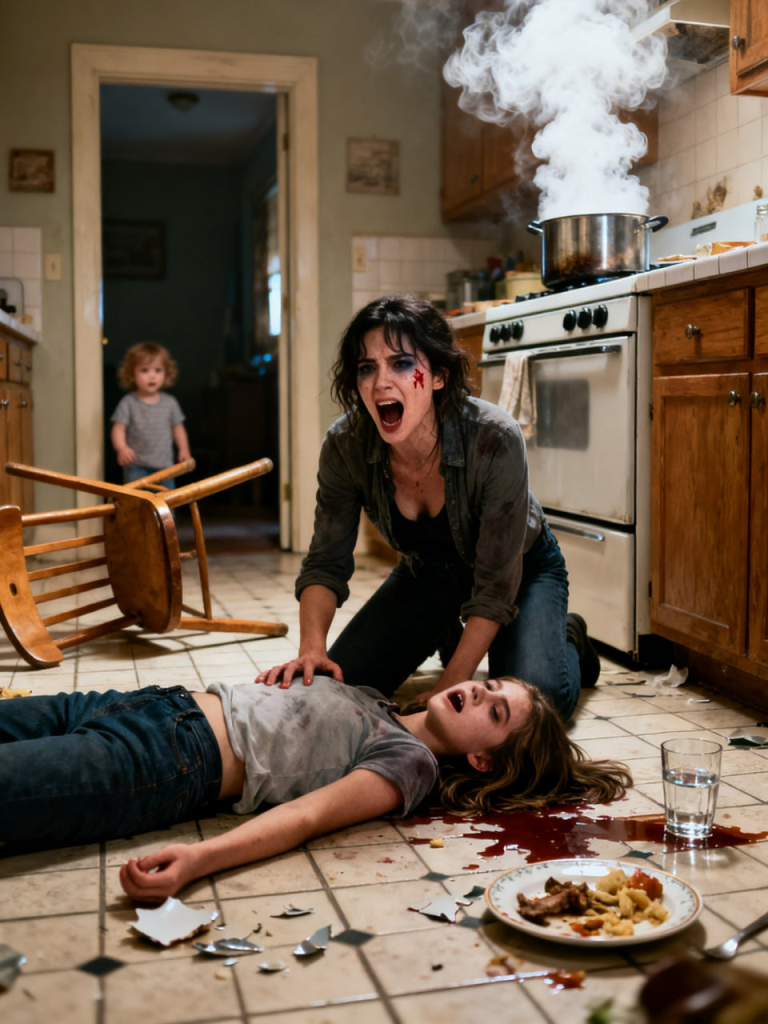
The first thing I noticed when I walked into the kitchen was how cheerful Karen looked.
Not happy—Karen didn’t do happy. She did performed warmth, like a spotlight she could switch on when the neighbors might be watching. Tonight, the light was all for me.
“Addison,” she said, drawing out my name like we were close. “Dinner’s ready.”
Her voice had that syrupy lilt she used when she wanted something. It was the same tone she used at church potlucks, the same tone she used when she introduced herself as the woman who raised a good man—even though she’d married into the family when my husband was already in high school.
I set my purse on the counter, fingers still damp from the October rain. Outside, the backyard maples were dropping leaves in slow spirals, like they didn’t have a care in the world. Inside, the air smelled like browned butter, garlic, and something sweet that made the back of my throat tighten.
Karen stood by the stove in a bright floral apron she never wore unless she had an audience. Her hair was pinned neatly, lipstick perfectly applied. She looked like a magazine version of domestic peace.
Which meant she was lying.
“From scratch,” she announced, lifting the lid from a dutch oven like she was presenting a prize. “I know you’re always busy. I thought you deserved a real meal.”
I forced a smile. “That’s… kind of you.”
Karen’s eyes flicked over my face, lingering. Assessing. Measuring.
She wasn’t looking to see if I appreciated the effort.
She was looking to see if I was going to cause trouble.
Behind me, the hallway creaked. My husband, Nate, appeared in the doorway, tugging at the hem of his sweatshirt. He looked exhausted in a way that had become normal lately—too many overtime shifts, too many nights of “we’ll figure it out” spoken into the dark.
“You okay?” he asked me softly.
I nodded. “Yeah. Just damp.”
Karen laughed lightly, the sound landing wrong. “Oh, sweetheart, you’re always damp in this house. It’s like the walls sweat.”
It was a joke, but it wasn’t. Karen never joked without a blade hidden in it.
This was her house—her reminder, every day, that Nate and I had needed help. That after Nate’s company downsized and the rent jumped again, we’d accepted her offer to stay “temporarily.” That temporary had stretched into months, and Karen’s kindness had calcified into control.
She always said it the same way: I opened my home to you.
What she meant was: You owe me.
Karen pointed at the dining table. “Sit. While it’s hot.”
The table was set like a holiday. Cloth napkins. Polished silverware. Her good plates with the tiny gold rim. A candle burning in the center, even though it was a Tuesday.
A Tuesday, Karen had decided, deserved theater.
Nate pulled out a chair for me. I sat, trying not to let my shoulders tense. Across the table, Karen took her seat like a queen settling onto a throne. She clasped her hands and smiled.
“Before we eat,” she said, “I want to say how grateful I am.”
Nate blinked. “For what?”
“For family,” Karen said, eyes on me. “For forgiveness. For fresh starts.”
My stomach tightened.
Karen didn’t do fresh starts. She did fresh paint over rot.
Nate cleared his throat. “Okay. Thanks, Karen.”
She beamed like she’d won.
Then she served.
She ladled something creamy onto our plates—pasta, I think, with chicken and a glossy sauce. It looked gorgeous, the kind of comfort food you’d expect from someone trying hard to prove she was the hero of the story.
Karen set my plate down last.
Her fingers brushed my wrist as she did, just a soft touch. But it felt like a warning.
“There you go,” she said. “Eat up.”
I stared at the food.
The smell hit me again—garlic, cream, and something else. Something nutty, faintly sweet.
I swallowed.
It wasn’t that I didn’t eat Karen’s cooking. I’d learned early on that refusing her food was a declaration of war. Karen treated a rejected casserole like a personal betrayal.
But there were other reasons my pulse started to race.
Karen knew I had a severe allergy.
Not a “my throat itches” allergy. A “my body treats the wrong ingredient like a threat and tries to shut down my airway” allergy.
I’d told her the first week we moved in, while I was unpacking kitchen boxes, trying to be proactive and polite.
“I have to be careful with tree nuts,” I’d said. “Even cross-contamination can be bad.”
Karen had nodded slowly, eyes wide with manufactured concern.
“Oh, Addison,” she’d said, pressing a hand to her chest. “That must be so hard. Don’t worry. I’ll be careful.”
Since then, she’d made little comments here and there.
“So many people are ‘allergic’ these days.”
“Are you sure it’s not just anxiety?”
“My friend’s daughter had an ‘allergy’ until she stopped reading things online.”
But she’d always said it with a laugh, always said it like she wasn’t being cruel.
Tonight, she was smiling too much.
Karen sat back in her chair, wine glass in hand. She didn’t eat right away. She watched.
I felt Nate’s eyes on me, waiting. He’d grown up with Karen’s moods. He could sense tension even when it wasn’t spoken.
I picked up my fork.
I looked at Karen.
Her smile didn’t waver.
“Looks delicious,” Nate said, trying to lighten the air.
“It is,” Karen replied. Her gaze stayed on me. “I made it special.”
I took a bite.
The sauce was rich, smooth—then the aftertaste hit.
Not strong. Not obvious.
But there.
A faint, oily sweetness that bloomed at the back of my tongue.
My skin didn’t prickle yet. My throat didn’t close. But the warning bell inside me started ringing like it had been waiting for this exact moment.
I set my fork down.
Karen’s eyes narrowed slightly. “Not hungry?”
“I’m just—” I swallowed. “It’s hot.”
Karen’s smile softened. “Oh, honey. You’re always so… cautious.”
Nate frowned. “Karen.”
“What?” she said innocently. “I’m complimenting her. Addison is cautious. Like a little rabbit.”
The words made my jaw tighten. I forced myself to pick up my fork again.
I took a second bite.
Then a third.
Karen exhaled—just barely, like she’d been holding her breath.
I watched her eyes. They moved from my face to my neck, like she was waiting for something to appear there.
My fingers started to tingle.
A pins-and-needles sensation, light at first, like static. Then my scalp prickled. The skin along my collarbone began to itch under my shirt.
My pulse thudded hard enough that I could feel it in my ears.
I looked down at my hands.
Tiny red blotches were rising on my wrists.
My breath caught.
Karen’s face changed.
It was subtle—blink-and-you’d-miss-it subtle—but I saw it.
Relief.
Not concern.
Not surprise.
Relief, like she’d just watched a lock click into place.
And in that moment, the last part of me that still tried to believe she was just difficult, just controlling, just “old-fashioned,” snapped clean in half.
She wanted this.
She’d cooked from scratch, set a table like a celebration, and watched me like my first bite was a countdown.
My throat tightened as my body reacted, and Karen’s eyes brightened like Christmas lights.
Nate noticed my expression. “Addie?” he said, voice sharpening. “What’s wrong?”
I stood up so fast my chair scraped the floor.
Karen’s smile widened, then tried to morph into concern. “Addison? Are you feeling okay?”
My tongue felt thick. My skin burned.
I grabbed my phone from the counter and hit the screen with shaking fingers.
Karen’s gaze snapped to it.
“No,” she said, soft but urgent. “Addison, don’t be dramatic—”
I didn’t hesitate.
I hit 911.
And I put it on speaker.
Because if Karen wanted me quiet forever, I was going to make sure the whole house heard the truth.
The line rang once.
Twice.
Karen’s lips parted in panic.
Nate stared at me, confusion and fear colliding in his face. “Addison—what are you doing?”
The operator answered.
“911, what’s your emergency?”
My voice came out strained, but clear enough. “I’m having a severe allergic reaction,” I said, breath catching. “I think someone put an allergen in my food on purpose.”
Karen’s head jerked back as if I’d slapped her.
Nate’s eyes widened. “What?”
The operator’s voice turned calm and firm, that trained steadiness you cling to when your body is betraying you.
“Ma’am, what’s your address?”
I rattled it off, my fingers trembling so hard I had to grip the edge of the counter.
The operator continued, “Are you having trouble breathing?”
“It’s starting,” I said, and my throat felt like it was swelling from the inside. “My skin is itching. I have hives. My mouth feels… wrong.”
Karen moved—fast. She stepped toward me, reaching for the phone.
“Addison,” she hissed, voice low now, mask slipping. “Stop it.”
Nate stepped between us instinctively. “Karen, what are you doing?”
Karen froze, eyes flashing.
The operator’s voice came through the speaker. “Ma’am, do you have an epinephrine injector?”
“Yes,” I managed. “In my purse.”
“Get it now,” the operator said.
I fumbled my purse open, fingers clumsy. Nate grabbed it, dumping the contents onto the counter—keys, wallet, receipts, lip balm.
Karen stared at the chaos like it offended her.
Then, on the speaker, the operator asked the question that turned the room into a courtroom.
“Who do you believe did this to you?”
I swallowed hard, feeling my throat tighten further.
I looked straight at Karen.
Her face was pale now, but her eyes were still sharp—angry, cornered.
“She did,” I said, voice cracking. “Karen. My mother-in-law. She knows my allergy.”
Nate made a strangled sound. “No. No—Karen, tell me you didn’t—”
Karen’s voice rose, desperate and furious. “She’s lying! She’s trying to ruin me!”
The operator’s tone sharpened. “Ma’am, is the person you’re accusing still present?”
“Yes,” I said. “She’s right here.”
The operator said, “Do not let her near you. Officers and paramedics are on the way. Stay on the line.”
Karen’s hands flew up. “This is insane! Nate, tell her—tell her she’s overreacting!”
Nate stared at Karen like he’d never seen her before. His voice was thin. “Did you put something in her food?”
Karen’s eyes flicked to the table. To the plates. To the pot on the stove.
Then she did what people like Karen always did when reality cornered them.
She tried to rewrite the script.
“Oh my God,” she gasped, pressing a hand to her mouth. “Addison, I didn’t realize—maybe I used the wrong broth. Maybe there was cross-contamination—”
“From scratch,” I rasped, throat tight. “You said… from scratch.”
Her gaze snapped to mine, hatred flaring.
I felt it in my bones: she wasn’t sorry. She was angry I spoke.
Nate’s hands were shaking now. “Karen,” he whispered, “why are you not eating?”
Karen froze.
The question landed like a hammer.
Because she hadn’t taken a single bite.
Not one.
She’d served. She’d watched. She’d waited.
And now she stood there with clean hands and an empty fork, trying to pretend she was just a worried caregiver.
Nate looked at the plates again, then at Karen.
His voice cracked. “Why aren’t you eating?”
Karen’s lips parted. No sound came out.
The operator said, “Ma’am, do you have the injector?”
Nate found it—my EpiPen—held it up with trembling fingers. The operator guided me through using it without letting the moment turn into a how-to lesson—short, urgent instructions focused on safety, not mechanics.
When it was done, I leaned against the counter, shaking.
Karen watched, eyes wide, breathing fast.
Not because she cared.
Because she’d lost control.
I heard footsteps upstairs—Nate’s younger sister, Mia, emerging sleepy-eyed from her room.
“What’s going on?” Mia asked, voice thick with sleep.
Then she saw me—pale, blotchy, trembling—and her face changed.
“Oh my God,” she whispered.
Karen spun to her instantly, voice snapping back into performance.
“Mia, go back upstairs,” Karen barked. “This is adult business.”
Mia didn’t move. Her gaze flicked to the speakerphone. To the word “911” glowing on my screen.
“Nate?” Mia asked, fear creeping in. “Why is 911 on speaker?”
Nate’s voice was flat. “Because Mom might have poisoned Addison.”
Silence.
Mia’s mouth fell open.
Karen’s eyes blazed. “How dare you,” she hissed at Nate. “After everything I’ve done—”
The operator’s voice cut through again. “Officers are en route. Paramedics are en route. Ma’am, stay on the line. Keep your breathing slow if you can.”
I tried.
It felt like breathing through a straw.
Karen paced, fingers twitching. She looked at the front door, then at us, calculating.
I realized she might run.
Or worse—she might try to destroy evidence.
“Nate,” I rasped. “The pot.”
His eyes widened. He turned and stepped toward the stove, blocking Karen’s line to it.
Karen’s face twisted. “Don’t you touch my cooking,” she snapped.
“My wife is having a reaction,” Nate said, voice shaking with rage. “Your cooking can go to hell.”
Karen flinched at the word wife, like it reminded her of something she’d been trying to erase: that I wasn’t a guest. I wasn’t temporary. I was family—whether she liked it or not.
Sirens sounded faintly in the distance, growing louder.
Karen’s breath came in short, fast pulls. Her eyes darted around the kitchen.
Then, with a sudden lunge, she reached for my phone.
I jerked it out of reach, but the movement made my vision spin.
Nate grabbed Karen’s wrist hard.
“Don’t,” he growled, and I had never heard that tone from him—not even in traffic. It was pure, raw boundary.
Karen stared at his hand on her wrist, shocked.
“How dare you touch me,” she whispered.
“How dare you hurt her,” Nate shot back.
The front doorbell rang.
Not the polite chime Karen loved.
A hard, official knock.
“Police!” a voice called. “Open the door!”
Mia ran to the living room and opened it.
Two officers entered first, hands poised, eyes scanning. Behind them came paramedics with a stretcher and equipment bags.
The kitchen filled with authority and fluorescent professionalism.
The leading officer—Officer Ramirez, her badge said—took one look at me and immediately asked, “Ma’am, are you the one who called?”
“Yes,” I said, voice raspy. “I’m Addison.”
The paramedics moved toward me, checking my pulse, my breathing, the spread of hives. They spoke calmly, like they were anchoring me to the world.
Officer Ramirez’s gaze snapped to Karen. “And you are?”
Karen’s chin lifted. “Karen Whitlock,” she said stiffly. “This is my house.”
Officer Ramirez didn’t care whose house it was.
She asked, “Did you prepare the food?”
“Yes,” Karen said quickly. “But I didn’t—”
Officer Ramirez cut her off. “Ma’am, step away from the counter. Keep your hands where I can see them.”
Karen’s eyes widened. “This is absurd!”
Nate spoke before Karen could spin it. His voice was hoarse with anger. “She didn’t eat any of it,” he said. “Not one bite.”
Officer Ramirez looked at the table. The plates. The untouched place setting in front of Karen.
Then she looked at the stove.
“What’s in the pot?” she asked.
Karen’s mouth opened, closed.
“I want it preserved,” Officer Ramirez said to the other officer. “Bag it. We’ll request testing.”
Karen’s voice shot up. “You can’t take my food!”
Officer Ramirez’s eyes were cold. “Ma’am, your daughter-in-law called 911 because she believes you intentionally exposed her to an allergen. This is evidence.”
Karen’s face tightened. “She’s lying,” Karen snapped. “She’s dramatic. She’s always—”
I forced myself upright. My heart hammered. My skin burned.
I looked at Officer Ramirez and said, voice loud enough for everyone in the room to hear—paramedics, officers, Nate, Mia, and Karen herself:
“She knows I’m allergic. She’s known for months. She served me something and watched me like she was waiting.”
Karen’s eyes flashed.
I heard the edge in my own voice, the truth slicing through the last of her performance.
The paramedic pressed a stethoscope to my chest. “Let’s get you to the ambulance,” he said gently.
“No,” I croaked. “Not until—”
Nate leaned close, voice trembling. “Addie, please.”
I looked at him. His eyes were wet. The disbelief in his face was a kind of grief.
“I’m not leaving you here with her,” I whispered.
Nate’s jaw clenched. “You’re not leaving alone,” he promised. “I’m coming.”
Officer Ramirez turned to Karen again. “Ma’am, we’re going to ask you some questions.”
Karen’s shoulders stiffened. “I want a lawyer,” she snapped.
Officer Ramirez nodded. “That’s your right.”
Karen’s eyes flicked to Nate, and she hissed, “You’re choosing her over me.”
Nate stared at her, shaking. “You tried to kill her.”
Karen’s face twisted with pure fury. “I tried to save you,” she spat.
The words froze the room.
Even Officer Ramirez’s eyebrows lifted slightly.
“What did you say?” Nate whispered.
Karen realized she’d said too much and tried to pull it back, but it was too late. The mask was fully off now, and the thing underneath wasn’t pretty.
“She’s poisoning you,” Karen snapped, pointing at me like I was the threat. “She’s taken you from me. She’s turned you into someone who looks at your own mother like a stranger.”
Nate’s voice cracked. “Because you are acting like one.”
Karen’s breathing was fast. “I did everything for you,” she hissed. “I built this house. I kept this family together. And she walks in and thinks she gets to—”
“She gets to live,” Nate said, voice shaking with rage. “That’s what she gets.”
Officer Ramirez stepped closer. “Ma’am,” she said firmly, “I need you to stop talking and step back.”
Karen didn’t. She was spiraling now, unraveling in front of witnesses.
“She’s weak,” Karen spit. “She’s dramatic. She’ll make you leave and then you’ll be alone—like you were before I—”
Nate’s voice went deadly quiet. “Like when Dad died?”
Karen froze.
Mia’s face went pale.
I felt a cold wave run through me, even as my skin burned.
Nate stared at Karen like he’d finally connected a dot he’d never wanted to see.
“You told me you ‘held us together,’” he whispered. “You told me you saved us.”
Karen’s lips trembled, but not with guilt—anger.
“You needed me,” she snapped.
Nate swallowed hard. “Did you do something to Dad?” he asked, voice barely audible.
The paramedic paused, looking between them.
Officer Ramirez’s gaze sharpened.
Karen’s face flickered—just for a moment—with something like fear.
Then she snapped her jaw shut.
“I want a lawyer,” she repeated, louder.
Officer Ramirez nodded once, but her eyes didn’t soften. “Okay. You’re not under arrest at this exact moment,” she said carefully, “but you are being investigated. Do not leave the property.”
Karen’s eyes darted toward the back door.
Officer Ramirez added, “And if you try, you will be detained.”
Karen’s shoulders sagged slightly, fury simmering.
The paramedics guided me toward the door. My legs were shaky, but I forced myself to keep my head up.
Because Karen was watching.
And I wasn’t going to give her the satisfaction of seeing me small.
As we stepped outside, the cold air hit my face. The ambulance lights flashed red and blue across the wet driveway, painting Karen’s perfect suburban exterior with emergency truth.
Nate followed, grabbing his coat, his hands still trembling.
Mia hovered in the doorway, eyes huge, as if her entire childhood had just cracked.
In the ambulance, the paramedic spoke softly, checking my breathing, my pulse. The world felt muffled, like I was underwater, but I could still hear Nate’s voice outside—tight, furious, broken.
“I heard her,” he said, and I realized he was talking to Officer Ramirez. “I heard what she said. She—she didn’t even deny watching. She watched Addie.”
Officer Ramirez’s voice was steady. “We’ll take your statement.”
Nate’s voice cracked. “She knew about the allergy.”
“I understand,” Officer Ramirez replied.
I closed my eyes, fighting the urge to cry—not from fear, but from the awful release of finally being believed.
At the hospital, doctors monitored me until the reaction stabilized. The worst of the burning itch faded into a lingering soreness, like my body had run a marathon it didn’t sign up for.
Nate sat beside my bed, hands clasped so tight his knuckles were white.
“I’m sorry,” he whispered. “I’m so sorry.”
I looked at him, exhausted. “For what?”
“For not seeing it,” he said. His voice broke. “For letting her make you feel crazy. For bringing you into that house.”
I swallowed. “You didn’t make her do it.”
Nate shook his head. “But I let her treat you like you were temporary,” he whispered. “Like you were something she could push out.”
I reached for his hand. My fingers were still slightly swollen.
“We’re leaving,” I said quietly.
Nate nodded instantly. “Tonight,” he said. “We’ll pack while she’s with the police. We’ll go to my friend Jordan’s. I don’t care if we sleep on a couch.”
Relief loosened something in my chest.
“What about Mia?” I asked.
Nate’s jaw tightened. “I’m taking her too if she wants. She’s eighteen. She doesn’t have to stay.”
I nodded slowly.
My phone buzzed with messages.
One from Mia:
I heard everything. I’m scared. Can I come with you?
I typed back with trembling fingers:
Yes. Pack a bag. We’ll get you.
Another message came through from an unknown number.
It was Karen.
You’ll regret this. You always ruin everything when you don’t get your way.
My stomach churned.
Nate saw the text and his face hardened in a way I’d never seen before.
He took my phone gently. “Block her,” he said.
I nodded.
And then, for the first time since we’d moved into Karen’s house, I felt something like safety.
Not because the world was safe.
Because I wasn’t alone inside the lie anymore.
By the time we returned to the house, it was nearly midnight.
The driveway was empty now. The porch light was still on—Karen’s habit, her insistence that the house always look welcoming, even when the inside was rotten.
Officer Ramirez’s card sat on my phone case like a small shield. She’d told us we could retrieve our belongings and leave. She’d also told us, very plainly, to call if Karen showed up again.
The kitchen still smelled like dinner. Like cream and garlic and betrayal.
The table was still set, the candle burned down into a stub.
I stared at the plates and felt my stomach flip.
Nate walked in behind me, face grim. “Don’t look,” he said softly.
But I did look.
Because I needed to remember the truth.
Mia came downstairs with a backpack, eyes red. She didn’t look at the table. She looked at me.
“I’m sorry,” she whispered.
“It’s not your fault,” I said immediately.
Mia swallowed. “She’s been… weird for a long time,” she admitted. “She always talked about you like you were a threat.”
Nate’s jaw tightened. “Why didn’t you tell me?”
Mia’s voice cracked. “Because she always said you’d choose your wife over us,” she whispered. “And I didn’t want to lose you too.”
Nate’s face softened, grief flickering. “You’re not losing me,” he said firmly. “Come on.”
We packed fast.
Clothes. Documents. Medications. My allergy kit. Nate’s laptop. Mia’s important things—passport, birth certificate, school papers.
The entire time, my skin still felt faintly prickly, like my body hadn’t fully let go of the fear.
When we were almost done, Nate opened a drawer by the fridge—one Karen always kept locked. He’d never questioned it. “Private,” she’d always said. “My things.”
Tonight, Nate didn’t care.
He found the key in Karen’s junk bowl—she’d always been careless about the things she assumed no one would challenge.
He unlocked it.
Inside were papers—insurance documents, bank statements, a folder labeled ESTATE.
Nate’s hands shook as he flipped through them.
Then he froze.
“What?” I whispered.
He held up a document.
A life insurance policy.
On him.
Not just Karen.
On Nate.
My stomach dropped.
Nate’s voice was barely audible. “She took out a policy on me,” he whispered.
Mia covered her mouth.
Nate flipped to another page—beneficiary.
Karen Whitlock.
My blood ran cold.
It wasn’t proof of murder.
But it was proof of motive.
Proof of planning.
Proof that Karen’s “performed warmth” had always been about control and payoff.
Nate swallowed hard and stuffed the documents into his bag.
“We’re giving this to the police,” he said, voice shaking with rage.
I nodded, my throat tight.
We left the house at 12:37 a.m.
No dramatic final speech.
No confrontation.
Just the sound of the front door closing on Karen’s world.
In the car, Mia sat in the back seat hugging her knees, trembling. Nate drove with both hands locked on the steering wheel like he was afraid the road might vanish.
I stared out the window at the sleeping neighborhood—perfect lawns, porch lights, quiet streets.
Karen had relied on this quiet.
On the idea that people don’t want drama, don’t want to involve police, don’t want to “make a big deal.”
She’d wanted me quiet forever.
Instead, I’d hit 911 on speaker and made sure the whole house heard the truth.
Weeks later, the investigation moved slowly, the way legal systems do when reality is messy.
But it moved.
The food was tested. The ingredient Karen had used—something she could easily claim was “an accident”—matched exactly what I’d told doctors and what was documented in my medical records.
Officer Ramirez interviewed neighbors. A pattern emerged: Karen’s “sweetness” was always loudest when people were watching.
Mia gave a statement. Nate gave a statement. I gave mine again, this time without shaking.
Karen denied everything, of course. Claimed I was unstable. Claimed Nate was manipulated. Claimed I was “trying to steal her family.”
But denial couldn’t erase the speakerphone call, the untouched plate, the way she lunged for my phone, the way she blurted out, I tried to save you.
And it couldn’t erase the insurance documents.
Karen was charged—not for what she wanted, but for what she did. Assault charges. Endangerment. A protective order.
When the judge read out the no-contact order, Karen’s face was tight with fury. She didn’t look remorseful.
She looked cheated.
And for the first time, that didn’t scare me.
It clarified everything.
Nate and I found a small apartment across town. It wasn’t fancy. The walls were thin. The neighbors were loud.
But the air felt lighter.
One evening, a month after we moved, Nate came home with a grocery bag and set it on the counter.
He pulled out a frozen lasagna and gave me a sheepish look.
“I didn’t cook from scratch,” he said.
I laughed softly, the sound surprising me.
“That’s okay,” I said.
Nate stepped closer, eyes wet. “I keep thinking about how she watched you,” he whispered. “Like she was waiting.”
I swallowed hard. “Me too.”
He reached for my hand, steady now. “I’m done being scared of making noise,” he said.
I nodded. “Me too.”
In the next room, Mia was on the couch filling out college applications, her shoulders less hunched than before. Healing didn’t look like a movie montage.
It looked like small, ordinary evenings where no one had to perform warmth to survive.
It looked like safety built from truth, not silence.
Karen had tried to make me quiet forever.
Instead, I made sure the whole house heard the truth.
And once truth is heard out loud—really heard—there’s no going back to the lie.

Leave a Reply